
Keep Your Family Warm and Safe—No Matter What
At 251 metres in the Lanaudière foothills, Chertsey's winter lows average -17.9°C and the heating season runs from October into April. I match homeowners here with a trusted local dealer for a wood stove, insert, or fireplace sized to actually carry that cold—no big-box guesswork, no unpermitted installs.
Every Project Starts From One of These Five Situations
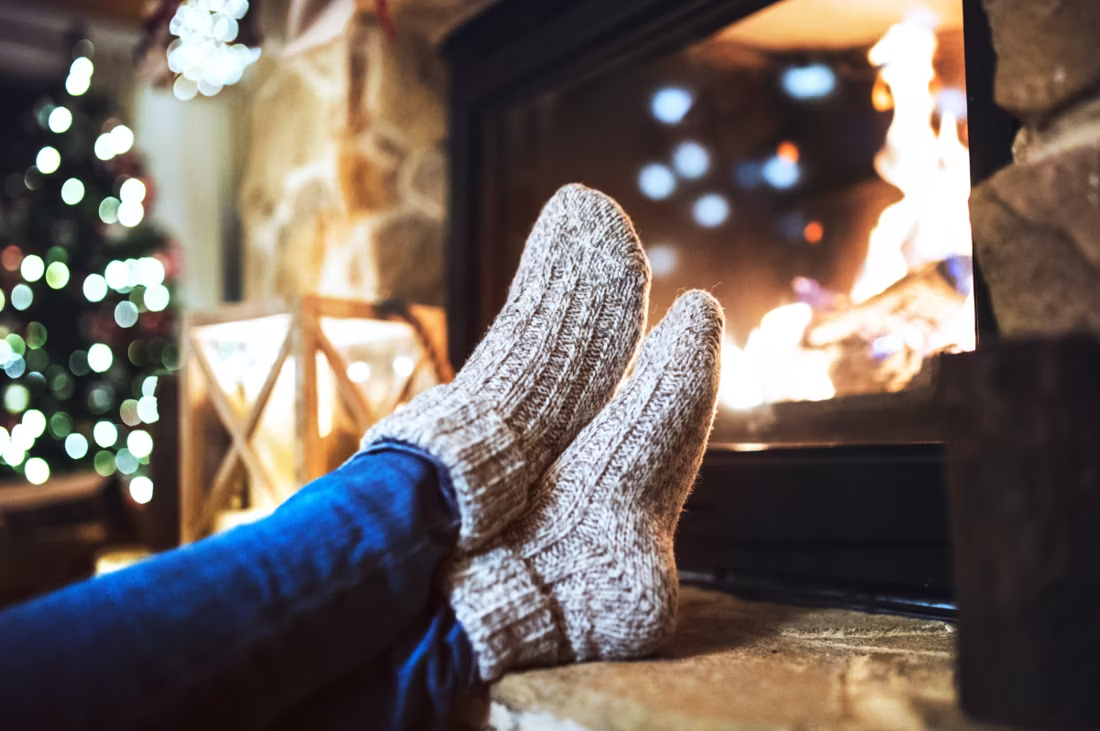
Wood heat still carries Chertsey through the coldest stretch of winter.
Chertsey sits in the foothills of the Laurentians in Lanaudière, at 251 metres, where winter lows average -17.9°C and the cold settles in for a genuinely long season—comparable to what Sudbury, Ontario sees most winters, not the milder shoulder-season climate of Montréal an hour and a half south. Wood heat isn't nostalgic in a town like this; it's a straightforward answer to a real number of cold months, and a hedge against a hydro grid that has gone down hard before, most memorably during the 1998 ice storm that left parts of Lanaudière without power for weeks.
Sugar maple, yellow birch, American beech, and red oak are the hardwoods most Chertsey households split and stack, and if you don't already own a woodlot, the Ministère des Ressources naturelles et des Forêts issues affouagement permits on public land for about $1.85 per cubic metre plus taxes, capped at 22.5 m3, with the season running April 1 to March 31 (regional harvest windows vary, so check with the local MRNF office before you plan a cutting trip). New installs go through the municipal building department under the CSA B365 code, and most insurers here will ask for a WETT inspection before they'll write a policy on a wood-burning appliance—a local dealer who installs regularly in Lanaudière will already have both steps built into the quote.
Firewood Cutting Permits Near Chertsey
Ministère Des Ressources Naturelles Et Des Forêts (Mrnf)
Three steps. No salesperson until you're ready.
Tell us about your project
Your postal code, your situation, and the fuel you're leaning toward—or let the answers point you to one.
See what's actually available
The brands dealers within 100 miles genuinely carry—real options, never a catalog mirage.
Get your dealer & Project Guide
A trusted local dealer, plus the free Project Guide & Parts List that names every component of the job.
Frequently Asked Questions
How much does a wood stove installation cost in Chertsey?
Most installations run $6,000 to $12,000 CAD. A wood insert going into an existing masonry firebox—common in older farmhouses around Chertsey and along the Rivière Rouge valley—tends to land toward the lower end. A freestanding stove that needs a full Class A chimney system built from scratch, which is typical in newer construction without an existing masonry flue, pushes toward the top of that range. Either way, your municipal building department permit and a WETT inspection for insurance purposes are worth building into the budget up front rather than treating as an afterthought.
What kind of firewood burns best around Chertsey?
Sugar maple and yellow birch are the two most common backyard and woodlot species locally, and both are dense hardwoods that put out serious heat once properly seasoned—figure at least a year under cover, two if you can manage it. American beech and red oak also show up regularly and burn similarly hot and long, which matters when you're trying to hold a fire overnight through a -17.9°C low. Softer, faster-burning species are around too, but most Chertsey households save those for kindling and shoulder-season fires rather than the coldest stretch of January and February.
Can I cut my own firewood near Chertsey, and what does it cost?
If you don't own a woodlot outright, the Ministère des Ressources naturelles et des Forêts issues personal-use cutting permits (affouagement) on public land for roughly $1.85 per cubic metre plus taxes, with a cap of 22.5 m3 per permit. The season runs April 1 to March 31 on paper, but actual harvest windows vary by region, so it's worth calling the local MRNF office before you plan a trip—some blocks open earlier or later depending on road access and silviculture schedules.
Do I need a permit and inspection to install a wood stove in Chertsey?
Yes. New installs go through Chertsey's municipal building department, and the work has to meet the CSA B365 installation code, which governs clearances, hearth pad sizing, and venting. Most home insurers in Lanaudière also want a WETT inspection completed before they'll cover a wood-burning appliance, and some ask for a re-inspection every few years. A dealer who installs regularly in this region will typically handle the permit application and can point you to a WETT-certified inspector rather than leaving you to find one yourself.
Are there restrictions on wood stoves near Chertsey?
The strictest rule in Quebec—a 2.5 g/h fine-particle limit and mandatory appliance registration—applies to the island of Montréal, not to Chertsey. That said, Chertsey's own municipal building department sets the local requirements for wood-burning appliances, and every new install still needs to meet the CSA B365 installation code regardless of address. A modern EPA/CSA-certified stove or insert clears both the Montréal-level bar and whatever Chertsey's own bylaw requires, so it's rarely a limiting factor—just confirm with the municipal office before you buy, especially if you're eyeing a used or older unit.
Does wood heat make sense in Chertsey when Hydro-Québec electricity is so cheap?
At roughly 7.8 cents per kWh, Hydro-Québec's residential rate is among the lowest in the country, and a lot of Chertsey homes do run electric baseboard or a heat pump as their main system for exactly that reason—electric install costs are modest too, typically $500-$1,600. Wood earns its place as backup rather than being cheaper on paper: Lanaudière has seen extended outages before, most notably during the 1998 ice storm, and a wood stove is the one heat source in the house that keeps working when the lines come down. Plenty of local households run electric day-to-day and keep a certified wood stove ready for exactly that scenario.
Wood stove or pellet stove—which is the better fit for a Chertsey home?
A wood stove burns whatever hardwood you can source locally or cut under an MRNF permit, and it keeps running without power, which matters given Lanaudière's history of winter outages. A pellet stove burning bags from Granules LG, Energex, or Trebio—running $400-$575 a ton regionally—is more convenient day to day, with longer burn times and less mess, but it needs electricity for the auger and fan, so it won't help during an outage unless you've got a battery backup. Install costs are similar, roughly $6,000-$10,000 CAD for pellet versus $6,000-$12,000 for wood. Households that want both convenience and outage resilience sometimes install one of each.
What size wood stove do I need for a Chertsey home?
Given winter lows averaging -17.9°C and a heating season that runs comfortably from October into April, undersizing is the more common mistake in this climate zone than oversizing. A stove rated for 1,500 to 2,000 square feet suits most Chertsey main living areas, but older farmhouses with less insulation or open floor plans that need to carry heat through several rooms often do better with a larger unit capable of a long overnight burn. A local dealer should size against your actual insulation, ceiling height, and floor plan rather than square footage alone.
How often should a wood-burning chimney be swept in Chertsey?
An annual inspection and sweep before the season starts, ideally in September or early October, is the standard recommendation, and it holds especially true here given how long the burning season runs. Dense hardwoods like sugar maple, yellow birch, and red oak burn clean when well-seasoned, but any wood burned before it's properly dried builds creosote fast, and Chertsey's cold snaps mean many households are running the stove hard for five months straight. If you're burning as a primary heat source rather than occasional supplemental heat, a mid-season check is worth adding too.
Why do fireplace quotes vary so much?
Because a fireplace is an iceberg—there's more behind the wall than in front of it. A low quote often covers only the unit; the full scope includes vent pipe, gas line or electrical, framing, and the tile or stone that has to come off and go back on. Make every bidder price the whole job. If a dealer can't speak to the full scope with confidence, that's your signal to keep looking.
Louvered or clean face—which fireplace front is better?
Louvered fronts have grill work above and below the glass for airflow, move heat a little better with a fan, and suit traditional mantels. Clean face designs drop the louvers entirely so finish work runs to the fire's edge—they fit both modern and traditional rooms. When we did our own home we chose clean face: a big viewing area beat a little extra airflow. It depends on your room, not on a rulebook.
Do I need a permit to install a fireplace?
In most jurisdictions, yes—fireplace and stove installations involve venting, clearances, and often gas or electrical work that gets permitted and inspected. That's a feature, not a hassle: the inspection protects your family and your homeowner's insurance. A professional installer pulls the permit, installs to code, and stands behind the inspection. If someone suggests skipping it, keep looking.
What fireplace styles should I know before shopping?
Four cover most of the market: screen-front traditional (mesh front, open feel, fits craftsman homes), traditional door set (the classic look you grew up with), modern linear (wide, low, the statement piece for entertaining), and clean face contemporary (no trim—your tile or stone runs right to the fire's edge). Walk in knowing those four terms and you're ahead of most buyers.
Nearby Dealers
Hearth shops serving Chertsey and the surrounding area. Every listing shows whether it is a WhyFire partner, a dealer we have verified as authorized for the brands we recommend, or a local business carrying hearth products. No manufacturer pays for placement. How we verify dealers →
Foyers Braizo
Le Ramoneur Du Foyer
Poeles Et Foyers Saint-Sauveur
Cheminées Sam-Alex Inc.
Décor Chaleur Laurentides Inc
Noeea Foyers Rive-Nord
Get your free Project Guide & Parts List for a Chertsey wood heat project.
Tell me about your home and I'll match you with a trusted local dealer in Lanaudière and send a free Project Guide & Parts List—sized for Chertsey's cold winters, with the CSA B365 permit steps, vent kit, and parts specified.
Find Your Fireplace →