
Gas Heat That Just Works, Even on Berks County's Coldest Nights.
Reliable, instant warmth for Whitfield's colonials and split-levels near Reading. Get matched with a trusted local dealer who can size the right gas fireplace or insert for your home.
Every Project Starts From One of These Five Situations
Gas is the natural choice in the Reading suburbs.
Whitfield sits at 340 feet in Berks County, just outside Reading, in climate zone 5A with a fairly demanding winter heating season and winter lows averaging 23°F. That's a real Mid-Atlantic winter—cold enough to matter, though nowhere near as brutal as places like Burlington, VT, where the heating season runs considerably longer and harder. Wood-burning fireplaces are uncommon here despite the oak, hickory, maple, and cherry that fill the surrounding Berks County woodlots—most of Whitfield's housing stock is closer-set suburban development where masonry chimneys and cordwood storage never really caught on the way they did in more rural parts of the county.
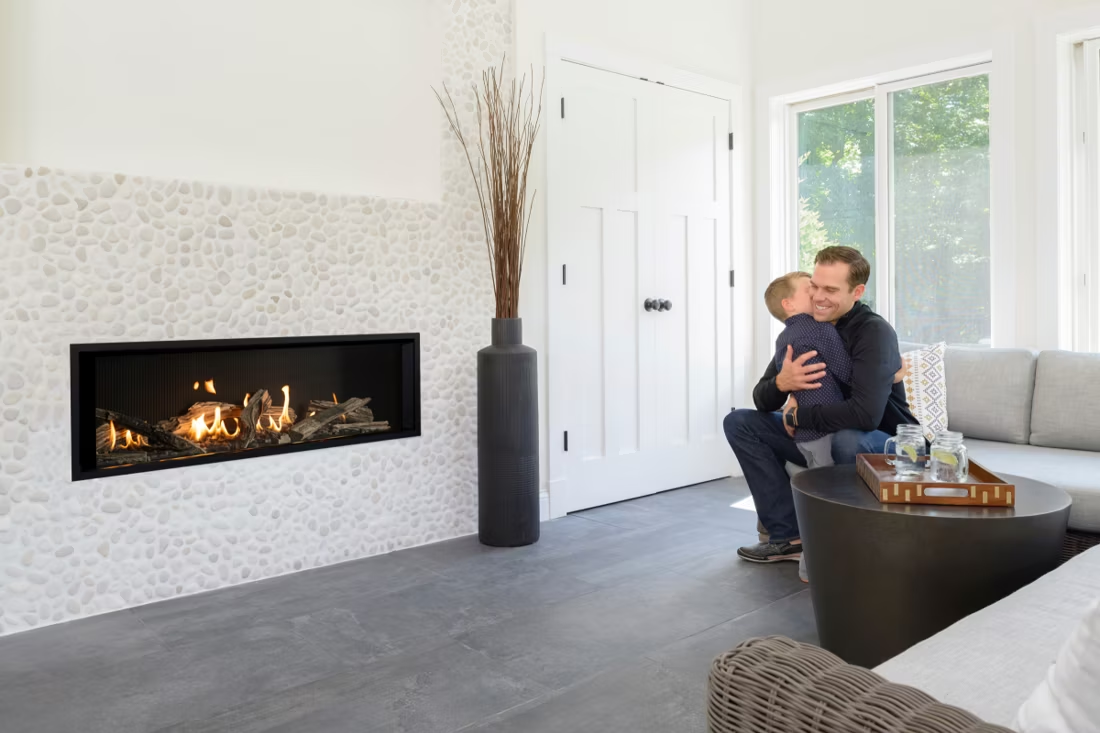
That leaves gas as the default hearth fuel for most homes in the 19608, 19609, and 19610 zip codes. Whether your street is served by natural gas or you're on propane at the edge of the service area, a direct-vent gas fireplace or insert delivers instant heat at the flip of a switch or the tap of a remote—no chimney sweep, no wood stacking, no ash. It's a natural fit for the colonials, capes, and split-levels common in this part of Spring Township, especially as a zone-heat supplement to central HVAC during the coldest stretches of a Pennsylvania winter.
Three steps. No salesperson until you're ready.
Tell us about your project
Your zip code, your situation, and the fuel you're leaning toward—or let the answers point you to one.
See what's actually available
The brands dealers within 100 miles genuinely carry—real options, never a catalog mirage.
Get your dealer & Project Guide
A trusted local dealer, plus the free Project Guide & Parts List that names every component of the job.
Frequently Asked Questions
How much does a gas fireplace installation cost in Whitfield?
Most gas fireplace and insert installations in the Whitfield area run between roughly $4,500 and $10,500, depending on the unit, the venting path, and whether new gas line work is needed. A direct-vent insert into an existing masonry fireplace with gas already run to the house sits at the lower end. A new built-in gas fireplace for a remodel or addition—with framing, venting through an exterior wall, and a fresh gas line—lands in the middle to upper end. Homes that need a propane tank set or a longer gas line run from the street will see the higher end of that range. A local dealer will give you a firm number after seeing the space.
Can I convert an existing wood fireplace to gas in Whitfield?
It's possible, though fewer Whitfield homes have a working wood-burning masonry fireplace than you'd find in the more rural parts of Berks County—wood heat never took hold the same way in this closer-in Spring Township suburb. For the older colonials and capes near Reading that do have an original masonry fireplace, a gas insert is a popular upgrade: it uses your existing chimney with a stainless liner, typically runs $4,500 to $9,000 depending on the insert and gas line work, and turns a fireplace you rarely used into daily supplemental heat.
Do I need natural gas service, or should I plan on propane?
Most of the 19608, 19609, and 19610 zip codes around Whitfield fall within a natural gas service footprint, but coverage isn't universal block by block—a licensed gas-fitter can confirm whether a line already runs to your street. For homes outside the natural gas footprint, propane is the standard fallback, supplied by regional propane companies with either a buried or above-ground tank. Nearly every gas fireplace and insert on the market today can be set up for either fuel—your installer just configures the correct orifice and regulator for the gas type you have.
Will a gas fireplace still work if the power goes out?
Most modern gas fireplaces will, which matters in Berks County given how often winter storms and ice knock out PPL Electric service for a day or more. Units with a standing pilot or IPI (intermittent pilot ignition) run on a small battery backup that kicks in the moment power drops, so the fireplace lights on demand just like normal. Valor fireplaces go a step further—their pilot assembly generates its own electricity through the thermocouple, so there's no battery to remember to replace. Ask your local dealer about the ignition system on any model you're considering if outage backup matters to you.
What's the difference between a gas fireplace, insert, and stove?
A gas fireplace is a fully built-in unit framed into a wall—the right call for new construction or a remodel where you're building the opening from scratch. A gas insert slides into an existing masonry fireplace opening and vents through the chimney with a liner, which is the more common project in Whitfield's older housing stock. A gas stove is a freestanding cast-iron or steel unit that sits on the floor like a wood stove but burns gas—a good option for a room that never had a fireplace at all, like a finished basement or sunroom.
Do I need a permit to install a gas fireplace in Whitfield?
Yes. Depending on your exact parcel, that permit runs through Spring Township's code enforcement office or Berks County's building codes department for unincorporated areas, and it covers both the fireplace installation and the gas line work. A licensed gas-fitter has to handle the gas connection itself. Most established hearth dealers in the Reading area pull these permits as part of the installation and coordinate the inspection, so you're not left managing multiple trades and two separate permit applications yourself.
Should I choose a vented or vent-free gas fireplace?
Vented (direct-vent) units draw combustion air from outside and exhaust it back outside through a sealed pipe—they're the standard choice and the one most Whitfield installers recommend for full-time use. Vent-free units burn gas directly into the room with no outside venting; they're legal in Pennsylvania with proper room-sizing and oxygen-depletion sensors, but they add water vapor and combustion byproducts to indoor air. For a primary heat source running for hours at a time in a tightly sealed suburban home, direct-vent is the safer, more common recommendation—vent-free tends to make more sense as an occasional-use unit in a larger, more open room.
How often does a gas fireplace need to be serviced?
Plan on an annual inspection, ideally before the first cold snap in November. A technician checks the burner, pilot assembly, venting, and gas connections, and cleans the glass and interior—a lighter lift than wood-stove chimney sweeping, but just as important for safe operation. Local gas appliance service providers typically charge $150 to $250 for this visit, and it's worth keeping on the same annual schedule as your furnace tune-up.
Gas vs. electric fireplace—which makes more sense for a Whitfield home?
Gas gives you a real flame, genuine heat output, and the ability to keep running during a power outage with battery or self-powered ignition—a real consideration given how PPL Electric's lines through Berks County can go down in a winter storm. Electric fireplaces plug into a standard outlet, need no venting or gas line at all, and cost far less to install—often under $1,000—but at PPL's residential rate of about 12.3 cents per kWh, they're primarily an ambiance and light-supplemental-heat option rather than a serious heat source for a whole room. For a den or bedroom where you mostly want the look and a little warmth, electric is the simpler, cheaper path. For a main living space where you want real heat you can rely on, gas is usually the better investment.
What's the difference between an insert and a zero-clearance fireplace?
An insert is a fireplace that slides into a pre-existing wood-burning fireplace—if you don't have one, there's nothing to insert it into. A zero-clearance fireplace is built into a framed wall, which makes it the answer for remodels and new construction. Simple test: existing masonry fireplace means insert; blank or framed wall means zero-clearance.
Is my gas fireplace wasting gas?
If it was installed more than 15 years ago, probably. Older gas fireplaces keep a standing pilot light burning all the time, and that little flame can cost a couple hundred dollars a year. Newer models use pilot-on-demand ignition—the pilot lights only when you use the fireplace and goes out when you turn it off.
Can a fireplace actually lower my heating bill?
Yes—by creating a comfort zone. A furnace heats every square foot of the house just to warm the one room you're in; a gas fireplace on low burns roughly a sixth of the gas a typical furnace does. Set the furnace around 55–60 degrees as a baseline, then heat the rooms your family actually uses. Families who heat this way commonly save $20–$60 a month.
How much should I budget for a fireplace?
For an average home—covering the fireplace, the vent pipe, and basic installation—a budget between $3,900 and $5,500 gives you a lot of options across wood, gas, and pellet. By the time you add finish work, gas line, and electrical, the average complete installation lands between $5,000 and $12,000 all-in. In a remodel or new build, a good rule is to put about 2.5% of the total project cost toward the fireplace.
Nearby Dealers
Hearth shops serving Whitfield and the surrounding area. Every listing shows whether it is a WhyFire partner, a dealer we have verified as authorized for the brands we recommend, or a local business carrying hearth products. No manufacturer pays for placement. How we verify dealers →
A Chimney King
Keystone Custom Decks
Sauder's Hardscape Supply
Scandia Stoves Of Pa Inc.
Krings Hearth & Home - Bechtelsville
Dewald & Lengle Hardware Inc.
Peak Distribution
Cressona Agway Store
Ds Stoves
Kring's Hearth & Home - Lancaster
Find your gas fireplace in Whitfield.
Tell us about your home and we'll put together a free Project Guide & Parts List—the exact parts, including the vent kit, for your gas fireplace project—and match you with a trusted local dealer in the Reading area.
Find Your Fireplace →