
Warm up your Sanatoga home without the guesswork.
Direct-vent gas heat that turns on at the flip of a switch, sized right for your Lower Pottsgrove Township home and installed by a trusted local dealer.
Every Project Starts From One of These Five Situations
Dependable heat for Montgomery County winters.
Sanatoga sits in Lower Pottsgrove Township just outside Pottstown, in a climate zone (4A) that puts it around a winter heating load similar to much of the Mid-Atlantic, with average winter lows near 22°F. That's a real Mid-Atlantic winter—nothing like the deep cold of Buffalo, NY or Burlington, VT, but cold enough that a lot of local homeowners want a heat source they can rely on beyond central HVAC, especially during a Nor'easter power blip.
Many homes in this part of Montgomery County were built decades ago with existing masonry fireplaces—stone farmhouses, older colonials, and mid-century ranches alike—which makes gas insert conversions a common project locally. Sanatoga has no wood-smoke air quality restrictions, so the choice between gas and wood here comes down to convenience rather than regulation. PECO Energy is the electric utility serving the area at roughly 14.7 cents per kWh, and most local homes already run on natural gas or propane appliances, which makes adding a gas fireplace or insert a relatively straightforward addition for a licensed installer.
Three steps. No salesperson until you're ready.
Tell us about your project
Your zip code, your situation, and the fuel you're leaning toward—or let the answers point you to one.
See what's actually available
The brands dealers within 100 miles genuinely carry—real options, never a catalog mirage.
Get your dealer & Project Guide
A trusted local dealer, plus the free Project Guide & Parts List that names every component of the job.
Frequently Asked Questions
How much does a gas fireplace installation cost in Sanatoga?
Most gas fireplace projects in the Sanatoga and Pottstown area run between $3,800 and $9,000. A direct-vent insert dropped into an existing masonry fireplace with gas already run to the house sits toward the lower end. A new built-in gas fireplace for a remodel or addition—with framing, venting through an exterior wall, and a fresh gas line—lands in the middle to upper range. Homes that need a propane tank set or a longer gas line run from the street can push toward the top of that range. A local dealer will give you a firm number after seeing the space.
Can I convert my existing wood fireplace to gas?
Yes, and it's one of the more common calls we get from this part of Montgomery County, where a lot of housing stock still has the original masonry fireplace and chimney. A gas insert with a stainless liner run up your existing flue typically runs $4,000 to $8,000 depending on the model and whether the home already has a gas line nearby. Homes on PECO's gas network or already using propane for a water heater or range tend to land on the lower end, since the fuel supply is already in place.
Do I need natural gas, or can I use propane?
Either works fine. Parts of Sanatoga and the surrounding Lower Pottsgrove and Pottstown area are served by natural gas, while other pockets of Montgomery County rely on propane with a tank on the property. Most gas fireplace and insert models can be set up for either fuel—your installer swaps the orifice and regulates the pressure accordingly. If you're not sure what's available at your address, a local dealer can check during the in-home consultation before quoting the job.
Will my gas fireplace still work if the power goes out?
Most direct-vent gas fireplaces will. Units with IPI (intermittent pilot ignition) run on a battery backup—typically AA batteries built into the unit—that kicks in automatically when the power drops, so the fireplace still lights on demand. Valor fireplaces skip the battery step entirely: their pilot assembly generates its own electricity through a thermocouple, so the unit works with zero power at all, indefinitely. For a Sanatoga home that occasionally loses power during a Nor'easter or summer storm, that's worth asking about when you're comparing units.
What's the difference between a gas fireplace, gas insert, and gas stove?
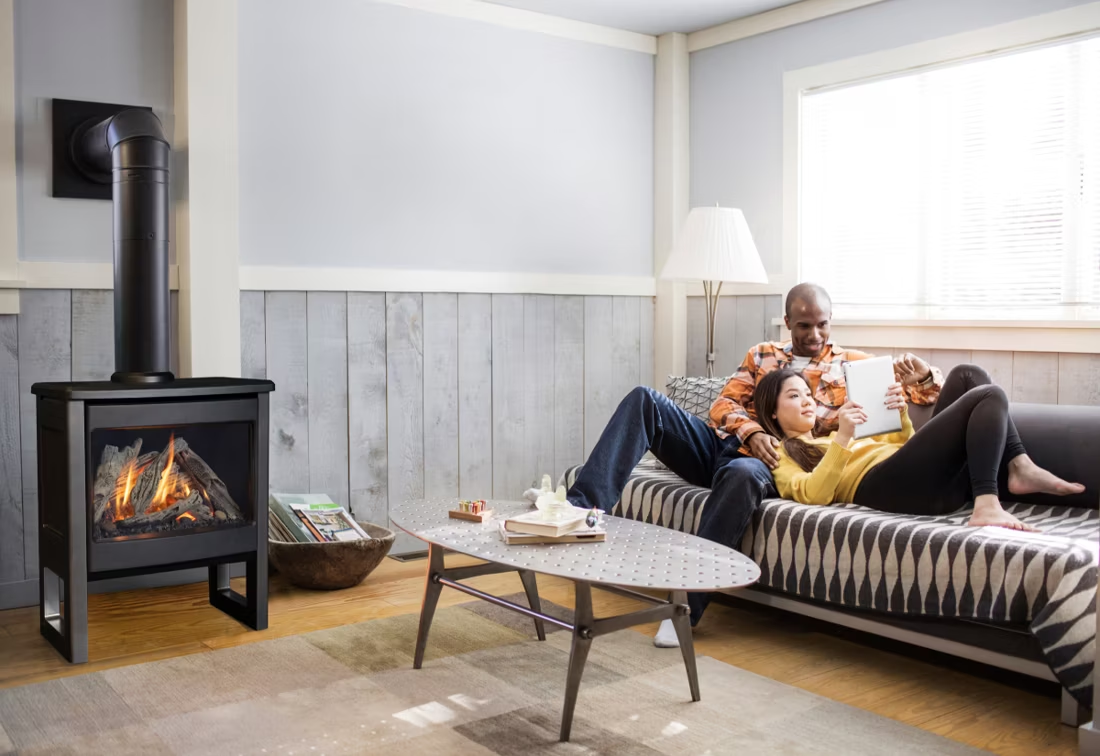
A gas fireplace is a fully built-in unit framed into a wall—the right call for new construction or a remodel without an existing chimney. A gas insert slides into an existing masonry fireplace opening and vents through the chimney you already have, which fits a lot of the older stone and colonial-era homes around Sanatoga and Lower Pottsgrove Township. A gas stove is a freestanding cast-iron or steel unit that sits on the floor like a wood stove but burns gas—a good option for a room with no existing fireplace and limited space for framing. A local dealer can tell you which fits your specific opening and floor plan.
Do I need a permit to install a gas fireplace in Sanatoga?
Yes. Because Sanatoga is unincorporated, permitting runs through Lower Pottsgrove Township's building and zoning department, and it covers both the appliance installation and any new gas line work. Gas line connections need to be done by a licensed gas fitter, which is one reason it pays to hire a hearth dealer who coordinates the venting, the gas line, and the township inspection together instead of juggling separate trades yourself.
What's the difference between vented and vent-free gas fireplaces?
Vented (direct-vent) gas fireplaces pull combustion air from outside and exhaust the byproducts back outside through a sealed pipe—they're the cleanest and most universally code-approved option. Vent-free units burn directly into the room without external venting; they're legal in Pennsylvania but come with strict room-size and ventilation requirements, and they release some moisture and combustion byproducts into your living space. For older Sanatoga homes with thicker walls and existing masonry openings, direct-vent inserts are usually the simpler and more comfortable choice, but a local dealer can walk you through both if you're weighing the options for a room without a chimney.
How often should my gas fireplace be serviced?
Plan on an annual inspection, ideally before the heating season starts. A technician checks the burner, pilot assembly, venting, and gas connections, and cleans the glass and interior—a much smaller job than a chimney sweep but just as important for safe operation. Locally, this kind of annual gas appliance service typically runs $150 to $250.
Gas vs. wood—which is right for my Sanatoga home?
Sanatoga has no wood-smoke air quality restrictions, and Montgomery County has plenty of oak, hickory, maple, and cherry available regionally, so wood heat is a fully viable option here if you want it—including as backup heat during an outage. But gas wins on convenience: instant on-off operation, no ash or creosote to manage, and consistent heat output without tending a fire. For a primary living space where you want heat at the flip of a switch, gas is usually the better fit; wood still makes sense as a secondary source in a den, sunroom, or as an off-grid backup.
Why is a fireplace insert so efficient?
An insert does two things: it seals the chimney completely, so you stop losing air you already paid to heat, and it radiates warmth into the room through the firebox and glass. Most add a heat-exchange fan that pulls cool room air underneath, wraps it around the hot firebox, and pushes it back out warm. Your home is more efficient before you've even lit the first fire.
Why is my open fireplace making my house colder?
Open fireplaces suck—literally. As the fire burns, it consumes air your furnace already paid to heat and pulls it out through the chimney, so the house is actually colder after the fire goes out than before you lit it. An insert fixes this: it seals the chimney, puts fixed glass across the front, and turns that hole in your house into a real heat source.
Can I install a fireplace myself?
If you're putting a fire in your house on purpose, it's best to work with an expert. Unless you're genuinely experienced in framing, gas line, vent pipe, and the national code on clearances to combustibles, have a professional do it—and ideally the same company that sells you the fireplace, so warranty, service, and liability all live under one roof.
Can a fireplace actually lower my heating bill?
Yes—by creating a comfort zone. A furnace heats every square foot of the house just to warm the one room you're in; a gas fireplace on low burns roughly a sixth of the gas a typical furnace does. Set the furnace around 55–60 degrees as a baseline, then heat the rooms your family actually uses. Families who heat this way commonly save $20–$60 a month.
Nearby Dealers
Hearth shops serving Sanatoga and the surrounding area. Every listing shows whether it is a WhyFire partner, a dealer we have verified as authorized for the brands we recommend, or a local business carrying hearth products. No manufacturer pays for placement. How we verify dealers →
Krings Hearth & Home - Bechtelsville
Independence Propane
Pennsburg Ace Hardware
A Chimney King
Halligan's Hearth And Home
Norristown Chimney
Sequoia Supply Hatfield Showroom
Atlantic Building Prodcuts Inc
Ambler Fireplace & Patio - Chalfont
Halco Grills And Fireplaces
Progressive Propane
Estates Chimney Sweep
Ambler Fireplace And Patio
Scandia Stoves Of Pa Inc.
Stoves N Stuff Ltd
Maple Glen Mechanical
Find your gas fireplace in Sanatoga.
Tell us about your home and your existing fireplace or opening, and we'll put together a free Project Guide & Parts List—the exact parts, including the vent kit, and a trusted local Sanatoga-area dealer to install it.
Find Your Fireplace →