
Ambiance and heat for New Hope's historic homes—no chimney required.
From stone farmhouses along the Delaware to apartments above Main Street shops, electric fireplaces bring real warmth and flame effect to New Hope without touching a flue, a masonry chimney, or a historic facade.
Every Project Starts From One of These Five Situations
Electric heat fits New Hope's historic homes without a single brick moved.
New Hope sits along the Delaware River in Bucks County, a borough of 18th- and 19th-century fieldstone houses, Federal-style rowhomes, and narrow in-town lots that make new chimney construction or masonry work a real undertaking—and often a Historic District Review matter before a contractor ever picks up a tool. At 159 feet elevation with a 4A mixed-humid climate, New Hope's winters are real but not extreme: the heating season adds up to a moderate amount of cold, and average winter lows sit around 19°F, noticeably milder than a true cold-climate town like Burlington, VT, where winters run far colder and longer. That's part of why wood and pellet appliances see little demand here—dense historic lots leave nowhere to store cordwood or stage pellet deliveries, and many building envelopes simply weren't built to accept new venting without altering a protected facade.
Electric fireplaces sidestep all of that. A zero-clearance electric insert can drop into an existing non-working firebox—common in New Hope's older stone homes—or mount flush in a wall with nothing more than a standard or dedicated circuit behind it. There's no flue, no exterior penetration, and nothing for a historic review board to weigh in on. Running costs are modest too: at PECO Energy's residential rate of about $0.1474 per kWh, a 1,500-watt unit running on high costs roughly 22 cents an hour—inexpensive zone heat for a den, a converted carriage house, or a second-floor unit above a Main Street storefront.
Three steps. No salesperson until you're ready.
Tell us about your project
Your zip code, your situation, and the fuel you're leaning toward—or let the answers point you to one.
See what's actually available
The brands dealers within 100 miles genuinely carry—real options, never a catalog mirage.
Get your dealer & Project Guide
A trusted local dealer, plus the free Project Guide & Parts List that names every component of the job.
Frequently Asked Questions
How much does an electric fireplace or insert cost to install in New Hope?
Most electric fireplace and insert projects in New Hope run somewhere between $400 and $2,500 installed. A plug-in insert dropped into an existing masonry firebox on a standard 15-amp circuit sits at the low end. A wall-mounted or built-in unit that requires a dedicated 20-amp circuit run by a licensed electrician, or custom surround work to fit an older fieldstone opening, pushes toward the higher end. Because there's no venting or chimney work involved, electric installs are consistently the least expensive fireplace option for New Hope's older housing stock—a local dealer can quote a firm number after seeing your firebox or wall.
Will New Hope's Historic District review process affect an electric fireplace install?
Generally, no—and that's the main reason electric is such a popular fit here. Exterior alterations like a new flue, chimney liner, or vent termination are exactly what triggers Historic District Review Board scrutiny in a town like New Hope. An electric fireplace needs none of that: no exterior penetration, no roofline change, no masonry work. If you're dropping an insert into an existing, already-approved firebox opening, there's typically nothing to submit at all. Always confirm with New Hope Borough before starting work on a designated historic structure, but electric is the appliance type least likely to require a hearing.
Do I need a permit or an electrician to install an electric fireplace?
A basic plug-in insert that runs on a standard household outlet typically doesn't require a permit. A hardwired built-in unit, or any installation that calls for a new dedicated circuit, does require a licensed electrician and an electrical permit through New Hope Borough. Older Bucks County homes with knob-and-tube or undersized panels sometimes need panel work before a higher-draw unit (1,500 watts or more) can be added safely—a detail worth flagging to your electrician up front rather than discovering mid-install.
Can an electric fireplace actually heat a room in New Hope, or is it just for looks?
A quality 1,500-watt electric insert or built-in unit will genuinely heat a small-to-medium room—figure 400 to 600 square feet depending on ceiling height and how well the space holds heat, which varies widely in New Hope's older stone construction. With a winter cold load that's moderate rather than severe and winter lows near 19°F, electric works best here as zone heat for a den, sunroom, or bedroom rather than as the sole heat source for a whole historic home. Most owners run electric alongside their existing furnace, using it to warm the room they're actually in and turning the thermostat down elsewhere.
Electric vs. gas fireplace—which makes more sense for a New Hope home?
Gas delivers more heat output and a closer approximation of a real flame, but it requires venting, a gas line, and—in a historic structure—a look at how that venting exits the building. Electric skips all of that: no gas line, no combustion, no venting, and installation that a historic property can accommodate almost anywhere. For a primary living space where you want serious heat output, gas is often worth the added installation complexity. For an upstairs apartment above a Main Street shop, a converted outbuilding, or any space where running a gas line isn't practical, electric is usually the more realistic answer.
What are the best electric fireplace brands to look at?
Dimplex, Napoleon, and Amantii are the three brands most local dealers carry and stand behind for realistic flame presentation and reliable heating elements. Dimplex's multi-fire LED technology gives a more convincing flame at night than older linear-light designs, which matters in a room where the fireplace is doing double duty as both heat and ambiance. For an existing New Hope firebox, ask your dealer about insert-specific trim kits sized to older, narrower masonry openings—a common mismatch in 18th- and 19th-century construction.
How much does it cost to run an electric fireplace at PECO's rates?
At PECO Energy's residential rate of roughly $0.1474 per kWh, a 1,500-watt heater running on its highest setting costs about 22 cents per hour. Most electric fireplaces let you run the flame effect alone, with the heater off, for pennies an hour—useful if you want ambiance in July without adding load to the AC. Compared with a portable space heater of the same wattage, the running cost is identical; the advantage of a built-in electric fireplace is thermostatic control and a fixed, safe installation rather than a cord running across the floor.
Can I put an electric insert into my home's existing but unused fireplace?
Yes, and it's one of the most common projects for New Hope's older housing stock, where many stone and brick homes have a fireplace that hasn't been safely burned in decades. An electric insert sized to your firebox opening drops in, plugs into a nearby outlet or a new dedicated circuit, and immediately stops cold air from pouring down an open flue—a real problem in drafty 18th-century construction. No chimney inspection, relining, or masonry repair is required, since the electric insert doesn't rely on the flue for anything beyond serving as a housing.
Is a built-in electric fireplace safer than a portable space heater?
Generally yes. A built-in or wall-mounted electric fireplace is professionally wired, often on its own circuit, and stays in a fixed location away from foot traffic—a meaningful safety upgrade over a portable heater with an exposed cord, especially in older New Hope homes with aging wiring or knob-and-tube runs still in some walls. Most electric fireplaces also run cool to the touch on the glass front and include tip-over and overheat shutoffs as standard. For a room you heat regularly all winter, a permanent installation is worth the modest extra cost over a plug-in space heater.
Can I put a TV above my fireplace?
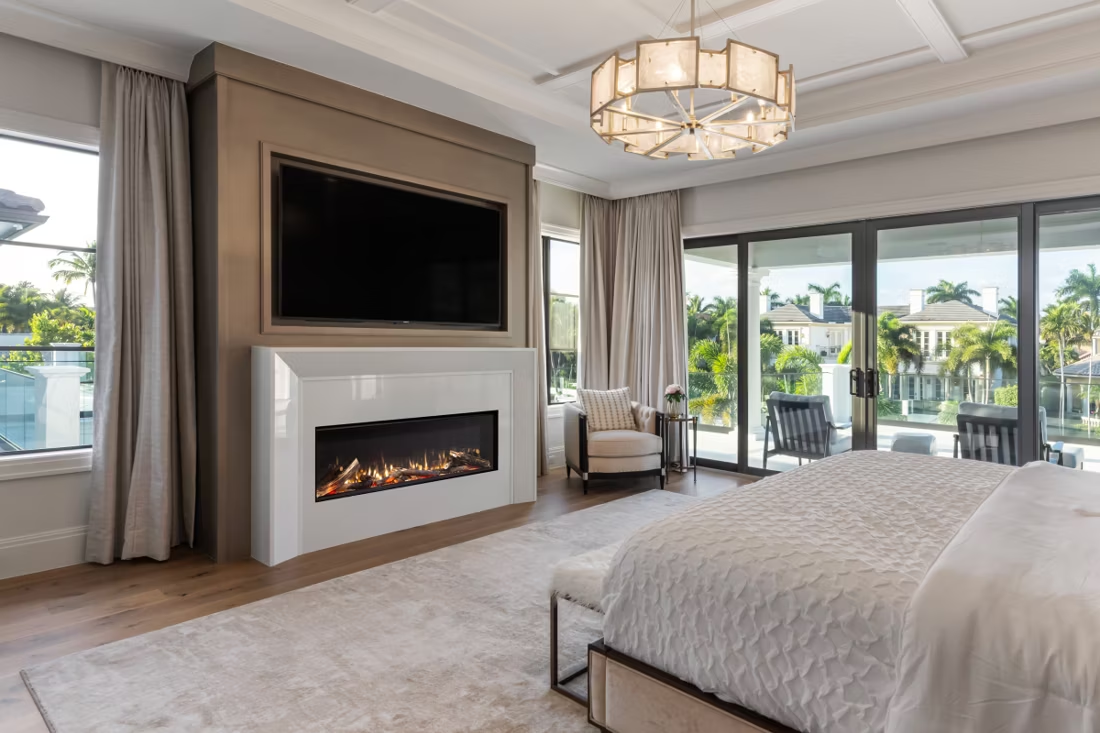
Yes—with an asterisk. Fireplaces are hot and TVs don't like heat. Either put a mantel between them to deflect rising warmth, or choose a fireplace with heat-management technology that creates a cool zone on the wall above—the wall stays around 125 degrees, barely warm, while the room still gets full heat. If you like clean lines and don't want a mantel, heat management is the answer.
Do electric fireplaces actually produce heat?
Yes—most put out around 4,800–5,000 BTUs from a standard outlet, which comfortably warms a bedroom, office, or den as a comfort-zone heater. What they won't do is carry a whole house the way wood, gas, or pellet can. Think of electric as ambiance-first with honest supplemental heat: flames on with no heat in July, flames plus warmth in January.
How much should I budget for a fireplace?
For an average home—covering the fireplace, the vent pipe, and basic installation—a budget between $3,900 and $5,500 gives you a lot of options across wood, gas, and pellet. By the time you add finish work, gas line, and electrical, the average complete installation lands between $5,000 and $12,000 all-in. In a remodel or new build, a good rule is to put about 2.5% of the total project cost toward the fireplace.
Can I install a fireplace myself?
If you're putting a fire in your house on purpose, it's best to work with an expert. Unless you're genuinely experienced in framing, gas line, vent pipe, and the national code on clearances to combustibles, have a professional do it—and ideally the same company that sells you the fireplace, so warranty, service, and liability all live under one roof.
Nearby Dealers
Hearth shops serving New Hope and the surrounding area. Every listing shows whether it is a WhyFire partner, a dealer we have verified as authorized for the brands we recommend, or a local business carrying hearth products. No manufacturer pays for placement. How we verify dealers →
We’ve paused dealer listings for this connection today. Enter your zip or postal code above to find dealers near you, or come back tomorrow.
Popular Electric Brands
Where each brand came from, what's inside it today, and every current model. No brand pays to be here. Not every dealer carries every brand, so enter your zip code to see what's sold near New Hope.
Fireplace Xtrordinair
Fireplace Xtrordinair, now often called FireplaceX, is the fireplace brand of Travis Industries, Inc., of Mukilteo, Washington.
5 electric models →DaVinci
DaVinci Custom Fireplaces is a brand of Travis Industries, Inc., of Mukilteo, Washington, the company behind Lopi and Fireplace Xtrordinair.
5 electric models →Kozy Heat
Kozy Heat was founded in 1976 by Dudley Hussong in Lakefield, Minnesota, and incorporated as Hussong Manufacturing Co., Inc. in 1978.
3 electric models →Forge & Flame
Forge & Flame is the stove brand Hearth & Home Technologies introduced in August 2023 to bring Vermont Castings, Harman, and Quadra-Fire under one name.
1 electric model →Electric Service in New Hope
An electric fireplace's heater draws about 1,500 watts—pennies per hour at local rates.
Peco Energy Co
Find your electric fireplace in New Hope.
Tell us about your home and your existing firebox or wall space, and we'll help you find a trusted local dealer and send over your free Project Guide & Parts List—sized correctly for your room, with no venting guesswork.
Find Your Fireplace →