
Instant ambiance for a Bucks County home, no chimney required.
With winter lows averaging 23°F and a heating season that stretches nearly seven months a year, New Britain doesn't need a fireplace to survive winter—it needs one that adds warmth and atmosphere to a room without a flue, a gas line, or a cord of wood. We'll help you find a trusted local dealer who can tell you exactly what fits your panel and your wall.
Every Project Starts From One of These Five Situations
A supplemental heat source that skips the masonry and the flue.
New Britain is a small Bucks County borough with a housing stock that ranges from 1700s and 1800s farmhouses near the township line to newer townhomes and developments closer to Route 202. A lot of those older homes either lack a working chimney or have one that's expensive to reline, and a lot of the newer construction never had one to begin with. At climate zone 4A and 272 feet elevation, with winters cold enough to average 23°F lows and a long, nearly seven-month heating season, residents still want supplemental heat and ambiance in a den, bedroom, or finished basement—they just don't want to cut a hole in the roof to get it.
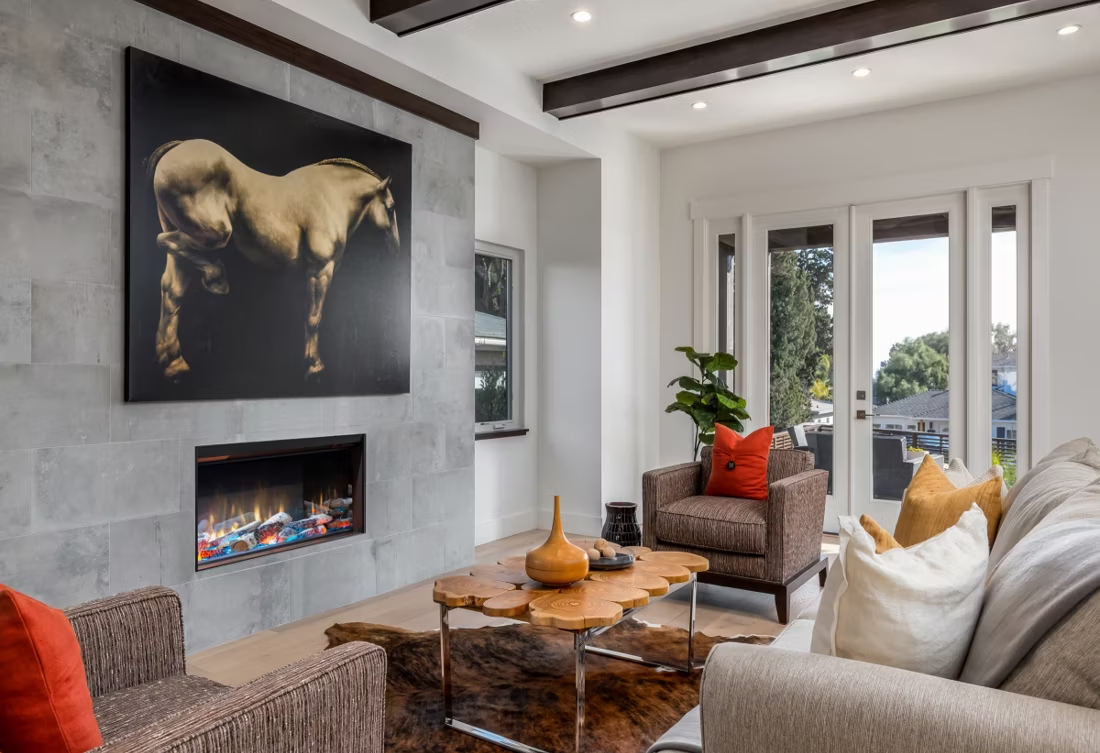
Electric inserts and built-ins solve that: they drop into an existing masonry opening or a stud wall, plug into a standard outlet or a dedicated circuit, and run on PECO Energy's residential service at roughly 14.7 cents per kWh. That's a different calculation than the wood heat many longtime New Britain households still split from local oak, hickory, maple, and cherry, or the pellet route using regional brands like Energex, Hamer, and Greene Team—electric won't replace a furnace on the coldest January night, but it adds zone heat to one room for the cost of running a space heater, with none of the ash, creosote, or venting work.
Three steps. No salesperson until you're ready.
Tell us about your project
Your zip code, your situation, and the fuel you're leaning toward—or let the answers point you to one.
See what's actually available
The brands dealers within 100 miles genuinely carry—real options, never a catalog mirage.
Get your dealer & Project Guide
A trusted local dealer, plus the free Project Guide & Parts List that names every component of the job.
Frequently Asked Questions
How much does it cost to install an electric fireplace in New Britain?
A plug-in electric insert or freestanding unit that runs on a standard 120V outlet is the cheapest route and often needs no electrician at all beyond mounting. A built-in electric fireplace or a larger insert that draws more amperage typically calls for a dedicated circuit, which means an electrician's visit and sometimes a small panel upgrade if your New Britain home is on older wiring—common in the farmhouses and colonials scattered through the borough and surrounding township. Either way, you're skipping the chimney, liner, and venting costs that drive up wood and gas installs, which is the main reason electric comes in well under those options.
Will an electric fireplace heat my whole house during a Bucks County winter?
No, and it isn't designed to. With a long, nearly seven-month heating season and winter lows averaging 23°F, New Britain needs a central heating system to carry the house through winter—an electric fireplace is built for zone heating a single room, usually rated to comfortably warm 400 to 1,000 square feet depending on the model. Where it earns its keep is taking the edge off a den or finished basement so you're not running the furnace harder just to make one room comfortable, or adding supplemental warmth in a room with poor duct coverage.
What does it actually cost to run an electric fireplace on PECO rates?
Most electric fireplace heaters draw around 1,500 watts on high, and at PECO Energy's residential rate of about 14.7 cents per kWh, that works out to roughly 22 cents an hour of heat output. Run it four hours an evening through a cold stretch and you're looking at under a dollar a day—cheap compared to electric baseboard heating the same space, though it's still more expensive per BTU than burning oak or hickory you split yourself. The flip side is zero maintenance cost and no fuel to haul or store.
Do I need a permit for an electric fireplace in New Britain?
A plug-in unit that just sits in an existing opening or against a wall generally doesn't trigger a permit. If your installer is adding a new dedicated circuit, running wire through walls, or doing any panel work, that's electrical work that falls under New Britain Borough's building and code enforcement process, and most licensed electricians pull that permit as a matter of course. It's a much lighter lift than the building permits required for a wood or gas install with venting, which is one reason electric is the fastest fuel to get installed here.
What's the difference between an electric insert, built-in, and freestanding fireplace?
An electric insert is sized to slide into an existing masonry firebox—a natural fit for the older farmhouses and colonials around New Britain that have a fireplace opening but no longer burn wood in it. A built-in is designed to be framed into a wall during a remodel or new construction, which suits the newer townhomes and developments near the borough. A freestanding electric stove or mantel unit needs no construction at all; it just needs an outlet, making it the simplest option for a renter or anyone who isn't ready to commit to permanent changes.
What size electric fireplace do I need for my living room?
Electric fireplaces are rated more by heater output and room coverage than raw BTUs the way wood and gas units are. A compact 1,500-watt insert or stove handles a bedroom or small den comfortably, while a wider built-in with a stronger blower is better suited to an open-concept living room in one of New Britain's newer homes. Because these units are supplemental rather than whole-house heat, it's worth sizing for the specific room you want warmed rather than the whole floor plan—a local dealer can match wattage and heater coverage to your actual square footage.
Is an electric fireplace a good fit for an older farmhouse without a working chimney?
It's one of the most common reasons homeowners in and around New Britain go electric. A lot of the township's older stone and fieldstone farmhouses have a fireplace opening that was never relined to modern code, or a chimney that would cost thousands to rebuild before it could safely burn wood again. An electric insert drops into that same opening, uses the existing mantel and surround, and gives you flame visuals and supplemental heat without touching the masonry above the firebox—a practical fix for a feature that's otherwise decorative.
How does electric compare to wood or pellet heat for a New Britain home?
Wood heat using local oak, hickory, maple, or cherry still makes sense for homeowners who want a genuine backup heat source—one that keeps working if PECO's lines go down in an ice storm, which does happen in Bucks County winters. Pellet stoves running regional fuel like Energex, Hamer, or Greene Team offer a cleaner, more automated middle ground but still need electricity for the auger and blower, same as an electric fireplace needs it for everything. Electric wins on simplicity, upfront cost, and zero fuel handling, but it offers no heat at all during an outage, so most households treat it as a convenience and ambiance choice rather than a resilience one.
Will my electric fireplace still work during a power outage?
No—unlike a wood stove, an electric fireplace is entirely dependent on PECO's grid, so if the power goes out, both the flame effect and the heat shut off. That's the main tradeoff New Britain homeowners weigh when choosing between fuels: electric is the easiest to install and run day to day, but if you want heat during a winter storm outage, you'll want a wood stove or a battery-backed gas unit somewhere in the house as a secondary option.
Does an electric fireplace need a vent or chimney?
No—that's its superpower. An electric fireplace needs a wall and an outlet, period. No vent pipe, no gas line, no clearances to design around, which is why it works in bedrooms, offices, apartments, and walls where venting a gas or wood unit would be impractical or impossible. Installation is typically the simplest and least expensive of any fireplace type.
How much does an electric fireplace cost to run?
With the heater on, a typical unit draws about 1,500 watts—at average electric rates that's roughly 20 cents an hour. Run the flame effect alone and it costs pennies; the flames are LED-driven and use about as much power as a light bulb. There's no pilot light, no fuel delivery, and essentially no maintenance.
Does a fireplace add value to my home?
On average, a fireplace adds back to the home about the same amount you spent installing it. Add the monthly savings from heating the rooms you actually use instead of the whole house—often hundreds of dollars a year—and the value case is strong before you even count what a fire does for how your family uses the room.
How much should I budget for a fireplace?
For an average home—covering the fireplace, the vent pipe, and basic installation—a budget between $3,900 and $5,500 gives you a lot of options across wood, gas, and pellet. By the time you add finish work, gas line, and electrical, the average complete installation lands between $5,000 and $12,000 all-in. In a remodel or new build, a good rule is to put about 2.5% of the total project cost toward the fireplace.
Nearby Dealers
Hearth shops serving New Britain and the surrounding area. Every listing shows whether it is a WhyFire partner, a dealer we have verified as authorized for the brands we recommend, or a local business carrying hearth products. No manufacturer pays for placement. How we verify dealers →
We’ve paused dealer listings for this connection today. Enter your zip or postal code above to find dealers near you, or come back tomorrow.
Popular Electric Brands
Where each brand came from, what's inside it today, and every current model. No brand pays to be here. Not every dealer carries every brand, so enter your zip code to see what's sold near New Britain.
Fireplace Xtrordinair
Fireplace Xtrordinair, now often called FireplaceX, is the fireplace brand of Travis Industries, Inc., of Mukilteo, Washington.
5 electric models →DaVinci
DaVinci Custom Fireplaces is a brand of Travis Industries, Inc., of Mukilteo, Washington, the company behind Lopi and Fireplace Xtrordinair.
5 electric models →Kozy Heat
Kozy Heat was founded in 1976 by Dudley Hussong in Lakefield, Minnesota, and incorporated as Hussong Manufacturing Co., Inc. in 1978.
3 electric models →Forge & Flame
Forge & Flame is the stove brand Hearth & Home Technologies introduced in August 2023 to bring Vermont Castings, Harman, and Quadra-Fire under one name.
1 electric model →Electric Service in New Britain
An electric fireplace's heater draws about 1,500 watts—pennies per hour at local rates.
Peco Energy Co
Get your free Project Guide & Parts List for a New Britain electric fireplace.
Tell us about your home, your electrical panel, and whether you're working with an existing fireplace opening or a bare wall, and we'll help you find a trusted local dealer and send a free Project Guide & Parts List with the exact unit and circuit requirements for your space.
Find Your Fireplace →