
Real fireplace warmth for Gibsonia—no chimney required.
A zero-clearance electric unit heats a room in minutes, needs no gas line or masonry chimney, and fits the newer subdivisions around Richland and Hampton Township. Find the right unit and find a trusted local dealer.
Every Project Starts From One of These Five Situations
The cleanest way to add heat to a Pittsburgh-area home.
Gibsonia sits at just over 1,000 feet in Richland Township, Allegheny County, part of the north Pittsburgh suburbs. Winters here average a low near 19°F and the area logs a long, several-month heating season each year—nowhere near Fargo ND or International Falls MN territory, but a real four-season climate where supplemental heat gets steady use from late October through March. A lot of Gibsonia's newer developments carry HOA covenants that restrict exterior venting or solid-fuel appliances, which is part of why electric fireplaces show up here as a first choice rather than a fallback—no flue, no chimney, no combustion byproducts to vent through the roof.
Allegheny County has a documented history of PM2.5 non-attainment issues, and the county Health Department still tracks air quality closely on inversion days—a real consideration for anyone comparing electric against a wood or gas unit. Electric adds zero local emissions. On the cost side, Duquesne Light Co. and Pennsylvania Power Co. serve most of Gibsonia, and the residential rate here runs around 19.5 cents per kWh—a bit above the Pennsylvania average, which is worth factoring in if you're leaning on an electric unit for more than occasional supplemental heat. Even so, installed cost and simplicity usually keep electric competitive for finished basements, media walls, and secondary living spaces.
Three steps. No salesperson until you're ready.
Tell us about your project
Your zip code, your situation, and the fuel you're leaning toward—or let the answers point you to one.
See what's actually available
The brands dealers within 100 miles genuinely carry—real options, never a catalog mirage.
Get your dealer & Project Guide
A trusted local dealer, plus the free Project Guide & Parts List that names every component of the job.
Frequently Asked Questions
How much does an electric fireplace installation cost in Gibsonia?
Plug-in electric inserts and freestanding units that use a standard 120V outlet typically run $200 to $900 for the unit itself, with no real installation cost beyond mounting. Built-in electric fireplaces or linear wall units usually need a dedicated 120V or 240V circuit run by a licensed electrician, and that combination of unit plus wiring generally lands between $1,500 and $4,000. Full media-wall installations with custom surround, shiplap or stone facing, and a mounted TV above the unit can run $3,000 to $8,000 depending on finish materials. Local dealers around Gibsonia will quote a firm number after seeing your wall and existing electrical panel capacity.
Do I need a permit to install an electric fireplace in Gibsonia?
A plug-in electric fireplace that runs off an existing outlet doesn't require a permit. If you're adding a built-in unit that needs a new dedicated circuit, an electrical permit is typically required through Richland Township's Building and Zoning office (or Hampton Township, depending on which side of the 15044 zip you're in). Most licensed electricians pull this permit as part of the job, so it's rarely something homeowners have to handle themselves. There's no chimney, flue, or combustion venting inspection involved, which is one of the reasons electric projects move faster than wood or gas installs in this area.
How much does it cost to run an electric fireplace in Gibsonia?
Most electric fireplaces draw around 1,500 watts on the heat setting. At Duquesne Light's residential rate of roughly 19.5 cents per kWh, that works out to about 29 cents an hour to run, or a little under $2.50 for eight hours of heat. Running the unit on flame-only mode without the heater draws only a few watts and costs pennies a day. Compared to central natural gas or propane heat, electric fireplaces are best used as zone heat for the room you're actually in rather than a whole-house heating strategy—that's where the operating cost math works in your favor.
Can I convert my existing wood-burning fireplace to electric in Gibsonia?
Yes, and it's a common project for older homes around Gibsonia with a masonry fireplace that no longer gets used. An electric insert slides into the existing firebox opening, and in most cases the chimney is simply capped or left as-is rather than being lined or vented, since electric units produce no combustion byproducts. The main variable is power access—if there's no outlet near the firebox, an electrician will need to run a line, which adds to the cost. This is generally the least expensive fireplace conversion available, well below what a gas insert conversion runs once gas line work is factored in.
What size electric fireplace do I need for my Gibsonia home?
Electric fireplaces are rated by both heating capacity and viewing width rather than whole-home BTU output, since almost all residential units cap out around 5,000–5,200 BTU regardless of size. A 1,500-watt unit will comfortably heat a single room of 400 to 600 square feet as supplemental warmth. For open-concept living rooms or larger media walls, homeowners usually size the unit for the visual width they want (30", 50", 60"+) and treat the heating function as a bonus rather than the primary source, especially in Gibsonia's colder months when central heat is doing the bulk of the work.
What's the best electric fireplace for a Pittsburgh-area climate like Gibsonia's?
For most Gibsonia homes, a linear built-in unit from Dimplex, Napoleon, or Amantii offers realistic flame presentation and a heater strong enough to genuinely warm a family room on the coldest days. If you're working with an existing masonry firebox, a fireplace-shaped insert with a log or ember bed set (also available from Dimplex and similar brands) preserves the traditional look. Since electric heat output tops out well below wood or gas, homeowners in colder pockets of Allegheny County who want real primary heat sometimes pair an electric unit for ambiance with a separate space heater or keep their existing gas furnace as the main heat source—a local dealer can walk through that trade-off room by room.
Will my electric fireplace still work during a power outage?
No—electric fireplaces are fully dependent on grid power, so a Duquesne Light or Pennsylvania Power outage means the unit shuts off along with everything else. This is worth planning around in Gibsonia, where ice storms and heavy wet snow occasionally knock out power for hours at a time in winter. Homes that want a heat source that survives an outage typically keep a wood stove, wood insert, or battery/propane backup heater somewhere in the house alongside an electric fireplace used for daily convenience and ambiance.
Are there air quality restrictions in Gibsonia that make electric fireplaces a better choice?
Allegheny County has a long-documented history of PM2.5 non-attainment status, and the Allegheny County Health Department monitors regional air quality closely, particularly during winter inversion periods when smoke and particulates can settle over the valley. While there's no outright ban on wood or gas appliances in Gibsonia, electric fireplaces add zero local emissions and never trigger any air-quality-related burn advisories. For homeowners who want fire-like ambiance without adding to the county's air quality footprint—or who live in an HOA development that already restricts exterior venting—electric is the cleanest option available.
Electric vs. pellet stove—which is right for my Gibsonia home?
A pellet stove burns bagged fuel (regional brands like Energex, Hamer, and Greene Team are common in Western Pennsylvania), produces genuine sustained heat in the 40,000–50,000 BTU range, and can serve as real supplemental or even primary heat through a Pittsburgh winter—but it needs venting, a hopper to refill, ash removal, and electricity to run its auger and blower, so it also goes down in an outage. An electric fireplace produces far less heat, needs no venting or fuel storage at all, and can go anywhere there's an outlet or a dedicated circuit. For a finished basement, bedroom, or media wall where ambiance and modest supplemental warmth are the goal, electric is simpler and cheaper. For a home that wants a real backup heat source during Allegheny County's colder stretches, a pellet stove does more work.
Can I put a TV above my fireplace?
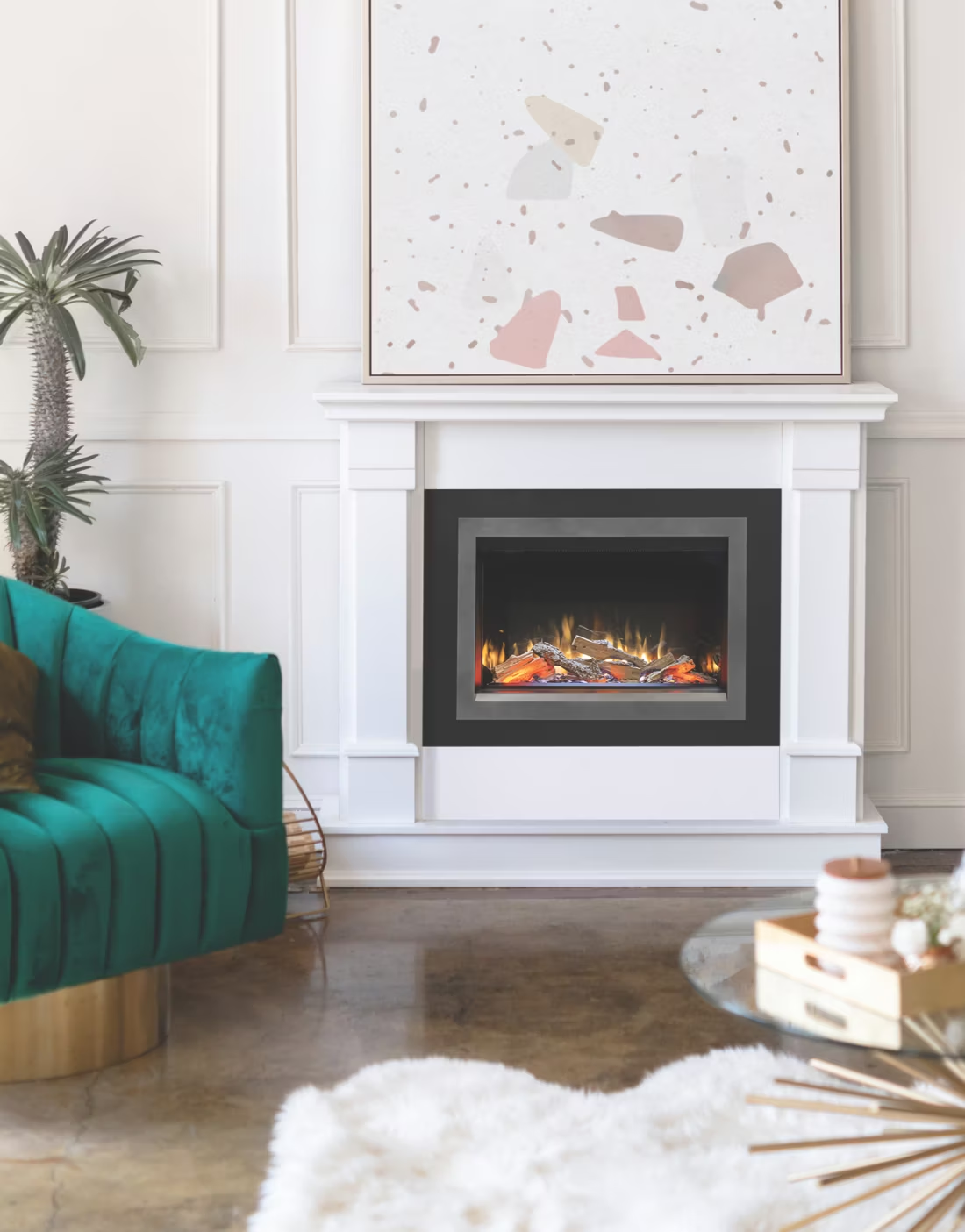
Yes—with an asterisk. Fireplaces are hot and TVs don't like heat. Either put a mantel between them to deflect rising warmth, or choose a fireplace with heat-management technology that creates a cool zone on the wall above—the wall stays around 125 degrees, barely warm, while the room still gets full heat. If you like clean lines and don't want a mantel, heat management is the answer.
Does an electric fireplace need a vent or chimney?
No—that's its superpower. An electric fireplace needs a wall and an outlet, period. No vent pipe, no gas line, no clearances to design around, which is why it works in bedrooms, offices, apartments, and walls where venting a gas or wood unit would be impractical or impossible. Installation is typically the simplest and least expensive of any fireplace type.
Does a fireplace add value to my home?
On average, a fireplace adds back to the home about the same amount you spent installing it. Add the monthly savings from heating the rooms you actually use instead of the whole house—often hundreds of dollars a year—and the value case is strong before you even count what a fire does for how your family uses the room.
Can a fireplace actually lower my heating bill?
Yes—by creating a comfort zone. A furnace heats every square foot of the house just to warm the one room you're in; a gas fireplace on low burns roughly a sixth of the gas a typical furnace does. Set the furnace around 55–60 degrees as a baseline, then heat the rooms your family actually uses. Families who heat this way commonly save $20–$60 a month.
Nearby Dealers
Hearth shops serving Gibsonia and the surrounding area. Every listing shows whether it is a WhyFire partner, a dealer we have verified as authorized for the brands we recommend, or a local business carrying hearth products. No manufacturer pays for placement. How we verify dealers →
We’ve paused dealer listings for this connection today. Enter your zip or postal code above to find dealers near you, or come back tomorrow.
Popular Electric Brands
Where each brand came from, what's inside it today, and every current model. No brand pays to be here. Not every dealer carries every brand, so enter your zip code to see what's sold near Gibsonia.
Fireplace Xtrordinair
Fireplace Xtrordinair, now often called FireplaceX, is the fireplace brand of Travis Industries, Inc., of Mukilteo, Washington.
5 electric models →DaVinci
DaVinci Custom Fireplaces is a brand of Travis Industries, Inc., of Mukilteo, Washington, the company behind Lopi and Fireplace Xtrordinair.
5 electric models →Kozy Heat
Kozy Heat was founded in 1976 by Dudley Hussong in Lakefield, Minnesota, and incorporated as Hussong Manufacturing Co., Inc. in 1978.
3 electric models →Forge & Flame
Forge & Flame is the stove brand Hearth & Home Technologies introduced in August 2023 to bring Vermont Castings, Harman, and Quadra-Fire under one name.
1 electric model →Electric Service in Gibsonia
An electric fireplace's heater draws about 1,500 watts—pennies per hour at local rates.
Duquesne Light Co
Pennsylvania Power Co
Find your electric fireplace in Gibsonia.
Tell us about your room, your wall, and what you're hoping to power (a media wall, an insert conversion, or a standalone unit), and we'll put together a free Project Guide & Parts List—the right electric fireplace, the wiring and mounting parts you'll need, and a trusted local Gibsonia-area dealer to install it.
Find Your Fireplace →