
Add mess-free heat to your Louisville home.
No chimney, no gas line, no venting—just plug-in or hardwired warmth for Stark County's cold months. Find the right unit and connect with a trusted local dealer.
Every Project Starts From One of These Five Situations
Electric heat fits Louisville's small-town housing stock.
Louisville sits in Stark County at just over 1,000 feet elevation, with a solidly long heating season and winter lows that settle around 20°F—a solid Northeast Ohio winter, colder than the Ohio Valley but nowhere near the extremes of places like Duluth MN or International Falls MN. Most homes here are older bungalows, cape cods, and postwar ranches on modest in-town lots, already served by AEP Ohio (listed locally as Ohio Power Co) for electric service at a residential rate of about $0.1435 per kWh.
Stark County's woodlots are full of oak, hickory, maple, and cherry, and wood heat still has a foothold in the surrounding rural townships—but wood-burning and pellet appliances are uncommon within Louisville's town limits, where small lots leave little room for log storage and most homes were built or updated with gas or electric systems already in place. That's where electric fireplaces fill a real niche: instant ambiance and zone heat in a bedroom, basement, or family room, with none of the venting, gas line, or chimney work that a wood or gas installation requires.
Three steps. No salesperson until you're ready.
Tell us about your project
Your zip code, your situation, and the fuel you're leaning toward—or let the answers point you to one.
See what's actually available
The brands dealers within 100 miles genuinely carry—real options, never a catalog mirage.
Get your dealer & Project Guide
A trusted local dealer, plus the free Project Guide & Parts List that names every component of the job.
Frequently Asked Questions
How much does an electric fireplace installation cost in Louisville?
A plug-in electric fireplace insert or mantel package typically runs $200–$600 installed if there's a nearby outlet and no electrical work is needed. Built-in wall units or larger mantel packages that require a dedicated 20-amp circuit run $800–$2,500 once an electrician is involved. Larger linear built-ins for a great room or finished basement, with custom framing and trim, can reach $3,000–$4,500. Because electric units skip venting and chimney work entirely, most of that cost spread comes down to circuit work and cabinetry rather than the heating mechanism itself.
Will an electric fireplace actually heat my Louisville home?
Most electric fireplace heaters top out around 1,500 watts (about 5,000 BTU/hour), which comfortably supplements one room—400 to 1,000 square feet depending on insulation and window age. With Louisville's solidly long heating season and winter lows near 20°F, that's enough to take the edge off a bedroom, den, or finished basement, but it isn't a whole-home heating solution. Think of it as targeted zone heat that lets you turn the furnace down in the room you're actually using, not a furnace replacement.
Can I convert my existing masonry fireplace to electric?
Yes, and it's a common project for Louisville's older housing stock, much of which has a masonry firebox that hasn't seen a real fire in years. An electric insert sized to your firebox opening slides in without a chimney liner, gas line, or venting of any kind—it restores the look of a working fireplace in an afternoon. If the opening is a nonstandard size, a local dealer can point you toward a trim kit or a custom-fit unit rather than a full masonry rebuild.
Do I need a permit to install an electric fireplace in Louisville?
Plug-in electric fireplaces generally don't require a permit since there's no gas line, chimney, or structural work involved. If you're adding a built-in unit that needs a new dedicated 20-amp circuit, that electrical work needs to be pulled by a licensed electrician and typically requires an electrical permit through the City of Louisville or Stark County, depending on where the work falls. Most local dealers coordinate the electrician and permitting as part of the install so you're not chasing paperwork yourself.
How much does it cost to run an electric fireplace in Louisville?
AEP Ohio bills Louisville residential customers around $0.1435 per kWh. A typical 1,500-watt electric fireplace on its highest heat setting draws about 1.5 kWh per hour, which works out to roughly $0.22 an hour. Most households run theirs a few hours a day for ambiance or supplemental warmth, not continuously, so a realistic monthly cost lands in the $10–$25 range for regular evening use. That's competitive with running a small space heater, and there's no fuel delivery or tank to manage.
Will my electric fireplace still work if the power goes out?
No—electric fireplaces stop working the moment AEP Ohio service drops, which can happen during the ice storms and heavy snow squalls that occasionally move through Stark County in January and February. If outage-proof backup heat matters to you, an electric fireplace is best treated as a daily-use ambiance and zone-heat appliance, paired separately with a generator or battery backup for the furnace if outages are a real concern in your area. This is one of the main tradeoffs against gas units, which can be set up with battery-backed ignition to keep running when the grid doesn't.
Electric vs. gas fireplace—which is right for my Louisville home?
Both are common choices locally. If your home already has natural gas service—a lot of Louisville does—a direct-vent gas insert delivers a stronger flame and more heat output, typically 20,000–30,000 BTU compared to an electric unit's roughly 5,000. But gas means venting, a gas line, and a higher install cost. Electric skips all of that: no combustion, no venting, no gas permit, and an install that a licensed electrician can often finish in a day. For a finished basement, a bedroom retrofit, or a room where running new gas line isn't practical, electric is usually the simpler and cheaper path.
Are wood stoves an option in Louisville?
Stark County has plenty of oak, hickory, maple, and cherry in the surrounding woodlots, and wood heat still shows up in the rural townships outside town. But wood-burning stoves and fireplaces are uncommon within Louisville's town limits—small in-town lots leave little room for a woodshed or seasoned log storage, and much of the housing stock was built or updated with gas or electric heat already in place. Homeowners looking for that experience here more often convert an existing masonry fireplace than start a wood installation from scratch; for day-to-day supplemental heat, electric or gas is the more practical fit in town.
What type of electric fireplace fits an older Louisville home best?
A lot of Louisville's homes are early-to-mid-20th-century bungalows and cape cods with an existing masonry firebox that's sat unused for years—an insert sized to that opening is usually the cleanest upgrade, with no chimney liner or venting needed. Homes without an existing fireplace opening tend to do better with a wall-mount linear unit or a mantel package, either of which just needs a nearby outlet, or a dedicated circuit if you want a higher-output model. A local dealer can walk your specific room and tell you which route makes sense.
Can I put a TV above my fireplace?
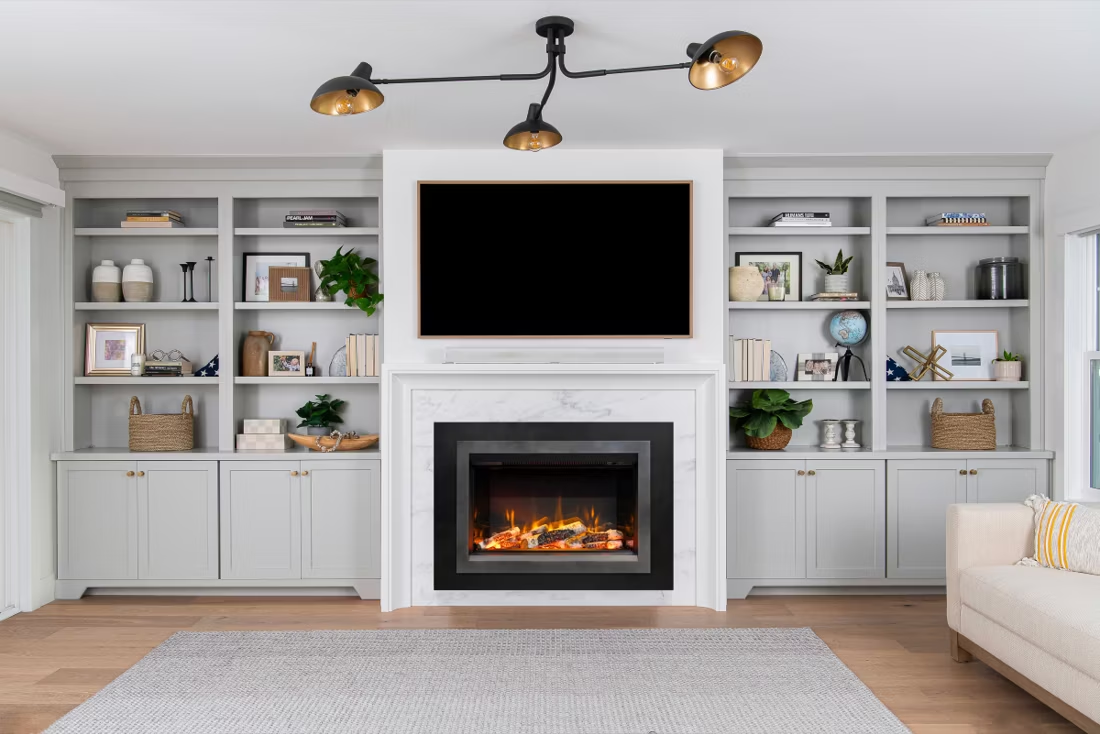
Yes—with an asterisk. Fireplaces are hot and TVs don't like heat. Either put a mantel between them to deflect rising warmth, or choose a fireplace with heat-management technology that creates a cool zone on the wall above—the wall stays around 125 degrees, barely warm, while the room still gets full heat. If you like clean lines and don't want a mantel, heat management is the answer.
What fireplace styles should I know before shopping?
Four cover most of the market: screen-front traditional (mesh front, open feel, fits craftsman homes), traditional door set (the classic look you grew up with), modern linear (wide, low, the statement piece for entertaining), and clean face contemporary (no trim—your tile or stone runs right to the fire's edge). Walk in knowing those four terms and you're ahead of most buyers.
What is an in-home preview and do I need one?
It's a visit where a hearth professional measures your space, confirms the model you picked actually works in your home, and walks the specs—framing, gas line, venting, finish work—before anything is ordered. Some details you just can't know until you see the house. Never make a down payment without one; it's the single most-skipped step that burns buyers.
Can a fireplace actually lower my heating bill?
Yes—by creating a comfort zone. A furnace heats every square foot of the house just to warm the one room you're in; a gas fireplace on low burns roughly a sixth of the gas a typical furnace does. Set the furnace around 55–60 degrees as a baseline, then heat the rooms your family actually uses. Families who heat this way commonly save $20–$60 a month.
Nearby Dealers
Hearth shops serving Louisville and the surrounding area. Every listing shows whether it is a WhyFire partner, a dealer we have verified as authorized for the brands we recommend, or a local business carrying hearth products. No manufacturer pays for placement. How we verify dealers →
Custom Fireplace Shop
Country View Hardware
StarFire Distributors
Brunk's Fireplace
Electric Service in Louisville
An electric fireplace's heater draws about 1,500 watts—pennies per hour at local rates.
Ohio Power Co
Find your electric fireplace in Louisville.
Tell us a bit about your home and we'll put together a free Project Guide & Parts List—the right electric fireplace or insert, the exact parts you'll need, and a trusted local dealer to install it.
Find Your Fireplace →