
Gas heat that keeps up with Portage County winters.
Kent sees roughly 6,400 heating degree days a year and winter lows near 17°F—gas gives you instant, steady heat without tending a fire. Find the right unit and get matched with a trusted local dealer.
Every Project Starts From One of These Five Situations
Steady, on-demand warmth for Kent's older housing stock.
Kent sits at about 1,050 feet in northeast Ohio's climate zone 5A, with roughly 6,400 heating degree days a year—a winter load in the same range as Buffalo, NY, though without Buffalo's lake-effect snow totals. Between Kent State University's campus neighborhoods and the older homes surrounding downtown, a lot of the local housing stock is 50 to 100+ years old, often with an original masonry fireplace that was never built to carry a house through a full Ohio winter on its own.
Natural gas service reaches most of Kent and the surrounding built-up parts of Portage County, which is why gas has become the default upgrade for homeowners replacing a drafty open fireplace or adding zone heat to a room the furnace never quite reaches. A direct-vent gas insert or fireplace gives you real, immediate heat at the flip of a switch or an app tap, and—with the right ignition system—it keeps working even if Ohio Edison's lines go down in an ice storm.
Three steps. No salesperson until you're ready.
Tell us about your project
Your zip code, your situation, and the fuel you're leaning toward—or let the answers point you to one.
See what's actually available
The brands dealers within 100 miles genuinely carry—real options, never a catalog mirage.
Get your dealer & Project Guide
A trusted local dealer, plus the free Project Guide & Parts List that names every component of the job.
Frequently Asked Questions
How much does a gas fireplace installation cost in Kent?
Most gas fireplace and insert projects in the Kent area run somewhere between $3,500 and $9,000. The lower end typically covers a direct-vent gas insert going into an existing masonry fireplace where a gas line is already nearby. The higher end applies to new construction or a remodel where a fireplace is being framed in from scratch and a gas line has to be run to a new location. Homes near downtown Kent with older chimneys sometimes need a stainless liner as part of the job, which adds to the cost but keeps the original brickwork and mantel intact.
Can I convert my existing wood fireplace to gas?
Yes, and it's a common project in Kent's older neighborhoods, where many homes near the university and downtown still have their original brick fireplace. A gas insert typically installs into that existing masonry opening, using a new stainless liner run through the same chimney for venting. Expect roughly $4,000 to $8,000 depending on the insert and whether the gas line needs to be extended to the fireplace location. The finished look keeps your existing mantel and surround while trading ash and stacked wood for a switch or remote.
Do I need natural gas to install a gas fireplace, or can I use propane?
Either works. Inside Kent and the more built-up parts of Portage County, natural gas service is common enough that most homeowners already have a line to tap for a fireplace or insert. Out in the more rural stretches of the county, propane is the standard fallback, supplied by a local tank delivery company. Nearly every gas fireplace on the market can be set up for either fuel—your installer swaps the orifice and regulator to match—so the fuel choice usually comes down to what's already running to your house.
Will my gas fireplace work during a power outage?
Most modern gas fireplaces will, which matters in Kent given how often winter storms take down Ohio Edison service for a few hours at a time. Units with IPI (intermittent pilot ignition) run on a small battery backup that kicks in the moment the power drops, so the fireplace still lights on command. Valor fireplaces go a step further—their pilot generates its own electricity through the thermocouple, so there's no battery to remember to replace. Either way, ask your local dealer which ignition system is on the model you're considering before you buy.
What's the difference between a gas fireplace, gas insert, and gas stove?
A gas fireplace is a fully built-in unit framed into a wall, typically used in new construction or a full remodel. A gas insert is built to slide into an existing masonry fireplace opening, using your current chimney as the vent path—this is the most common option in Kent's older housing stock, where an original brick fireplace already exists. A gas stove is a freestanding cabinet unit that sits on the floor, similar in footprint to a wood stove but gas-fired. If you've got an existing fireplace opening you want to upgrade, an insert is almost always the right call; if you're building or remodeling without one, a built-in fireplace or freestanding stove makes more sense.
Do I need a permit to install a gas fireplace in Kent?
Yes—a new gas fireplace or insert installation generally requires both a building permit and a gas line permit through the City of Kent Building Department, and the gas line itself has to be run by a licensed gas-fitter. Most established local hearth dealers coordinate all of this for you as part of the installation, pulling permits and scheduling the gas trade so you're not left managing separate contractors and inspections yourself.
What's the difference between vented and vent-free gas fireplaces?
Vented (direct-vent) gas fireplaces pull combustion air from outside and exhaust it back outside through a sealed pipe—they're the cleanest and most universally code-approved option, and they're what most Kent installers recommend by default. Vent-free units burn gas directly into the room without any exterior venting; they're legal in Ohio but come with strict room-size and ventilation requirements, plus an oxygen depletion sensor built in. For a full-heat installation in an older Kent home with normal-sized rooms, direct-vent is almost always the better fit—you get real heat output without any question marks around indoor air quality.
How often should my gas fireplace be serviced?
Plan on an annual inspection, ideally in late summer or early fall before the heating season starts. A technician checks the burner, pilot assembly, venting, and gas connections, and cleans the glass and interior—a much quicker job than a wood chimney sweep, but not one to skip. Local gas appliance service providers in the Kent area typically charge in the $150 to $225 range for a standard annual inspection.
Gas vs. wood—which makes more sense for a Kent home?
For most Kent homeowners today, gas is the more practical choice—instant heat, no ash or creosote, and no need to source, split, or stack firewood. Wood-burning fireplaces and stoves are much less common as primary heat here now, mostly showing up as legacy features in older homes near downtown or as a supplemental setup for people who enjoy burning locally split oak, hickory, maple, or cherry. If you've got an existing wood-burning fireplace you rarely use, converting it to a gas insert is usually the more livable upgrade; if you specifically want the experience of a real wood fire and don't mind the extra work, that option is still available through a handful of local dealers, just less of the default path than it once was.
What's the difference between an insert and a zero-clearance fireplace?
An insert is a fireplace that slides into a pre-existing wood-burning fireplace—if you don't have one, there's nothing to insert it into. A zero-clearance fireplace is built into a framed wall, which makes it the answer for remodels and new construction. Simple test: existing masonry fireplace means insert; blank or framed wall means zero-clearance.
Can I put a TV above my fireplace?
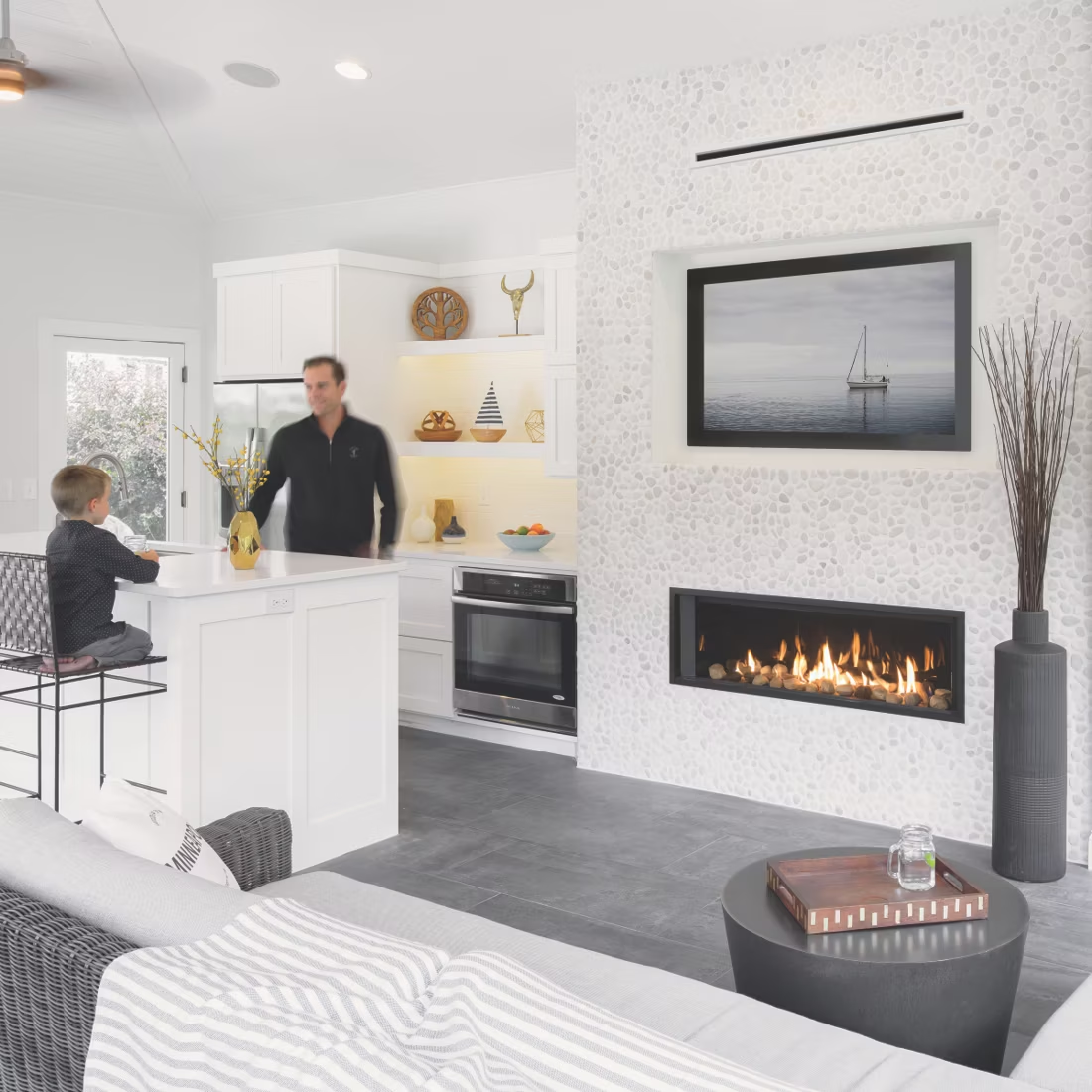
Yes—with an asterisk. Fireplaces are hot and TVs don't like heat. Either put a mantel between them to deflect rising warmth, or choose a fireplace with heat-management technology that creates a cool zone on the wall above—the wall stays around 125 degrees, barely warm, while the room still gets full heat. If you like clean lines and don't want a mantel, heat management is the answer.
Can a fireplace actually lower my heating bill?
Yes—by creating a comfort zone. A furnace heats every square foot of the house just to warm the one room you're in; a gas fireplace on low burns roughly a sixth of the gas a typical furnace does. Set the furnace around 55–60 degrees as a baseline, then heat the rooms your family actually uses. Families who heat this way commonly save $20–$60 a month.
Does a fireplace add value to my home?
On average, a fireplace adds back to the home about the same amount you spent installing it. Add the monthly savings from heating the rooms you actually use instead of the whole house—often hundreds of dollars a year—and the value case is strong before you even count what a fire does for how your family uses the room.
Find your gas fireplace in Kent, Ohio.
Tell us a bit about your home and we'll put together a free Project Guide & Parts List—the right gas fireplace or insert for your space, the exact parts including the vent kit, and a trusted local dealer near Kent to install it.
Find Your Fireplace →