
Instant heat, no chimney required, right here in Dayton.
Zone heat for Dayton's brick two-stories and newer suburban builds alike—plug-in or built-in, matched with a local installer who knows the code.
Every Project Starts From One of These Five Situations
Electric fireplaces plug into Dayton's low-cost power grid.
Dayton sits in climate zone 5A with roughly 5,432 heating degree days a year and winter lows that average around 20°F—cold enough to want supplemental heat in a bedroom or sunroom, but nowhere near the extremes that push a household toward wood or pellet as a primary fuel. That's part of why wood-burning and pellet setups are genuinely uncommon across Montgomery County's mostly urban and suburban zip codes, from downtown's 45402 to the University of Dayton area around 45469—there's little demand and, in many of the denser neighborhoods, little practical space for a chimney or fuel storage.
What does make sense here is electricity, and Dayton Power & Light's residential rate of about 8.5 cents per kWh is well below the national average, which changes the math on running an electric fireplace more than people expect. A built-in wall unit or insert running a few hours a night in a home office or family room costs pennies compared to firing up a whole-house furnace, and there's no gas line, no venting, and no combustion byproducts to worry about—just an outlet or a dedicated circuit, sized correctly by a licensed local electrician.
Three steps. No salesperson until you're ready.
Tell us about your project
Your zip code, your situation, and the fuel you're leaning toward—or let the answers point you to one.
See what's actually available
The brands dealers within 100 miles genuinely carry—real options, never a catalog mirage.
Get your dealer & Project Guide
A trusted local dealer, plus the free Project Guide & Parts List that names every component of the job.
Frequently Asked Questions
How much does an electric fireplace installation cost in Dayton?
A plug-in electric insert or freestanding electric stove that uses a standard 120V outlet typically runs $300 to $1,500 installed, since there's no new wiring involved beyond mounting the unit. A built-in wall unit or a linear electric fireplace set into a new stud wall usually runs $1,500 to $4,000 once you factor in framing, trim work, and a dedicated 20-amp circuit pulled by a licensed electrician—common in Dayton's older homes near downtown where panel capacity is already tight. Local dealers will give you a firm number after seeing your wall and panel.
Do I need a permit to install an electric fireplace in Dayton?
A plug-in unit generally doesn't require a permit since it's treated like any other appliance. If your installation involves running a new dedicated circuit or opening up a wall for a built-in unit, that electrical work does need to go through the City of Dayton's building inspection process (or Montgomery County's, if you're outside city limits), and it has to be pulled by a licensed electrician. Most hearth dealers who install built-in electric units either hold the electrical license themselves or coordinate directly with one, so the permit gets handled as part of the job rather than left to you.
Electric vs. gas fireplace—which makes more sense in Dayton?
Gas is the standard whole-room heating option here, and plenty of Dayton homes already have a gas line for the furnace or water heater, which makes a gas insert or fireplace a natural add-on with real BTU output for a cold January night. Electric fireplaces don't compete on raw heat output for a large, drafty room, but they win on installation simplicity—no venting, no gas line, and a fraction of the cost—and Dayton's below-average electric rate keeps the running cost reasonable for zone heating. Many homeowners here use gas in the main living area and add an electric unit in a bedroom, basement rec room, or home office where a gas line isn't practical.
Why don't more people burn wood or pellets in Dayton?
It's not that wood heat doesn't exist in Montgomery County, but across Dayton's mostly urban and inner-suburban zip codes it's genuinely uncommon—lot sizes are smaller, HOA and city ordinances in denser neighborhoods often restrict solid-fuel appliances, and with moderate winters (around 5,432 heating degree days) there's less pressure to rely on cordwood or pellets as backup heat the way there is in harsher Midwest climates like Minneapolis or Duluth. Electric and gas cover the vast majority of hearth installs in the city proper.
How much does it actually cost to run an electric fireplace in Dayton?
At Dayton Power & Light's residential rate of roughly $0.0854 per kWh, a typical 1,500-watt electric fireplace running on high for five hours a night costs about $0.64 a day, or roughly $19 a month for regular evening use. Most units also run on a lower heat setting or flame-only mode that draws far less power, so if you're using it mainly for ambiance with occasional heat, the monthly cost drops well under $10. That low rate is one of the more practical reasons electric heat pencils out here compared to higher-cost-of-electricity regions.
What size electric fireplace do I need for my room?
Most electric fireplaces top out around 1,500 watts, which translates to roughly 5,000 BTU—enough to comfortably supplement heat in a room up to about 400 square feet, and to take the chill off a larger open space up to 800-1,000 square feet as long as it's not your only heat source. For a primary living room, most Dayton homeowners pair a wide linear electric unit for visual impact with the existing furnace for actual whole-room heating, since electric units are built more for supplemental zone heat and ambiance than for heating an entire home.
Will my home's electrical panel handle a built-in electric fireplace?
It depends on the home. Many of Dayton's older houses near downtown and in first-ring neighborhoods were built with 100-amp panels that are already carrying a full load of appliances, and adding a dedicated 1,500-watt circuit for a built-in fireplace can push things close to capacity. Newer suburban construction typically has 150- or 200-amp service with more headroom. A licensed electrician should check your panel before a built-in install—this is one of the first things a local hearth dealer will ask about, and it's often the deciding factor between recommending a plug-in insert versus a hardwired unit.
What electric fireplace brands are available through local Dayton dealers?
Local hearth and fireplace dealers in the Dayton area typically carry established electric fireplace lines like Napoleon, Dimplex, and Amantii, which cover everything from compact insert units to wide linear wall fireplaces with realistic flame technology. Availability varies by dealer and by what's currently stocked versus special-order, so the specific model and finish options are best confirmed with the local dealer you're matched with rather than assumed from a manufacturer's website.
Are there rebates for installing an electric fireplace in Dayton?
Electric fireplaces are usually classified as supplemental or decorative heat rather than a primary heating system, so they typically don't qualify for the same efficiency rebates as a heat pump or furnace upgrade. That said, it's worth checking directly with Dayton Power & Light for any current residential efficiency programs, since utility rebate offerings change from year to year and occasionally include electric space-heating equipment. A local dealer can also tell you if a specific model you're considering has qualified for any regional program in the past.
Can I put a TV above my fireplace?
Yes—with an asterisk. Fireplaces are hot and TVs don't like heat. Either put a mantel between them to deflect rising warmth, or choose a fireplace with heat-management technology that creates a cool zone on the wall above—the wall stays around 125 degrees, barely warm, while the room still gets full heat. If you like clean lines and don't want a mantel, heat management is the answer.
Does an electric fireplace need a vent or chimney?
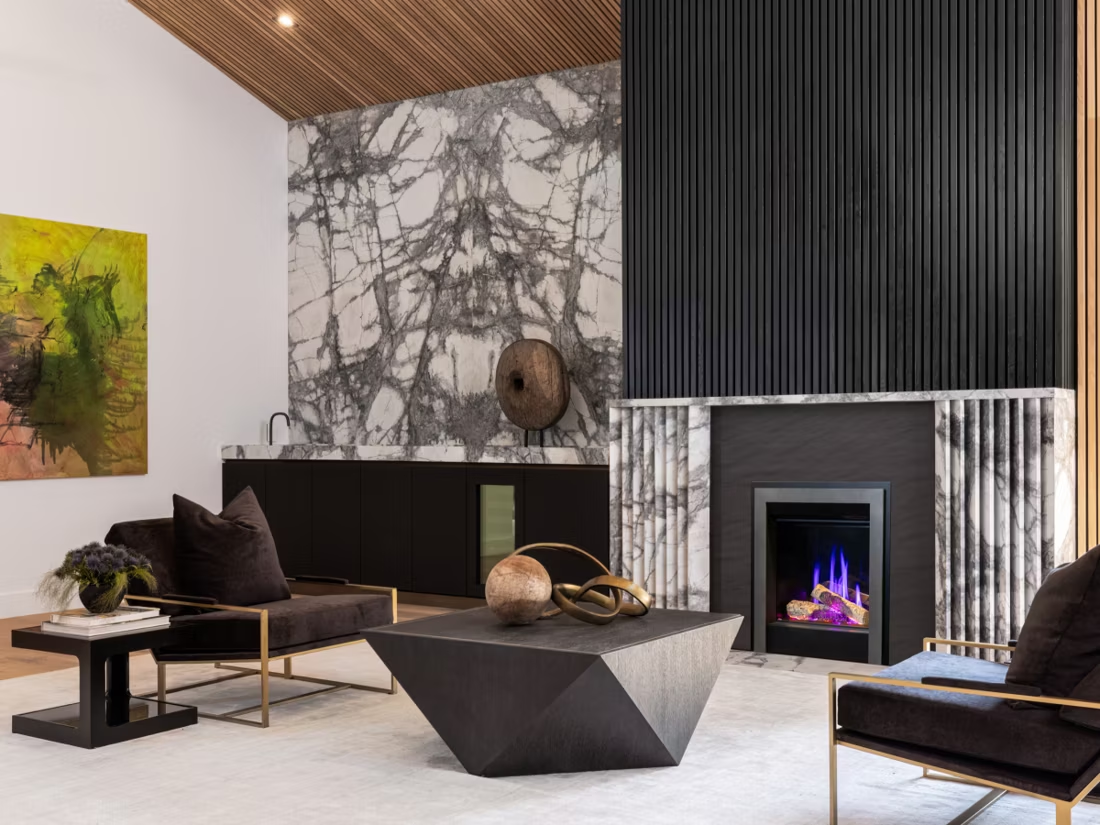
No—that's its superpower. An electric fireplace needs a wall and an outlet, period. No vent pipe, no gas line, no clearances to design around, which is why it works in bedrooms, offices, apartments, and walls where venting a gas or wood unit would be impractical or impossible. Installation is typically the simplest and least expensive of any fireplace type.
How much should I budget for a fireplace?
For an average home—covering the fireplace, the vent pipe, and basic installation—a budget between $3,900 and $5,500 gives you a lot of options across wood, gas, and pellet. By the time you add finish work, gas line, and electrical, the average complete installation lands between $5,000 and $12,000 all-in. In a remodel or new build, a good rule is to put about 2.5% of the total project cost toward the fireplace.
Can a fireplace actually lower my heating bill?
Yes—by creating a comfort zone. A furnace heats every square foot of the house just to warm the one room you're in; a gas fireplace on low burns roughly a sixth of the gas a typical furnace does. Set the furnace around 55–60 degrees as a baseline, then heat the rooms your family actually uses. Families who heat this way commonly save $20–$60 a month.
Nearby Dealers
Hearth shops serving Dayton and the surrounding area. Every listing shows whether it is a WhyFire partner, a dealer we have verified as authorized for the brands we recommend, or a local business carrying hearth products. No manufacturer pays for placement. How we verify dealers →
Ye Olde Chimney Sweep & Sons, Ltd.
Bells Fireplace Services
Dayton Fireplace Systems Inc.
Watson's Of Dayton
Southlite Fan City
Abbey Road Chimney Sweep
Chimney Solutions LLC
Moseley Stove Shop
Creative Fires, LLC
Ted's Chimney Service
Cloverleaf Mechanical
Fireside Radiant
Electric Service in Dayton
An electric fireplace's heater draws about 1,500 watts—pennies per hour at local rates.
Dayton Power & Light Co
Find your electric fireplace in Dayton.
Tell us a bit about your home and we'll match you with the right electric fireplace, insert, or wall unit—plus a free Project Guide & Parts List and a trusted local Dayton dealer to install it.
Find Your Fireplace →