
Real Warmth for Cortland's Long Winters, No Chimney Required.
With a long, Buffalo-style winter and Ohio Edison's below-average residential rate, electric heat is a practical way to add warmth to a Trumbull County home without venting, wood, or a gas line.
Every Project Starts From One of These Five Situations
A clean, plug-in answer to Cortland's snowbelt winters.
Cortland sits in Trumbull County at roughly 1,040 feet, close enough to Lake Erie's snowbelt that winter lows average 18°F and the heating season runs long—winters about as long and cold as Buffalo, NY. On tight village lots and in the smaller homes common around Cortland's 44410 zip code, cutting and stacking a winter's worth of firewood isn't practical for most households, and wood heat has never been the go-to fuel here the way it is farther out in rural Ohio.
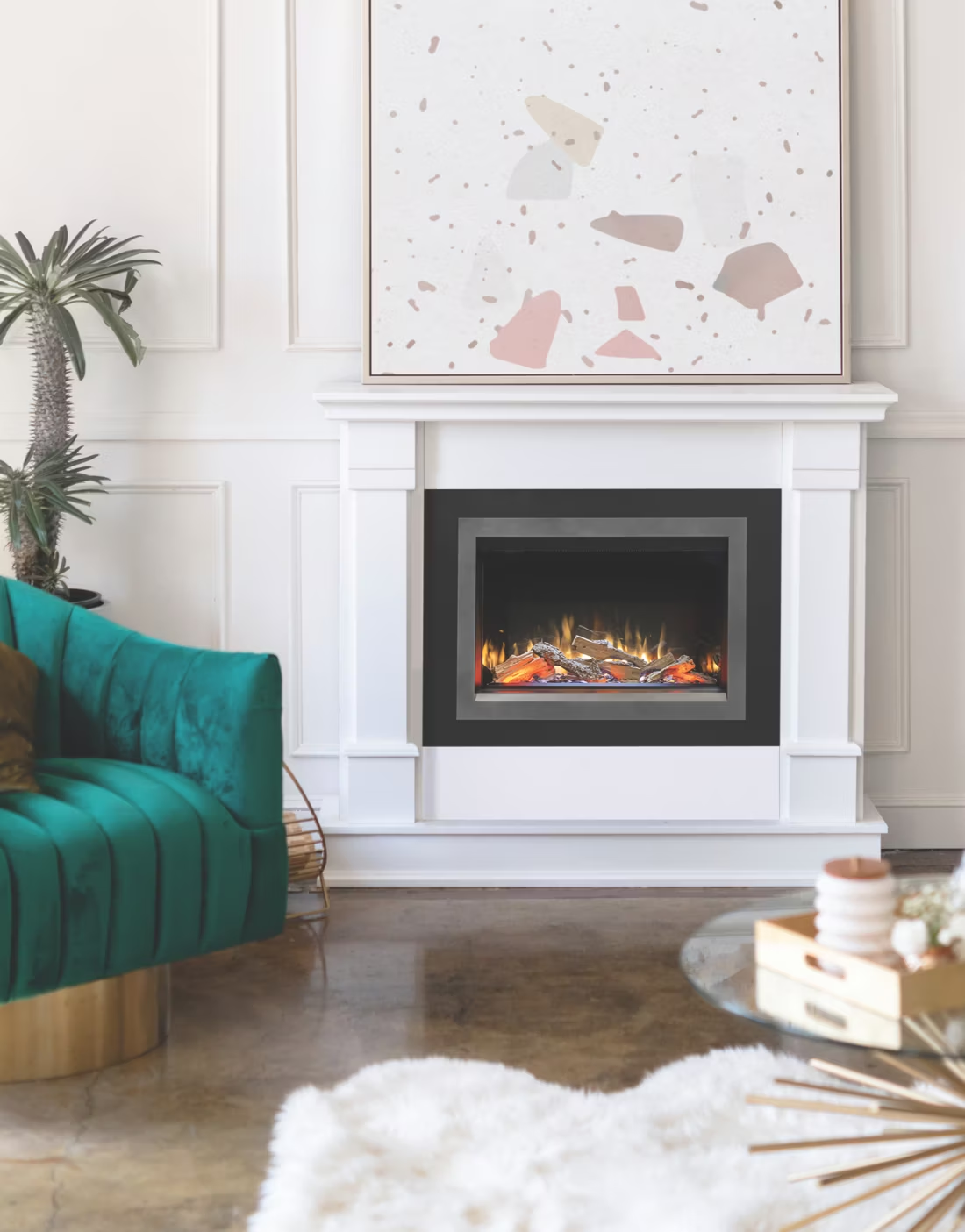
Instead, most Cortland homeowners lean on natural gas or propane for whole-house heat and use electric fireplaces to add zone heat and ambiance where it's actually needed—a family room, a finished basement, a bedroom that never quite warms up. Because Ohio Edison's residential rate runs about $0.0955 per kWh, well under the national average, running an electric unit for supplemental heat during Cortland's long shoulder seasons doesn't carry the sting it would in higher-rate markets. No chimney, no venting, no gas line—just a unit, an outlet or circuit, and a wall.
Three steps. No salesperson until you're ready.
Tell us about your project
Your zip code, your situation, and the fuel you're leaning toward—or let the answers point you to one.
See what's actually available
The brands dealers within 100 miles genuinely carry—real options, never a catalog mirage.
Get your dealer & Project Guide
A trusted local dealer, plus the free Project Guide & Parts List that names every component of the job.
Frequently Asked Questions
How much does it cost to install an electric fireplace in Cortland?
Plug-in electric fireplace inserts and freestanding stoves typically run $150 to $600 for the unit itself, with no professional installation required beyond plugging into an existing outlet. Built-in linear electric fireplaces—the kind recessed into a wall or media console opening—run $1,500 to $4,000 installed once you factor in the unit, any framing or wall-cutting, and an electrician running a dedicated circuit if the unit calls for one. Either way, costs stay well below wood or gas projects in Cortland, since there's no chimney, venting, or gas line to install.
What does it actually cost to run an electric fireplace here?
Most electric fireplaces draw around 1,500 watts on their highest heat setting. At Ohio Edison's residential rate of $0.0955 per kWh, that works out to roughly $1.15 for 8 hours of use—about $34 a month if you run it daily through the coldest stretch of Cortland's heating season. That's noticeably cheaper than the same unit would cost in a market paying the national average rate of around $0.16 per kWh, which is one reason electric zone heating pencils out reasonably well for Trumbull County homeowners even with a long, Buffalo-style winter to cover.
Do I need a permit to install an electric fireplace in Cortland?
A plug-in unit that runs off an existing outlet typically needs no permit at all. If you're installing a built-in linear fireplace that requires a new dedicated circuit or hardwired connection, that electrical work should go through the Village of Cortland or Trumbull County Building Department and be performed by a licensed electrician per code. Cutting into a wall to recess a unit may also trigger a building permit if it involves structural framing—your installer or electrician can tell you which applies to your specific project.
Can an electric fireplace be my main source of heat?
Not realistically for a whole Cortland home. With winters about as long and cold as Buffalo, NY, and lows averaging 18°F, running enough electric resistance heat to cover an entire house all winter gets expensive fast, even at Ohio Edison's relatively low rate. Most local homeowners use electric fireplaces the way they're best suited to be used—as zone heat for a specific room, like a basement rec room or a converted garage—while a gas furnace or boiler handles the whole-house load.
Electric vs. gas fireplace—which makes more sense for my Cortland home?
Gas fireplaces are common in this part of Trumbull County and deliver real, substantial heat output plus operation during power outages if you choose a battery-backup or Valor-style self-powered ignition model. Electric fireplaces trade that heat output for simplicity: no gas line, no venting, no combustion byproducts, and a lower install cost. If you want a genuine secondary heat source for a chilly room, gas is usually the stronger performer. If you want ambiance, flexibility, and an easy retrofit into an apartment, rental, or a room where running gas line isn't practical, electric is the better fit.
Can I convert my existing wood-burning fireplace to electric?
Yes, and it's a common project in Cortland's older housing stock. Many homes here have masonry fireplaces originally built to burn the oak, hickory, maple, and cherry that's common firewood in this part of Ohio. An electric insert can drop directly into that existing firebox opening, plugging into a nearby outlet or a new dedicated circuit, without any chimney sweeping, liner work, or wood handling. It's a popular option for homeowners who inherited a fireplace they no longer want to maintain but still want the visual of a fire.
Are electric fireplaces safe around kids and pets?
Generally yes, more so than wood or gas units. Most electric fireplaces use LED flame-effect technology behind cool-touch glass, so there's no open flame, no hot glass surface, and no carbon monoxide to worry about—which also means no need for the combustion-appliance precautions that come with a wood stove or gas insert. If the unit will sit near a bathroom or other damp area, it should still be installed on a GFCI-protected circuit, which any licensed electrician handling the install will know to do.
What's a good electric fireplace for Cortland's climate?
For zone heating through Cortland's long shoulder seasons, look at linear electric inserts from brands like Dimplex, Napoleon, or Touchstone, which let you run the flame effect on its own without heat—useful in October or April when you want ambiance but the furnace already has the house covered. For rooms that genuinely run cold, look for units rated for larger square footage with a stated BTU output in the 4,000–5,000 range, which will do real work heating a den or finished basement rather than just looking good.
What's the difference between an electric fireplace, insert, and stove?
An electric fireplace is typically a built-in unit recessed into a wall or cabinet opening, an electric insert is sized to drop into an existing masonry firebox, and an electric stove is a freestanding unit styled like a traditional wood stove that can sit anywhere near an outlet. All three work the same way—electric resistance heat plus an LED flame effect—so the choice mostly comes down to what kind of opening or space you're working with in your Cortland home rather than any real difference in performance.
Can I put a TV above my fireplace?
Yes—with an asterisk. Fireplaces are hot and TVs don't like heat. Either put a mantel between them to deflect rising warmth, or choose a fireplace with heat-management technology that creates a cool zone on the wall above—the wall stays around 125 degrees, barely warm, while the room still gets full heat. If you like clean lines and don't want a mantel, heat management is the answer.
Do electric fireplaces actually produce heat?
Yes—most put out around 4,800–5,000 BTUs from a standard outlet, which comfortably warms a bedroom, office, or den as a comfort-zone heater. What they won't do is carry a whole house the way wood, gas, or pellet can. Think of electric as ambiance-first with honest supplemental heat: flames on with no heat in July, flames plus warmth in January.
What is an in-home preview and do I need one?
It's a visit where a hearth professional measures your space, confirms the model you picked actually works in your home, and walks the specs—framing, gas line, venting, finish work—before anything is ordered. Some details you just can't know until you see the house. Never make a down payment without one; it's the single most-skipped step that burns buyers.
Can a fireplace actually lower my heating bill?
Yes—by creating a comfort zone. A furnace heats every square foot of the house just to warm the one room you're in; a gas fireplace on low burns roughly a sixth of the gas a typical furnace does. Set the furnace around 55–60 degrees as a baseline, then heat the rooms your family actually uses. Families who heat this way commonly save $20–$60 a month.
Nearby Dealers
Hearth shops serving Cortland and the surrounding area. Every listing shows whether it is a WhyFire partner, a dealer we have verified as authorized for the brands we recommend, or a local business carrying hearth products. No manufacturer pays for placement. How we verify dealers →
We’ve paused dealer listings for this connection today. Enter your zip or postal code above to find dealers near you, or come back tomorrow.
Popular Electric Brands
Where each brand came from, what's inside it today, and every current model. No brand pays to be here. Not every dealer carries every brand, so enter your zip code to see what's sold near Cortland.
Fireplace Xtrordinair
Fireplace Xtrordinair, now often called FireplaceX, is the fireplace brand of Travis Industries, Inc., of Mukilteo, Washington.
5 electric models →DaVinci
DaVinci Custom Fireplaces is a brand of Travis Industries, Inc., of Mukilteo, Washington, the company behind Lopi and Fireplace Xtrordinair.
5 electric models →Kozy Heat
Kozy Heat was founded in 1976 by Dudley Hussong in Lakefield, Minnesota, and incorporated as Hussong Manufacturing Co., Inc. in 1978.
3 electric models →Forge & Flame
Forge & Flame is the stove brand Hearth & Home Technologies introduced in August 2023 to bring Vermont Castings, Harman, and Quadra-Fire under one name.
1 electric model →Electric Service in Cortland
An electric fireplace's heater draws about 1,500 watts—pennies per hour at local rates.
Ohio Edison Co
Find your electric fireplace in Cortland.
Tell us about your home and we'll help you find a trusted local dealer near Cortland, plus a free Project Guide & Parts List—the exact parts for your electric fireplace project and who locally can install it right.
Find Your Fireplace →