
Warmth you can flip on—even when it's 30 below.
Burke County's population is under 1,000 and its winters rank among the harshest in the Lower 48. Find the right electric fireplace or insert for supplemental zone heat, and get matched with a trusted local dealer who can wire it in correctly.
Every Project Starts From One of These Five Situations
Zone heat for a Zone 7 winter.
Burke County sits in North Dakota's northwest corner along the Canadian border, home to just under 1,000 residents spread across the county seat of Bowbells and a handful of unincorporated communities. The county falls in IECC climate zone 7—the same severe-cold classification used for interior Alaska and the coldest pockets of the Upper Midwest—with a heating season more than double what a place like Minneapolis sees. Winters run long, dry, and bitterly cold, with wind chills that make even short stretches outdoors dangerous.
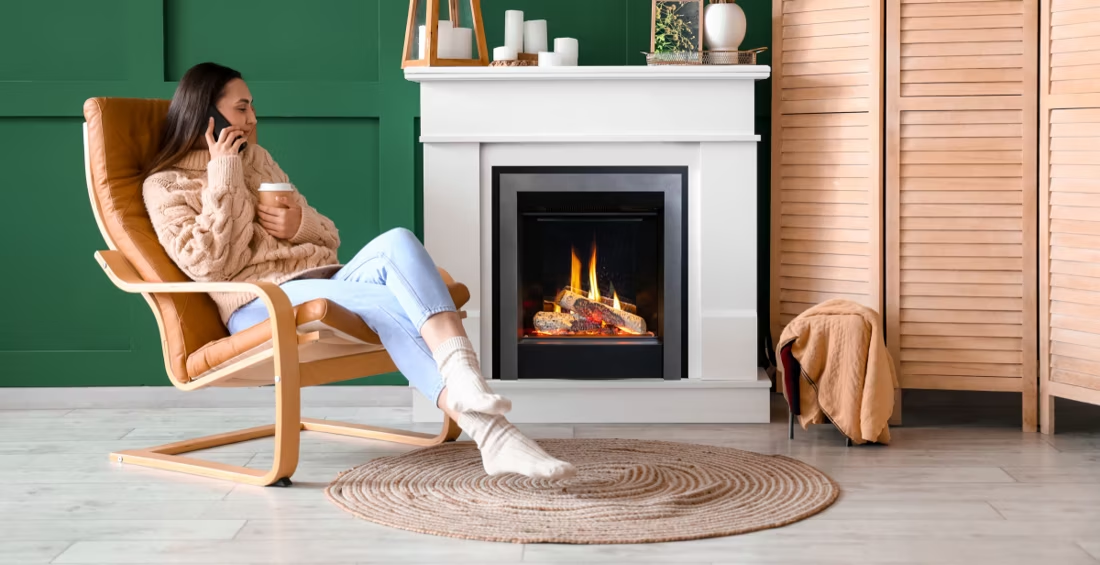
Given those numbers, most Burke County homes lean on propane furnaces or dual-fuel systems for whole-house heat, with Burke-Divide Electric Cooperative supplying the power that keeps those systems—and everything else—running. Electric fireplaces fit into that picture as supplemental zone heat rather than a primary source: a den or living room gets a quartz infrared insert that adds instant, focused warmth on top of the furnace, without the cost or hassle of running gas lines or building a chimney in a county with no hearth retailer of its own. Wood stoves are largely absent here—there's no public timber land to speak of, and residents who do burn local oak, cottonwood, or ash firewood mostly use it for outdoor fire pits rather than home heating.
Three steps. No salesperson until you're ready.
Tell us about your project
Your zip code, your situation, and the fuel you're leaning toward—or let the answers point you to one.
See what's actually available
The brands dealers within 100 miles genuinely carry—real options, never a catalog mirage.
Get your dealer & Project Guide
A trusted local dealer, plus the free Project Guide & Parts List that names every component of the job.
Frequently Asked Questions
How much does an electric fireplace installation cost in Burke County?
Because Burke County has no local hearth retailer, most installs are handled by an electrician or a dealer traveling in from Minot or Williston. A basic plug-in electric insert or wall-mount unit typically runs $200 to $600 installed, since it just needs a standard 120V outlet. A hardwired built-in electric fireplace—the more common choice for a permanent living-room installation—usually runs $1,200 to $3,000 once a dedicated circuit, in-wall wiring, and finish carpentry are factored in. Travel time from Minot, about an hour south, or Williston is often added to the quote, so it pays to bundle the fireplace work with other electrical projects if you're already having someone out.
Can an electric fireplace heat my whole house in Burke County?
No—and any installer worth hiring will tell you the same. Most electric fireplaces top out around 5,000 to 10,000 BTUs, enough to noticeably warm a single room but nowhere near enough to carry a home through a Zone 7 North Dakota winter on its own. Burke County's winter heating load is among the highest in the Lower 48, closer to what you'd expect in International Falls, Minnesota, than a typical Midwest county. Plan on your electric fireplace as supplemental heat layered on top of your propane furnace or dual-fuel system, not a replacement for it.
Do I need a permit to install an electric fireplace in Burke County?
Burke County does not enforce a county-wide building code, so there's typically no permit pulled for a plug-in unit or even most built-in installations outside city limits. That said, any hardwired unit should still be installed to National Electrical Code standards—a dedicated circuit sized correctly, proper breaker protection, and a junction box installed by a licensed electrician. Skipping that step can void your homeowner's insurance if something goes wrong, even without a permit requirement forcing the issue.
Will my electric fireplace still work if the power goes out?
No. Electric fireplaces run entirely on electricity—no battery backup, no standing pilot, nothing that works without grid power. That matters in a county served by a single rural cooperative, Burke-Divide Electric, where an ice storm or a downed line during a January cold snap can mean hours without power. Homes here that want heat during an outage typically rely on a propane furnace with a standing pilot or a generator, not the electric fireplace. Think of the electric unit as everyday convenience heat, not emergency heat.
What's the difference between an electric insert, built-in, and freestanding electric fireplace?
An electric insert drops into an existing fireplace opening or a cabinet cutout and plugs in or hardwires depending on the model. A built-in unit is framed into a wall during construction or remodeling for a flush, finished look. A freestanding or wall-mount unit needs no construction at all—just an outlet or, for larger units, a dedicated circuit. In Burke County, where a meaningful share of housing is manufactured or modular, freestanding and wall-mount units are the most common choice, since they don't require reworking wall framing that was never built around a masonry chimney to begin with.
What kind of electric fireplace works best for Burke County's cold?
Look for a unit with a quartz infrared or ceramic heating element rated at the roughly 5,000-BTU, 1,500-watt range most residential electric fireplaces max out at—that's the ceiling for how much supplemental heat you'll actually get. Multi-function models that run the flame effect without the heater engaged are worth considering too, since Burke County's shoulder seasons don't call for the heating element at all. Given how extreme the cold gets here, pair the fireplace with a well-sealed room rather than expecting it to fight drafts in an older farmhouse.
Where can I buy and install an electric fireplace near Burke County?
With a population under 1,000 spread across the whole county, Burke County doesn't support its own hearth or appliance retailer. Most residents source electric fireplaces through retailers in Minot, roughly an hour south, or through electricians and general contractors who handle the installation as part of a broader remodel. This is exactly the gap Find My Fireplace fills—we match you with a trusted dealer who actually services this part of northwestern North Dakota, rather than leaving you to guess which Minot or Williston retailer will show up for a Bowbells address.
How much maintenance does an electric fireplace need?
Very little compared to wood or gas. There's no chimney to sweep, no gas line to inspect, and no ash to clean up. Periodically dust the vents and heating element, and check the bulb or LED light source on flame-effect models every few years. That low-maintenance profile is part of why electric units are popular in Burke County's rental properties and second homes, where nobody's checking on the unit weekly.
Electric vs. propane fireplace—which makes more sense in Burke County?
Propane fireplaces and inserts put out real heat—often 20,000 to 40,000 BTUs—and can be set up to keep running during a power outage with a standing pilot, which matters given how remote parts of Burke County are from utility crews. Electric fireplaces can't compete on heat output or outage performance, but they install in an afternoon with no gas line or tank, cost less upfront, and work anywhere there's an outlet. For primary supplemental heat in a Zone 7 winter, propane usually wins. For ambiance, a quick heat boost in a home office or bedroom, or a rental unit where a gas line isn't practical, electric is the simpler answer.
Can I put a TV above my fireplace?
Yes—with an asterisk. Fireplaces are hot and TVs don't like heat. Either put a mantel between them to deflect rising warmth, or choose a fireplace with heat-management technology that creates a cool zone on the wall above—the wall stays around 125 degrees, barely warm, while the room still gets full heat. If you like clean lines and don't want a mantel, heat management is the answer.
Do electric fireplaces actually produce heat?
Yes—most put out around 4,800–5,000 BTUs from a standard outlet, which comfortably warms a bedroom, office, or den as a comfort-zone heater. What they won't do is carry a whole house the way wood, gas, or pellet can. Think of electric as ambiance-first with honest supplemental heat: flames on with no heat in July, flames plus warmth in January.
How much should I budget for a fireplace?
For an average home—covering the fireplace, the vent pipe, and basic installation—a budget between $3,900 and $5,500 gives you a lot of options across wood, gas, and pellet. By the time you add finish work, gas line, and electrical, the average complete installation lands between $5,000 and $12,000 all-in. In a remodel or new build, a good rule is to put about 2.5% of the total project cost toward the fireplace.
Can I install a fireplace myself?
If you're putting a fire in your house on purpose, it's best to work with an expert. Unless you're genuinely experienced in framing, gas line, vent pipe, and the national code on clearances to combustibles, have a professional do it—and ideally the same company that sells you the fireplace, so warranty, service, and liability all live under one roof.
Find your electric fireplace in Burke County.
Tell us about your home and we'll match you with a trusted local dealer and send over your free Project Guide & Parts List—the exact parts and recommended dealer for your Burke County electric fireplace project.
Find Your Fireplace →