
Instant Heat for Sawmills Homes—No Venting, No Wood, No Wait.
Zone heat and real ambiance for Caldwell County's mild foothills winters—plug it in or wire it in, and skip the chimney entirely. Find a trusted local dealer.
Every Project Starts From One of These Five Situations
The foothills here don't demand a chimney.
Sawmills sits at about 1,180 feet in the Blue Ridge foothills of Caldwell County, with winter lows averaging around 30°F and a heating season that's comparatively short and mild. That's a genuinely mild climate zone (4A) compared to places like Burlington, VT or Duluth, MN—the kind of cold where a wood stove or gas furnace has to carry the whole house through months of hard freeze. Here, an electric fireplace isn't a compromise; it's often the right tool for a bonus room, sunroom addition, or primary bedroom that the central system doesn't quite reach.
Electric service in Sawmills is split between Duke Energy Carolinas and Blue Ridge Electric Membership Corporation, the rural co-op that covers much of Caldwell County outside town limits. At rates of roughly 13.9 to 14.6 cents per kWh, running an electric fireplace on high (typically a 1,500-watt draw) costs somewhere around 20 to 22 cents an hour—cheap zone heat with no wood to split, no flue to sweep, and nothing to burn down a Caldwell County home in a manufactured-housing park or a tight new-construction addition where a masonry chimney was never in the plans.
Three steps. No salesperson until you're ready.
Tell us about your project
Your zip code, your situation, and the fuel you're leaning toward—or let the answers point you to one.
See what's actually available
The brands dealers within 100 miles genuinely carry—real options, never a catalog mirage.
Get your dealer & Project Guide
A trusted local dealer, plus the free Project Guide & Parts List that names every component of the job.
Frequently Asked Questions
How much does an electric fireplace cost to install in Sawmills?
It depends heavily on the unit type. A freestanding or wall-mount electric fireplace that plugs into a standard outlet typically runs $150 to $800 for the unit itself, with no real installation cost beyond hanging it. A built-in electric fireplace set into a framed wall or mantel surround runs $1,000 to $3,500 once you factor in framing, trim work, and—if you need a dedicated circuit—an electrician. An electric insert dropped into an existing masonry fireplace opening (common in older Sawmills and Lenoir-area homes) usually lands between $800 and $2,500. None of these require chimney work, which is the biggest cost saver compared to wood or gas.
Do I need a permit to install an electric fireplace in Sawmills?
In most cases, no. A plug-in electric fireplace that uses an existing outlet doesn't trigger a permit through Caldwell County Building Inspections. If your installer adds a new dedicated 120V or 240V circuit, or does structural framing to build in a mantel unit, that electrical work typically does require a permit pulled by a licensed electrician. A reputable local dealer will tell you upfront whether your specific install crosses that line—it's usually only the larger built-in units that do.
How much does it actually cost to run an electric fireplace here?
Most electric fireplaces draw about 1,500 watts on their highest heat setting, which works out to 1.5 kWh per hour of use. At Duke Energy Carolinas' residential rate of roughly 13.94 cents per kWh, that's about 21 cents an hour. Blue Ridge Electric Membership Corporation customers, at roughly 14.59 cents per kWh, land closer to 22 cents an hour. Either way, running one for an evening in a bonus room or den costs well under a dollar—a fraction of heating that same space with central HVAC.
Electric insert vs. wood insert—which makes sense for my Sawmills home?
A wood insert burns local oak, hickory, or maple—species that are plentiful in this part of the foothills, and cuttable for around $20 a cord through Nantahala-Pisgah National Forest permits between May and October. Wood delivers serious BTUs and keeps working during a power outage, which matters more in areas with frequent ice-storm outages than it does here given Sawmills' relatively mild, short winter heating season. An electric insert skips the wood handling, chimney sweeping, and creosote entirely, but tops out around 5,000 to 9,000 BTU and goes dark the moment the power does. For a primary fireplace that gets daily use with minimal fuss, electric is hard to beat here; for a home that wants backup heat during winter storms, wood still has the edge.
What's the best electric fireplace for a Sawmills home?
For most homes here, a mid-size built-in or insert from Dimplex, Napoleon, or Touchstone covers a bonus room or den comfortably without needing a dedicated circuit. Manufactured and modular homes, which are common throughout rural Caldwell County, do well with lightweight wall-mount units that avoid adding load-bearing framing. If you're heating a larger open-concept living area, talk to a local dealer about a unit with a higher-wattage heater kit—but keep in mind electric heat output is capped by what a standard outlet or circuit can deliver, so it's best suited to zone heating rather than whole-house duty.
Why choose electric instead of gas in Sawmills?
Natural gas service is limited in this part of Caldwell County, and a lot of homes here already run on propane or heat pumps rather than piped gas. An electric fireplace sidesteps that question entirely—no gas line to run, no propane tank to maintain, and no combustion byproducts to vent. For homeowners who already have electric heat pumps and don't want to add a second fuel source just for a fireplace, electric is usually the simpler path, even if it can't match a gas unit's higher heat output on the coldest nights.
Is an electric fireplace safe around kids and pets?
Generally yes, more so than wood or gas. Most electric models use cool-touch glass and an LED flame effect rather than an actual flame, so there's no open combustion, no carbon monoxide risk, and no hot glass surface to worry about. That makes them a common choice for family rooms, rentals, and homes with small children in Sawmills where a real wood-burning unit might be more supervision than a household wants. Always check the specific model's surface temperature rating, since some higher-output units do run warmer than the basic LED display units.
How do I know if I'm on Duke Energy or Blue Ridge Electric?
Sawmills sits in a coverage overlap area—Duke Energy Carolinas serves parts of town closer to Lenoir, while Blue Ridge Electric Membership Corporation, the local rural co-op, covers much of the surrounding county. The fastest way to check is your existing power bill or meter, since rates and any efficiency rebate programs differ slightly between the two. A local hearth dealer sizing your electrical needs will usually ask which utility serves your address before recommending a unit that needs a dedicated circuit.
Electric vs. wood stove—which is right for my home?
Wood stoves burning local oak or hickory put out far more heat per hour and keep running when the power lines don't—a real consideration during a Caldwell County ice storm. Electric fireplaces can't touch that BTU ceiling and go dark in an outage, since they need the very grid they're meant to supplement. But Sawmills' winters are mild by national standards, averaging a 30°F low with a short, mild heating season, so most households here don't need a primary wood-burning heat source—they want ambiance and quick zone heat in a specific room. For that job, with no chimney, no wood stacking, and pennies-per-hour running costs from Duke Energy or Blue Ridge Electric, electric is usually the more practical everyday choice.
Can I put a TV above my fireplace?
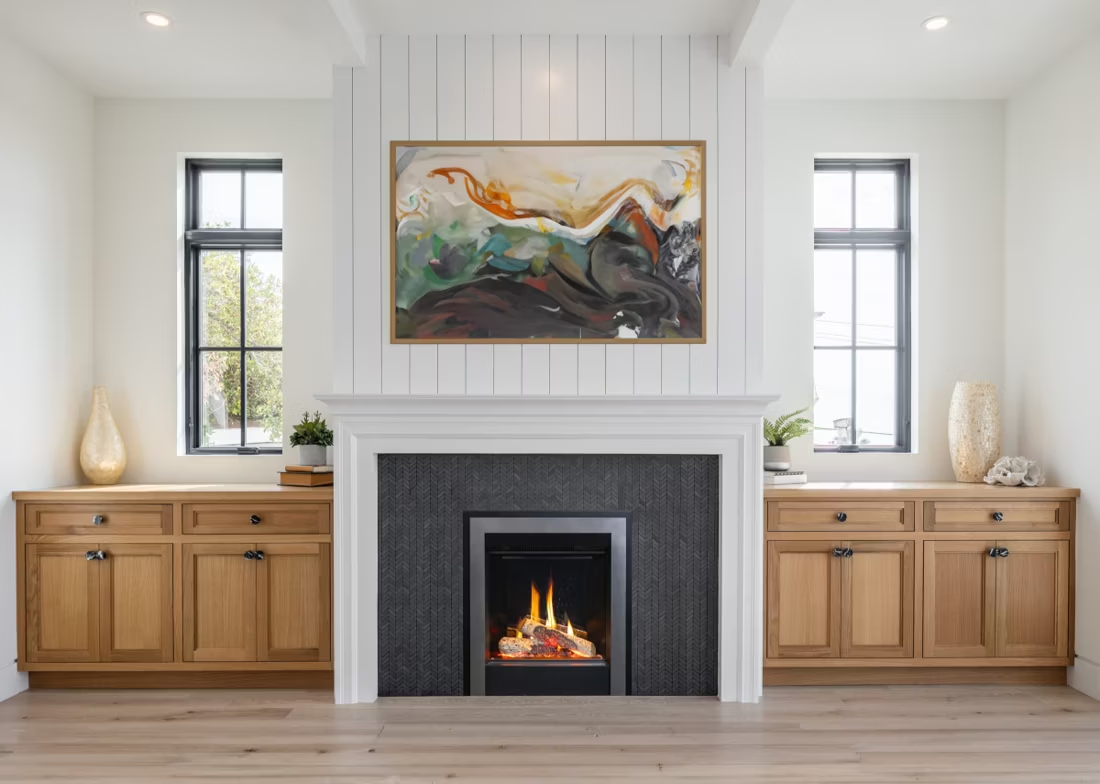
Yes—with an asterisk. Fireplaces are hot and TVs don't like heat. Either put a mantel between them to deflect rising warmth, or choose a fireplace with heat-management technology that creates a cool zone on the wall above—the wall stays around 125 degrees, barely warm, while the room still gets full heat. If you like clean lines and don't want a mantel, heat management is the answer.
Does an electric fireplace need a vent or chimney?
No—that's its superpower. An electric fireplace needs a wall and an outlet, period. No vent pipe, no gas line, no clearances to design around, which is why it works in bedrooms, offices, apartments, and walls where venting a gas or wood unit would be impractical or impossible. Installation is typically the simplest and least expensive of any fireplace type.
Can a fireplace actually lower my heating bill?
Yes—by creating a comfort zone. A furnace heats every square foot of the house just to warm the one room you're in; a gas fireplace on low burns roughly a sixth of the gas a typical furnace does. Set the furnace around 55–60 degrees as a baseline, then heat the rooms your family actually uses. Families who heat this way commonly save $20–$60 a month.
Can I install a fireplace myself?
If you're putting a fire in your house on purpose, it's best to work with an expert. Unless you're genuinely experienced in framing, gas line, vent pipe, and the national code on clearances to combustibles, have a professional do it—and ideally the same company that sells you the fireplace, so warranty, service, and liability all live under one roof.
Nearby Dealers
Hearth shops serving Sawmills and the surrounding area. Every listing shows whether it is a WhyFire partner, a dealer we have verified as authorized for the brands we recommend, or a local business carrying hearth products. No manufacturer pays for placement. How we verify dealers →
We’ve paused dealer listings for this connection today. Enter your zip or postal code above to find dealers near you, or come back tomorrow.
Popular Electric Brands
Where each brand came from, what's inside it today, and every current model. No brand pays to be here. Not every dealer carries every brand, so enter your zip code to see what's sold near Sawmills.
Fireplace Xtrordinair
Fireplace Xtrordinair, now often called FireplaceX, is the fireplace brand of Travis Industries, Inc., of Mukilteo, Washington.
5 electric models →DaVinci
DaVinci Custom Fireplaces is a brand of Travis Industries, Inc., of Mukilteo, Washington, the company behind Lopi and Fireplace Xtrordinair.
5 electric models →Kozy Heat
Kozy Heat was founded in 1976 by Dudley Hussong in Lakefield, Minnesota, and incorporated as Hussong Manufacturing Co., Inc. in 1978.
3 electric models →Forge & Flame
Forge & Flame is the stove brand Hearth & Home Technologies introduced in August 2023 to bring Vermont Castings, Harman, and Quadra-Fire under one name.
1 electric model →Electric Service in Sawmills
An electric fireplace's heater draws about 1,500 watts—pennies per hour at local rates.
Duke Energy Carolinas, LLC
Blue Ridge Elec Member Corp - (Nc)
Find your electric fireplace in Sawmills.
Tell us a bit about your home and we'll help you find a trusted local dealer and send over a free Project Guide & Parts List—sized to your room, your circuit, and your budget.
Find Your Fireplace →