
Warmth Without the Chimney, Right Here in River Bend.
River Bend's mild Neuse River winters rarely call for a wood or pellet setup. An electric fireplace gives you real ambiance and zone heat without venting, gas lines, or a chimney.
Every Project Starts From One of These Five Situations
Electric heat fits River Bend's mild winters.
At 7 feet above sea level along the Neuse River, River Bend sits squarely in climate zone 3A, with an average winter low of 35°F and a mild, short winter heating season. Compare that to a place like Duluth, MN, which has a much longer and far colder winter—and it's clear why full wood-burning setups and pellet stoves are rare here. Most River Bend homes lean on central heat pumps for the bulk of their winter heating, which leaves electric fireplaces to do what they do best: supplemental warmth in a den, sunroom, or waterfront living area, plus the look of a fire without smoke, ash, or a masonry chimney.
River Bend homes are served by a mix of providers—Duke Energy Progress, Tideland Electric Membership Corporation, and the City of New Bern's municipal utility—with residential rates ranging from about $0.1265 to $0.1618 per kWh depending on which one serves your address. Because electric fireplaces don't need venting or a gas line, installation is usually a matter of an outlet or, for built-in units, a dedicated circuit—work that's straightforward for a licensed electrician and doesn't involve the permitting hurdles that come with wood or gas appliances.
Three steps. No salesperson until you're ready.
Tell us about your project
Your zip code, your situation, and the fuel you're leaning toward—or let the answers point you to one.
See what's actually available
The brands dealers within 100 miles genuinely carry—real options, never a catalog mirage.
Get your dealer & Project Guide
A trusted local dealer, plus the free Project Guide & Parts List that names every component of the job.
Frequently Asked Questions
How much does an electric fireplace installation cost in River Bend?
A plug-in freestanding or wall-mount electric fireplace can run as little as $150 to $600 for the unit itself, since it plugs into a standard outlet with no professional install required. Built-in electric inserts or linear wall units that need a dedicated 20-amp circuit typically run $800 to $2,500 once you factor in the unit, an electrician to run the new circuit, and any surround or mantel finish work. Homes on the older side of River Bend near the Neuse sometimes need panel capacity checked before adding a dedicated circuit, which a local electrician can confirm during a quick site visit.
Do I need a permit to install an electric fireplace in River Bend?
A plug-in unit that uses an existing outlet doesn't require a permit. If you're installing a built-in insert or wall unit that needs a new dedicated circuit, that electrical work does require a permit, which in River Bend is handled through the Craven County Inspections Department. Most licensed electricians and hearth dealers pull this permit as part of the installation, so it's rarely something homeowners have to manage themselves.
Which electric utility will affect my running cost—Duke Energy, Tideland Electric, or the City of New Bern?
It depends on your specific address in River Bend, since Duke Energy Progress, Tideland Electric Membership Corporation, and the City of New Bern's municipal utility all serve different pockets of Craven County. Rates vary meaningfully: Duke Energy Progress runs about $0.1554/kWh, Tideland (a rural electric co-op) runs closer to $0.1618/kWh, and City of New Bern customers pay the least at roughly $0.1265/kWh. In practice this is a small difference for a fireplace—a typical 1,500-watt unit costs somewhere between 19 and 24 cents an hour to run regardless of provider—but it's worth knowing which utility bills you if you're comparing operating costs against a gas alternative.
Should I get an electric fireplace or a gas fireplace?
Both are common choices in River Bend, but they solve different problems. Gas fireplaces (typically propane here, since piped natural gas isn't standard in the area) deliver more heat output and work during power outages, which matters for waterfront homes that see storm-related outages off the Neuse. Electric fireplaces skip the fuel tank and gas line entirely, install faster, and cost less up front—but they won't run without power and are best suited to supplemental warmth rather than serious heat output on a genuinely cold night. For a sunroom, bedroom, or secondary living space, electric is usually the simpler, cheaper answer.
Why don't more homes in River Bend use wood or pellet stoves?
With a mild, short winter heating season and winter lows that average 35°F, River Bend's coastal climate just doesn't generate the sustained cold that makes a wood or pellet stove worth the investment for most households. There's also little of the infrastructure that supports wood heat out west or up north—no nearby national forest cutting permits, no regional pellet delivery culture built around winter heating. Local oak, hickory, and pine are more likely to end up in a backyard fire pit than a primary heat source. Electric and gas cover the local demand for supplemental warmth far more practically.
What type of electric fireplace works best for a River Bend home?
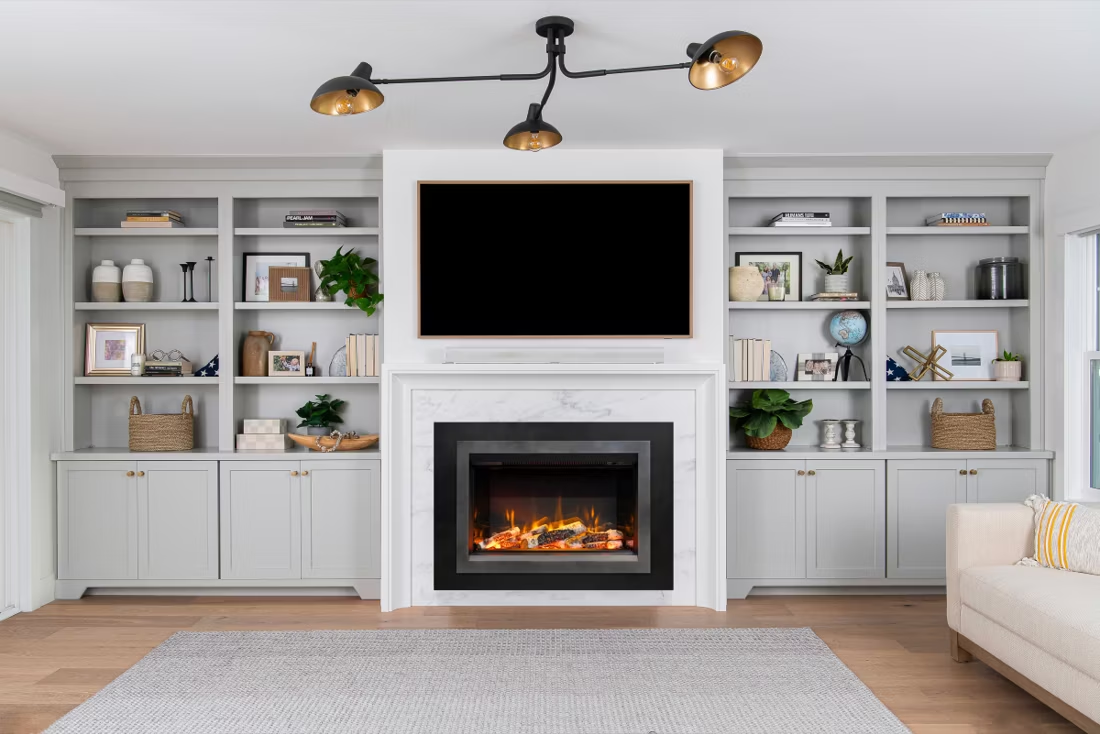
For a den or living room, a linear wall-mount or built-in insert from a brand like Dimplex or Touchstone gives you a clean, modern look with a good flame effect and enough heat output (typically 4,600–5,200 BTU) for a single room. For sunrooms or waterfront-facing spaces with lots of glass, a freestanding stove-style electric unit is often easier to place and doesn't require any wall modification. A local dealer can walk you through sightline and heat-output tradeoffs based on your room's layout.
Will an electric fireplace heat my whole house?
No—a typical electric fireplace puts out enough heat for one room, generally up to 400–500 square feet, and is designed as supplemental or zone heat rather than a whole-home solution. That's actually a good match for River Bend, where central heat pumps already handle the bulk of heating through a mild winter, and an electric fireplace just takes the edge off a specific room during a cold snap without running the whole system.
Are electric fireplaces safe for homes near the Neuse River or on crawl spaces?
Yes, and in some ways they're a simpler fit than a vented appliance. Electric fireplaces don't require any exterior venting penetration, chimney, or gas line—a real advantage for homes in River Bend built on crawl spaces or closer to grade near the river, where running new venting or gas lines can mean extra work around flood-zone considerations. The units themselves run cool to the touch on the glass front and typically include auto shut-off features, making them a low-risk option for homes with kids or pets.
What's the difference between an electric fireplace and a plug-in space heater?
A space heater is a portable appliance meant to be moved room to room and put away in the off-season. An electric fireplace is a permanent or semi-permanent fixture—built into a wall, set into a mantel surround, or styled as a freestanding stove—that combines heat output with a realistic flame display and typically includes better safety features like tip-over and overheat protection. If you want something that looks like a real fireplace and stays in place year-round, that's an electric fireplace; if you just need portable heat for a weekend cold snap, a space heater is the cheaper, simpler tool.
Do electric fireplaces actually produce heat?
Yes—most put out around 4,800–5,000 BTUs from a standard outlet, which comfortably warms a bedroom, office, or den as a comfort-zone heater. What they won't do is carry a whole house the way wood, gas, or pellet can. Think of electric as ambiance-first with honest supplemental heat: flames on with no heat in July, flames plus warmth in January.
How much does an electric fireplace cost to run?
With the heater on, a typical unit draws about 1,500 watts—at average electric rates that's roughly 20 cents an hour. Run the flame effect alone and it costs pennies; the flames are LED-driven and use about as much power as a light bulb. There's no pilot light, no fuel delivery, and essentially no maintenance.
Does a fireplace add value to my home?
On average, a fireplace adds back to the home about the same amount you spent installing it. Add the monthly savings from heating the rooms you actually use instead of the whole house—often hundreds of dollars a year—and the value case is strong before you even count what a fire does for how your family uses the room.
Can a fireplace actually lower my heating bill?
Yes—by creating a comfort zone. A furnace heats every square foot of the house just to warm the one room you're in; a gas fireplace on low burns roughly a sixth of the gas a typical furnace does. Set the furnace around 55–60 degrees as a baseline, then heat the rooms your family actually uses. Families who heat this way commonly save $20–$60 a month.
Nearby Dealers
Hearth shops serving River Bend and the surrounding area. Every listing shows whether it is a WhyFire partner, a dealer we have verified as authorized for the brands we recommend, or a local business carrying hearth products. No manufacturer pays for placement. How we verify dealers →
We’ve paused dealer listings for this connection today. Enter your zip or postal code above to find dealers near you, or come back tomorrow.
Popular Electric Brands
Where each brand came from, what's inside it today, and every current model. No brand pays to be here. Not every dealer carries every brand, so enter your zip code to see what's sold near River Bend.
Fireplace Xtrordinair
Fireplace Xtrordinair, now often called FireplaceX, is the fireplace brand of Travis Industries, Inc., of Mukilteo, Washington.
5 electric models →DaVinci
DaVinci Custom Fireplaces is a brand of Travis Industries, Inc., of Mukilteo, Washington, the company behind Lopi and Fireplace Xtrordinair.
5 electric models →Kozy Heat
Kozy Heat was founded in 1976 by Dudley Hussong in Lakefield, Minnesota, and incorporated as Hussong Manufacturing Co., Inc. in 1978.
3 electric models →Forge & Flame
Forge & Flame is the stove brand Hearth & Home Technologies introduced in August 2023 to bring Vermont Castings, Harman, and Quadra-Fire under one name.
1 electric model →Electric Service in River Bend
An electric fireplace's heater draws about 1,500 watts—pennies per hour at local rates.
Duke Energy Progress - (Nc)
Tideland Electric Member Corp
City Of New Bern - (Nc)
Find your electric fireplace in River Bend.
Tell us about your room and your home, and we'll put together a free Project Guide & Parts List—the right electric fireplace or insert, the exact parts, and a trusted local dealer in Craven County to install it.
Find Your Fireplace →