
Warm Up Your High Point Home the Easy Way.
Instant, even heat for High Point's mild Piedmont winters—find the right gas fireplace or insert and connect with a trusted local dealer.
Every Project Starts From One of These Five Situations
Consistent heat for a climate that rarely freezes hard.
High Point sits at 870 feet in the Piedmont, in climate zone 4A, where winter lows average around 32 degrees and the region has a fairly mild, moderate winter heating season—a fraction of the winter heating load a true cold-climate city like Duluth, Minnesota racks up. That milder profile is a big reason wood heat never took hold here the way it did in the mountains west of Greensboro: most High Point homes need a fireplace that supplements central HVAC on chilly nights, not a primary heat source that has to carry a household through a hard winter.
Gas fits that role well. Piedmont Natural Gas serves most of the High Point service area, from downtown and Emerywood out to the surrounding Guilford County suburbs, so adding a gas line to an existing home is usually straightforward. Electric service in the metro splits across Duke Energy Progress, Duke Energy Carolinas, and EnergyUnited depending on which side of town you're on—worth knowing if you're comparing a gas unit's battery-backup ignition against an all-electric fireplace. Either way, a gas fireplace or insert gives you real, instant heat at the flip of a switch, with none of the ash, smoke, or wood storage that comes with a solid-fuel unit.
Three steps. No salesperson until you're ready.
Tell us about your project
Your zip code, your situation, and the fuel you're leaning toward—or let the answers point you to one.
See what's actually available
The brands dealers within 100 miles genuinely carry—real options, never a catalog mirage.
Get your dealer & Project Guide
A trusted local dealer, plus the free Project Guide & Parts List that names every component of the job.
Frequently Asked Questions
How much does a gas fireplace installation cost in High Point?
Most gas fireplace and insert installations in High Point fall between roughly $3,500 and $9,000, depending on the unit, the venting path, and whether new gas line work is needed. A direct-vent insert going into an existing masonry fireplace in one of High Point's older Emerywood or Johnson Street bungalows—where a gas line is often already run for a range or water heater—tends to land on the lower end. A new built-in gas fireplace for a remodel or addition, requiring fresh framing, venting, and a gas line extension from Piedmont Natural Gas service, runs higher. A local dealer will give you a firm number after seeing the space.
Can I convert my existing wood-burning fireplace to gas?
Yes, and it's a common project in High Point's older neighborhoods, where many homes built during the furniture industry's early-to-mid-century boom still have their original brick fireboxes. A gas insert slides into that existing masonry opening, running a stainless liner up the current chimney for venting, so you keep the look of the original fireplace while gaining real heat output and a burner you can turn on with a switch or remote. Conversions typically run $3,500 to $7,500 depending on the insert and whether a new gas line has to be pulled to the fireplace.
Do I need natural gas, or should I use propane?
Piedmont Natural Gas covers most of High Point proper, so if your home already has gas service for a furnace, range, or water heater, adding a fireplace is usually a simple tap-in. Homes on the edges of Guilford County—out toward Jamestown, Sedgefield, or the more rural stretches near the Randolph County line—sometimes fall outside the natural gas footprint and rely on propane instead, with a tank set on the property. Nearly every gas fireplace model can be configured for either fuel; your installer sets the correct orifice and regulator for whichever you have.
Will my gas fireplace still work if the power goes out?
Most modern gas fireplaces will, with a caveat. Units with intermittent pilot ignition (IPI) run on a small battery backup that kicks in automatically when Duke Energy or EnergyUnited service drops—common enough during Piedmont ice storms—so the fireplace lights on demand just as it would with power on. The batteries do need to be fresh, which is easy to forget until an outage hits. Valor fireplaces skip batteries entirely: their pilot generates its own electricity through the thermocouple, so the unit works during an outage indefinitely. Worth asking about if backup heat matters to you.
What's the difference between a gas fireplace, gas insert, and gas stove?
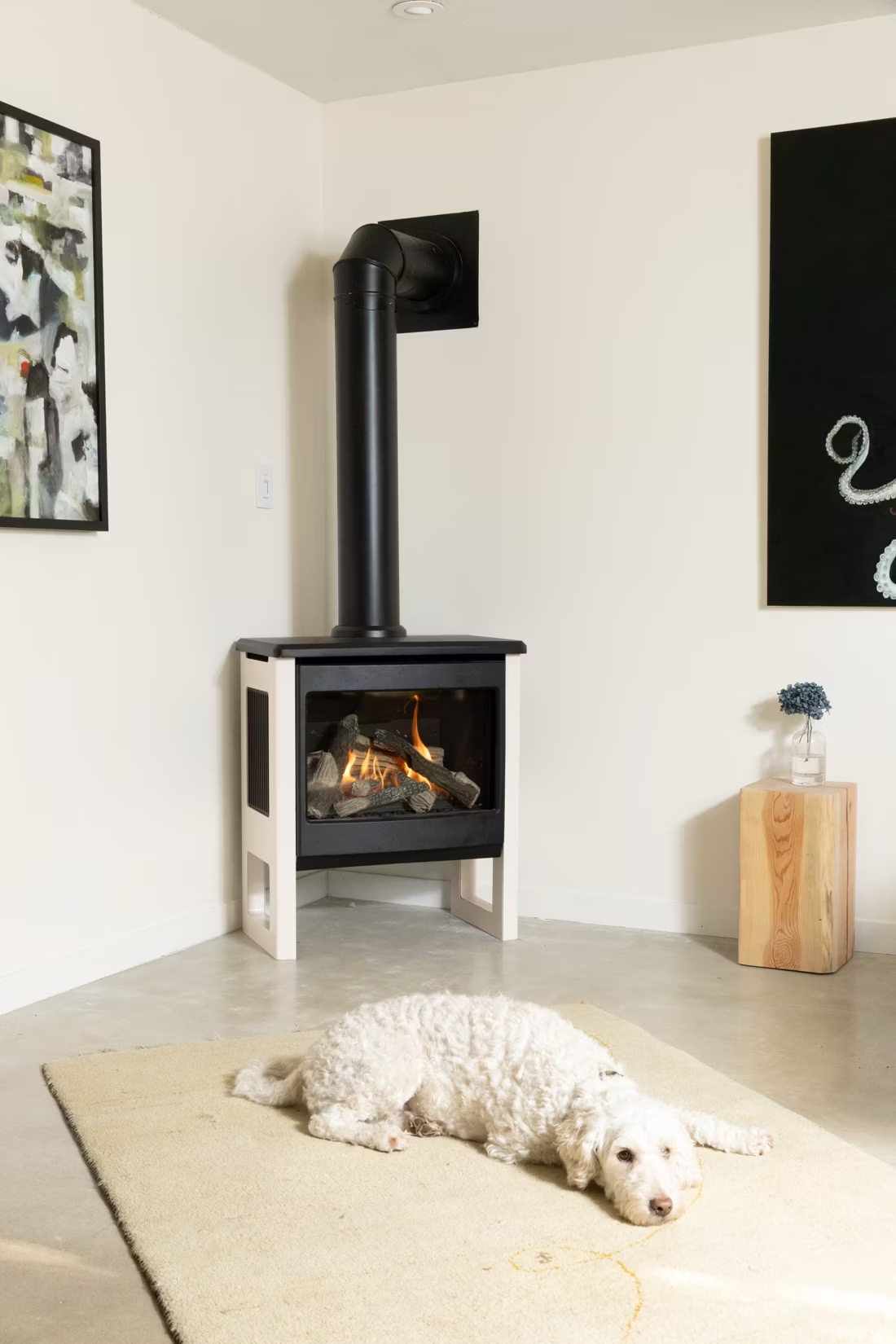
A gas fireplace is a fully built-in unit framed into a wall—the right choice for new construction or a remodel without an existing firebox. A gas insert is sized to slide into an existing masonry fireplace opening, which describes a large share of High Point's older housing stock. A gas stove is a freestanding cast-iron or steel unit that sits on the floor and vents out through a wall or existing chimney, often used in additions or rooms without a fireplace at all. For most High Point homeowners upgrading a fireplace they already have, an insert is the straightforward answer.
Do I need a permit to install a gas fireplace in High Point?
Yes—a building permit and a gas piping permit are both required for a new gas fireplace or insert installation. Homes inside city limits go through the City of High Point's Development Services Building Codes Division; homes in the unincorporated pockets of Guilford County outside city limits go through Guilford County Code Enforcement instead. A licensed gas-fitter has to handle the line work regardless of jurisdiction, which is one reason it's worth using a hearth dealer who coordinates the gas line, venting, and inspection as one job rather than juggling separate trades yourself.
Should I get a vented or vent-free gas fireplace?
Vented (direct-vent) gas fireplaces pull combustion air from outside and exhaust it back outside through sealed venting—they're the standard choice and code-compliant everywhere, including North Carolina. Vent-free units burn fuel directly into the room with no outside venting; they're legal in North Carolina under specific room-size and ventilation rules, and the appeal in a mild climate like High Point's is that you can skip venting work entirely on an interior wall. That said, most local dealers steer homeowners toward direct-vent models because they don't add moisture or combustion byproducts to the room and give you more flexibility on placement and size. It's worth discussing both with your installer before you decide.
How often does a gas fireplace need to be serviced?
Plan on an annual inspection, ideally in early fall before the unit sees regular winter use. A certified technician checks the burner, pilot assembly, venting, and gas connections, and cleans the glass and interior—a much smaller job than a wood chimney sweep, but it's what keeps the ignition system and safety controls working correctly. Local gas appliance technicians typically charge $150 to $250 for this visit, and it's especially worth staying current on if your unit relies on battery-backup ignition for outage protection.
Should I go with gas or a wood-burning fireplace in High Point?
Wood heat just isn't a big part of how High Point homes stay warm the way it is in the mountains or in a genuinely cold-winter city like Burlington, Vermont—with average lows only around 32 degrees and a fairly mild, moderate winter heating season, most households don't need a primary wood-heat setup, even though oak, hickory, maple, and pine are all common locally and plenty of older homes still have a working masonry fireplace for the occasional fire. Gas is the more practical fit for most High Point homeowners: instant on-and-off operation, no ash or wood storage, and consistent heat output that pairs cleanly with central HVAC. If you already have a masonry fireplace and just want occasional wood fires for the experience, keeping it as-is is reasonable—but for anyone who wants that fireplace to actually contribute meaningful heat on a January night, a gas insert is usually the better investment.
Is my gas fireplace wasting gas?
If it was installed more than 15 years ago, probably. Older gas fireplaces keep a standing pilot light burning all the time, and that little flame can cost a couple hundred dollars a year. Newer models use pilot-on-demand ignition—the pilot lights only when you use the fireplace and goes out when you turn it off.
What's the difference between an insert and a zero-clearance fireplace?
An insert is a fireplace that slides into a pre-existing wood-burning fireplace—if you don't have one, there's nothing to insert it into. A zero-clearance fireplace is built into a framed wall, which makes it the answer for remodels and new construction. Simple test: existing masonry fireplace means insert; blank or framed wall means zero-clearance.
Can I install a fireplace myself?
If you're putting a fire in your house on purpose, it's best to work with an expert. Unless you're genuinely experienced in framing, gas line, vent pipe, and the national code on clearances to combustibles, have a professional do it—and ideally the same company that sells you the fireplace, so warranty, service, and liability all live under one roof.
Can a fireplace actually lower my heating bill?
Yes—by creating a comfort zone. A furnace heats every square foot of the house just to warm the one room you're in; a gas fireplace on low burns roughly a sixth of the gas a typical furnace does. Set the furnace around 55–60 degrees as a baseline, then heat the rooms your family actually uses. Families who heat this way commonly save $20–$60 a month.
Nearby Dealers
Hearth shops serving High Point and the surrounding area. Every listing shows whether it is a WhyFire partner, a dealer we have verified as authorized for the brands we recommend, or a local business carrying hearth products. No manufacturer pays for placement. How we verify dealers →
Builder's Fireplace & Stone
Casual Furniture World
Ash Busters Chimney Service
Blossman Gas And Appliance
Central Gas
Lanier Ace Hardware
Blossman Gas
Amick's Superstore
Briles Oil And Gas
Randolph Oil Company
Big Apple Farm Supply
Find your gas fireplace in High Point.
Tell us a bit about your home and we'll match you with the right gas fireplace, insert, or stove—plus a free Project Guide & Parts List and a trusted local dealer to install it.
Find Your Fireplace →