
Instant fireplace warmth for Columbus County's mild winters.
From Whiteville to Tabor City, Chadbourn, and the Lake Waccamaw shoreline, Columbus County winters rarely demand a full heating system overhaul. Find the right electric unit and connect with a trusted local dealer.
Every Project Starts From One of These Five Situations
A short heating season that favors simple, electric heat.
Columbus County sits in the southeastern North Carolina coastal plain, bordering South Carolina along the Waccamaw River and the edge of the Green Swamp. Winters here are mild by any national standard: average winter lows hover around 32°F, and the county's overall winter heating load is light—a fraction of what a place like Bismarck, ND or Duluth, MN sees in a single season. Most Columbus County homes only need meaningful supplemental heat for a handful of weeks between December and February.
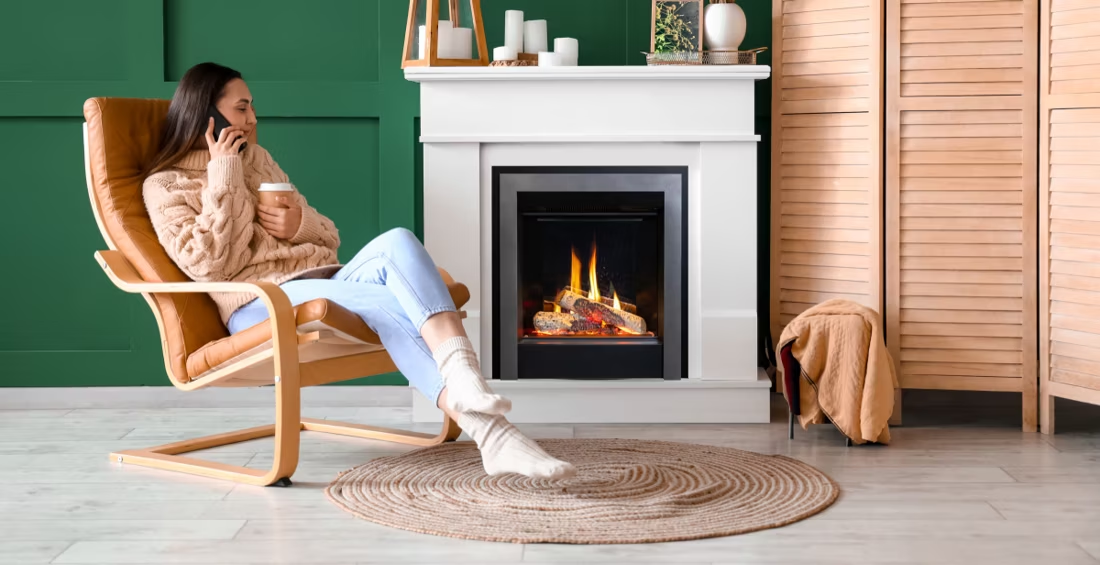
That climate profile is exactly where electric fireplaces earn their keep. There's no chimney to build, no venting to size, and no combustion byproducts to manage—just a unit that plugs in or wires into a circuit and produces real, usable warmth for a bedroom, den, or converted sunroom in Whiteville, Tabor City, Chadbourn, or out toward Fair Bluff and Lake Waccamaw. For homeowners who want the look and glow of a fireplace without a wood supply or a gas line, and who don't need a whole-home heating solution for a county this mild, electric is often the most practical fit.
Three steps. No salesperson until you're ready.
Tell us about your project
Your zip code, your situation, and the fuel you're leaning toward—or let the answers point you to one.
See what's actually available
The brands dealers within 100 miles genuinely carry—real options, never a catalog mirage.
Get your dealer & Project Guide
A trusted local dealer, plus the free Project Guide & Parts List that names every component of the job.
Frequently Asked Questions
How much does an electric fireplace installation cost in Columbus County?
Plug-in electric fireplace inserts and freestanding stoves are the most affordable option, often installed for a few hundred dollars since they run off a standard outlet with no wiring changes. Built-in electric fireplaces or wall-mounted units that need a dedicated circuit run higher once you factor in a licensed electrician and any drywall or mantel work—this is where cost climbs into the low thousands depending on the unit and finish work involved. A local dealer can walk you through both paths during an in-home look at your space.
What size electric fireplace do I need for my home?
Because Columbus County's heating season is short, most homeowners are sizing for a single room rather than whole-home heat—a bedroom, den, or the main living area of a single-wide or double-wide, which are common throughout the rural parts of the county. Compact plug-in inserts and small wall units are usually sufficient for supplemental warmth in a 200–400 square foot space. Larger built-in units with higher wattage heaters can cover an open living/dining area, but few Columbus County homes need the largest units sold, since even January cold snaps here are brief compared to points further inland or north.
Do I need a permit to install an electric fireplace in Columbus County?
A plug-in electric fireplace or insert that uses an existing outlet typically doesn't require a permit—it's treated like any other appliance. A built-in unit that requires a new dedicated circuit or panel work generally does need an electrical permit through Columbus County's permitting office, and that work should be done by a licensed electrician regardless of the paperwork. Most local dealers who sell built-in units either handle the electrical coordination themselves or can point you to an electrician who's done the work before.
Can I install an electric insert into my existing fireplace?
Yes—this is one of the most common projects in older Columbus County homes, particularly farmhouses and older homes around Whiteville and Lake Waccamaw with a masonry firebox that's no longer used for wood burning. An electric insert slides into the existing opening, uses the mantel and surround you already have, and typically just needs a nearby outlet or a short electrical run. It's a much simpler retrofit than a gas or wood conversion since there's no venting or gas line to consider.
Will my electric fireplace work during a power outage?
No—and this matters more in Columbus County than in most inland areas, since the county sits in a coastal plain corridor that has seen real hurricane impact, including significant flooding from Florence in 2018 around Fair Bluff and Lake Waccamaw. Electric fireplaces are entirely dependent on grid power from Duke Energy Progress, so they offer zero backup heat during a storm-related outage. Homeowners who want both everyday convenience and a true backup heat source often pair an electric unit in the main living area with a wood stove or gas insert elsewhere in the house for storm season.
What's the difference between an electric fireplace, insert, and stove?
An electric fireplace is typically a wall-mounted or built-in unit designed to look like a traditional firebox, often set into a mantel surround. An electric insert is sized to slide into an existing masonry or zero-clearance fireplace opening, replacing wood or gas hardware with an electric heater and flame-effect display. An electric stove is a freestanding unit styled like a traditional wood stove, useful for homes without an existing fireplace opening. For most Columbus County retrofits—especially older homes with a fireplace already in place—an insert is the simplest path.
How much does it cost to run an electric fireplace day to day?
Most electric fireplaces draw around 1,500 watts on their highest heat setting, which at typical Duke Energy Progress residential rates runs somewhere in the range of 15 to 25 cents per hour of heater use—considerably less than running central heat to cover a single room. Because Columbus County's cold stretches are short, many homeowners run the flame effect year-round for ambiance (which uses very little power on its own) and only switch on the heater during the coldest weeks of December and January.
How much maintenance does an electric fireplace need?
Very little compared to wood or gas. There's no chimney to sweep, no gas line to inspect, and no ash or soot to clean up. Basic upkeep is limited to dusting the unit, occasionally cleaning the glass front, and replacing LED lights on older models if the flame effect dims—something that happens far less often on newer units. This low-maintenance profile is part of why electric is a popular choice for rental properties and second homes around Lake Waccamaw.
Electric vs. wood—which is right for my Columbus County home?
Wood remains a strong option in Columbus County, where local oak, hickory, and pine are widely available and a wood stove keeps producing heat even when the power's out during hurricane season. Electric wins on convenience—no wood to split or stack, no ash, and instant on-off control—and it fits a climate where the heating season is genuinely short. Many Columbus County homeowners land on electric for daily-use ambiance in a main living space, while keeping a wood stove or fireplace as a backup for the handful of days each year when both the temperature and the grid can't be counted on.
Can I put a TV above my fireplace?
Yes—with an asterisk. Fireplaces are hot and TVs don't like heat. Either put a mantel between them to deflect rising warmth, or choose a fireplace with heat-management technology that creates a cool zone on the wall above—the wall stays around 125 degrees, barely warm, while the room still gets full heat. If you like clean lines and don't want a mantel, heat management is the answer.
How much does an electric fireplace cost to run?
With the heater on, a typical unit draws about 1,500 watts—at average electric rates that's roughly 20 cents an hour. Run the flame effect alone and it costs pennies; the flames are LED-driven and use about as much power as a light bulb. There's no pilot light, no fuel delivery, and essentially no maintenance.
Can I install a fireplace myself?
If you're putting a fire in your house on purpose, it's best to work with an expert. Unless you're genuinely experienced in framing, gas line, vent pipe, and the national code on clearances to combustibles, have a professional do it—and ideally the same company that sells you the fireplace, so warranty, service, and liability all live under one roof.
Can a fireplace actually lower my heating bill?
Yes—by creating a comfort zone. A furnace heats every square foot of the house just to warm the one room you're in; a gas fireplace on low burns roughly a sixth of the gas a typical furnace does. Set the furnace around 55–60 degrees as a baseline, then heat the rooms your family actually uses. Families who heat this way commonly save $20–$60 a month.
Find your electric fireplace in Columbus County.
Tell us a bit about your home and we'll put together a free Project Guide & Parts List—the right electric unit, the wiring needs, and a trusted local dealer to install it.
Find Your Fireplace →