
Real Warmth Without the Renovation.
No chimney, no gas line, no venting—just a fireplace that plugs into your South Farmingdale home and adds real ambiance and zone heat. We'll help you find a trusted local dealer.
Every Project Starts From One of These Five Situations
Built for co-ops, condos, and close-set Long Island lots.
South Farmingdale is a tightly-built hamlet in the Town of Oyster Bay, full of the postwar Cape Cods and ranches that define this stretch of Nassau County—small lots, shared property lines, and homes that were never built with a wood-burning hearth in mind. Winters here are real but not brutal: with an average winter low around 25°F and a heating season that adds up to a moderate workload for your furnace, South Farmingdale sees a fraction of the cold that hits places like Burlington, VT or Duluth, MN. There's no public forest land nearby for cutting permits, and Nassau County's dense residential zoning and HOA rules make wood or pellet stoves impractical for the vast majority of homes here—which is exactly why those fuels don't come up much in this zip code.
Electric fireplaces fill the gap. A freestanding or wall-mounted unit plugs into a standard outlet and needs no chimney, no gas line, and no combustion venting—a real advantage for co-op boards, condo associations, and finished basements where open flame isn't an option. Long Island Power Authority (LIPA) serves electric service here at a residential rate around $0.2457 per kWh, noticeably higher than the national average, which is worth knowing upfront: an electric fireplace is best used as supplemental zone heat for a family room or den, not a replacement for your home's existing furnace or boiler. Used that way, it's inexpensive to run and one of the simplest hearth upgrades available for a South Farmingdale home.
Three steps. No salesperson until you're ready.
Tell us about your project
Your zip code, your situation, and the fuel you're leaning toward—or let the answers point you to one.
See what's actually available
The brands dealers within 100 miles genuinely carry—real options, never a catalog mirage.
Get your dealer & Project Guide
A trusted local dealer, plus the free Project Guide & Parts List that names every component of the job.
Frequently Asked Questions
How much does an electric fireplace installation cost in South Farmingdale?
Plug-in freestanding units and small inserts typically run $250 to $1,200 installed, since they need no wiring beyond an existing outlet. Built-in wall units and larger linear fireplaces that require a dedicated 120V or 240V circuit run higher, often $1,500 to $3,500 once an electrician cuts in a new line and a carpenter handles any surround or mantel work. Because there's no venting, chimney, or gas line to run, electric installs are consistently the least expensive hearth upgrade available in South Farmingdale—a fraction of what a comparable gas insert costs.
What are my options—insert, wall-mount, or freestanding?
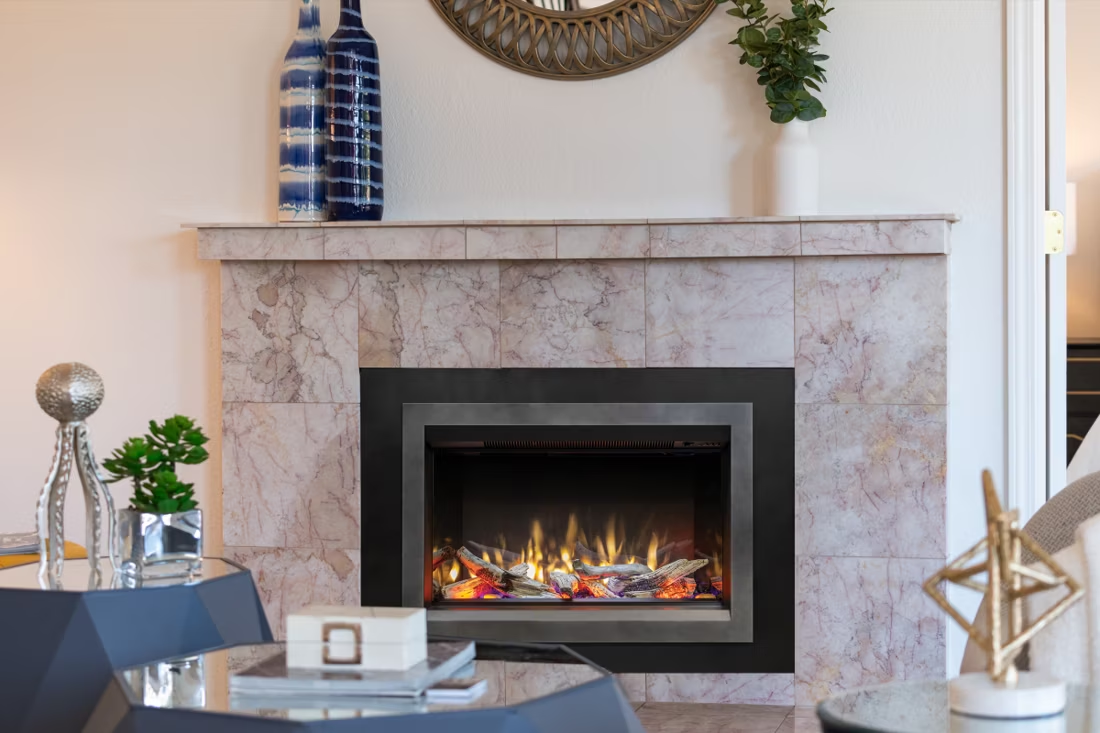
For South Farmingdale's stock of 1950s-60s Cape Cods and ranches, an electric insert that slides into an existing masonry fireplace opening is a popular choice—it covers up an unused firebox without any venting work and can be swapped in during a weekend. Wall-mounted linear units are common in remodeled family rooms and finished basements, hung like a flat-screen TV with a heater built in. Freestanding stove-style units are the simplest option and can be moved between rooms, which works well in rental units or smaller attached homes where a permanent installation isn't practical.
Can an electric fireplace actually heat my house, or is it just for looks?
Most electric fireplaces put out around 5,000 BTU (roughly 1,500 watts) of real heat—enough to comfortably warm a single room, but not a whole South Farmingdale house through a winter with a moderate heating workload. At the LIPA residential rate of about $0.2457/kWh, running a 1,500W unit for eight hours costs roughly $3 a day. That makes electric heat a smart, low-cost way to warm the room you're actually sitting in without firing up the whole furnace, but it's best paired with your existing gas or oil heat system rather than used as a full replacement.
Do I need a permit to install an electric fireplace in South Farmingdale?
A plug-in freestanding unit generally doesn't require a permit—it's treated like any other appliance. If you're installing a built-in wall unit or insert that requires new household wiring or a dedicated circuit, the electrical work needs to be pulled through the Town of Oyster Bay Building Department and completed by a licensed electrician. There's no chimney, gas line, or combustion venting involved, which is why electric permitting in South Farmingdale is far simpler than a wood or gas project—most local dealers can tell you in the first conversation whether your chosen unit needs one.
Electric vs. gas fireplace—which makes more sense for my South Farmingdale home?
Gas fireplaces put out more heat per hour and are generally cheaper to run than electric resistance heat at LIPA's current rate, but they require a gas line, venting, and a higher install cost. Electric fireplaces cost less upfront, need no venting or gas work, and are the only realistic option in co-ops, condos, or homes where an association restricts open flame. If your South Farmingdale home already has gas service and you want real supplemental heat in a main living space, gas is worth a look. If you want ambiance and light zone heat with the simplest possible install—especially in a finished basement, bedroom, or rental unit—electric is the more practical choice.
Why don't wood or pellet stoves show up much in South Farmingdale?
South Farmingdale's small, close-set lots and Nassau County's residential zoning make wood-burning installations impractical for most homes here—there's no nearby public forest land for cutting permits the way there is upstate, and few local homes were built with a masonry chimney sized for a solid-fuel stove. Pellet stoves face the same hurdles: sourcing bagged pellets locally is harder on Long Island than in the Northeast's wood-heating regions, and most homeowners here who want wood-fireplace ambiance opt for an electric or gas unit instead. It's not that wood heat doesn't work physically—it's just a poor fit for this housing stock and lot layout.
What's the best electric fireplace for an older Cape Cod or ranch in this area?
For the classic South Farmingdale Cape Cod with an existing but unused masonry fireplace, a zero-clearance electric insert is usually the cleanest fix—it fits into the firebox opening, plugs into a nearby outlet or a newly added receptacle, and requires no venting or masonry work. For homes without an existing fireplace, a wall-mounted linear unit in a renovated family room or finished basement gives you a modern, low-profile heat source without touching the home's structure. A local dealer can measure your firebox opening and recommend a model that fits without any custom carpentry.
How long do electric fireplaces last, and what maintenance do they need?
Most electric fireplace units last 10 to 15 years with normal use. There's no chimney to sweep and no creosote to manage—maintenance is limited to occasionally cleaning the glass front, checking the heater fan for dust buildup, and replacing the LED flame bulbs or heating element if it eventually wears out, which is usually a straightforward part swap rather than a full replacement. This is one of the lowest-maintenance hearth options available to South Farmingdale homeowners, particularly compared to the annual inspections a gas or wood system requires.
Is running an electric fireplace expensive given Long Island electric rates?
LIPA's residential rate of roughly $0.2457/kWh is higher than the national average, so it's worth being realistic about running costs. A typical 1,500-watt unit costs about $0.37 per hour to run at full heat output, or roughly $3 for an eight-hour evening. Used as supplemental heat for one room a few hours a day, that's a modest add to your electric bill—but it's not the fuel to choose if you're trying to heat a large space for long stretches. Many South Farmingdale homeowners use the heater setting sparingly and run the flame effect alone (which draws only a few watts) the rest of the time.
Can I put a TV above my fireplace?
Yes—with an asterisk. Fireplaces are hot and TVs don't like heat. Either put a mantel between them to deflect rising warmth, or choose a fireplace with heat-management technology that creates a cool zone on the wall above—the wall stays around 125 degrees, barely warm, while the room still gets full heat. If you like clean lines and don't want a mantel, heat management is the answer.
Do electric fireplaces actually produce heat?
Yes—most put out around 4,800–5,000 BTUs from a standard outlet, which comfortably warms a bedroom, office, or den as a comfort-zone heater. What they won't do is carry a whole house the way wood, gas, or pellet can. Think of electric as ambiance-first with honest supplemental heat: flames on with no heat in July, flames plus warmth in January.
Can a fireplace actually lower my heating bill?
Yes—by creating a comfort zone. A furnace heats every square foot of the house just to warm the one room you're in; a gas fireplace on low burns roughly a sixth of the gas a typical furnace does. Set the furnace around 55–60 degrees as a baseline, then heat the rooms your family actually uses. Families who heat this way commonly save $20–$60 a month.
How much should I budget for a fireplace?
For an average home—covering the fireplace, the vent pipe, and basic installation—a budget between $3,900 and $5,500 gives you a lot of options across wood, gas, and pellet. By the time you add finish work, gas line, and electrical, the average complete installation lands between $5,000 and $12,000 all-in. In a remodel or new build, a good rule is to put about 2.5% of the total project cost toward the fireplace.
Nearby Dealers
Hearth shops serving South Farmingdale and the surrounding area. Every listing shows whether it is a WhyFire partner, a dealer we have verified as authorized for the brands we recommend, or a local business carrying hearth products. No manufacturer pays for placement. How we verify dealers →
We’ve paused dealer listings for this connection today. Enter your zip or postal code above to find dealers near you, or come back tomorrow.
Popular Electric Brands
Where each brand came from, what's inside it today, and every current model. No brand pays to be here. Not every dealer carries every brand, so enter your zip code to see what's sold near South Farmingdale.
Fireplace Xtrordinair
Fireplace Xtrordinair, now often called FireplaceX, is the fireplace brand of Travis Industries, Inc., of Mukilteo, Washington.
5 electric models →DaVinci
DaVinci Custom Fireplaces is a brand of Travis Industries, Inc., of Mukilteo, Washington, the company behind Lopi and Fireplace Xtrordinair.
5 electric models →Kozy Heat
Kozy Heat was founded in 1976 by Dudley Hussong in Lakefield, Minnesota, and incorporated as Hussong Manufacturing Co., Inc. in 1978.
3 electric models →Forge & Flame
Forge & Flame is the stove brand Hearth & Home Technologies introduced in August 2023 to bring Vermont Castings, Harman, and Quadra-Fire under one name.
1 electric model →Electric Service in South Farmingdale
An electric fireplace's heater draws about 1,500 watts—pennies per hour at local rates.
Long Island Power Authority
Find your electric fireplace in South Farmingdale.
Tell us about your home and we'll put together a free Project Guide & Parts List—the right unit, the exact parts, and a trusted local South Farmingdale dealer to install it.
Find Your Fireplace →