
Reliable heat for a village without a gas main.
At 16 feet above the bay with winter lows near 20°F and a heating season as demanding as Burlington, Vermont's, Quogue homes still need real heat—most of it fed by propane rather than pipeline gas. We'll help you find a trusted local dealer who knows the tank setup, the venting, and the village's permit process.
Every Project Starts From One of These Five Situations
Propane carries the load here, not pipeline gas.
Quogue sits low and close to the water on Long Island's South Fork, and its winters, with a heating season about as demanding as Burlington, Vermont's, run colder than most visitors assume of a Hamptons village. Winter lows average 20°F, and the nor'easters that roll off the Atlantic bring the kind of multi-day cold and wind that makes a dependable secondary heat source more than a luxury. Oak, maple, birch, and ash—the species most local wood-burners split—do fine for an open hearth, but for a lot of Quogue homeowners, especially those who aren't on the property full-time, a gas appliance that fires reliably without tending is the more practical fit.
Quogue is a small incorporated village, and there's no natural gas main running through it—propane is the standard fuel path for a gas fireplace or insert here, typically from a buried or pad-mounted tank rather than a utility line. Electric service runs through the Long Island Power Authority at roughly $0.25 per kWh for most of the village, which matters for ignition reliability given how often South Fork storms interrupt LIPA service for a day or more. A propane fireplace with a self-powered pilot or battery-backed ignition keeps running through exactly those outages, which is a real consideration for a shoreline community that loses power more often than it would like to admit.
Three steps. No salesperson until you're ready.
Tell us about your project
Your zip code, your situation, and the fuel you're leaning toward—or let the answers point you to one.
See what's actually available
The brands dealers within 100 miles genuinely carry—real options, never a catalog mirage.
Get your dealer & Project Guide
A trusted local dealer, plus the free Project Guide & Parts List that names every component of the job.
Frequently Asked Questions
How much does a gas fireplace installation cost in Quogue?
Most propane installs in Quogue run $5,500 to $12,500. A direct-vent insert dropping into an existing masonry firebox in one of the village's older shingle-style or colonial homes lands toward the low end, since the chimney chase is already there. A new built-in unit for a renovation or addition—common given how much construction activity moves through Quogue's smaller lots each season—runs higher once you add a new propane tank set, buried line, and fresh venting. Labor rates on the South Fork during peak building season can also push quotes above Suffolk County's typical range, so getting a quote locked in before Memorial Day construction season fills up installer calendars is worth doing early.
Is natural gas available in Quogue, or is it propane only?
Propane is the standard here. Quogue doesn't have a natural gas main serving the village, so virtually every gas fireplace or insert installed locally runs off a propane tank rather than a utility hookup. That's not unusual for the smaller East End villages—some nearby hamlets with larger commercial corridors have partial gas service, but Quogue itself doesn't, so budgeting for a tank (buried or pad-mounted) as part of the project is standard practice rather than an edge case.
Will a gas fireplace still work if the power goes out during a storm?
It depends on the ignition system, and on the South Fork that's not a minor detail—LIPA outages after a nor'easter or a late-season hurricane can run a day or more. Units with intermittent pilot ignition (IPI) carry AA battery backup that kicks in automatically when the power drops. Valor's lineup skips batteries altogether since the pilot's thermocouple generates its own current. Given how often Quogue loses power before it loses propane supply, this is worth asking your dealer about directly rather than assuming any gas unit will just work.
Can I convert an old wood-burning fireplace to gas in my Quogue home?
Yes, and it's a common project in Quogue's older homes, many of which were built with open masonry fireboxes decades before propane inserts were standard. A direct-vent gas insert typically slides into the existing firebox with a stainless liner run up the current chimney, usually landing in the $5,500 to $10,000 range depending on chimney condition and tank placement. It's a popular upgrade for owners who want the look of the original hearth without hauling and splitting oak or maple every weekend they're in residence.
Do I need a permit to install a gas fireplace in Quogue?
Yes. Quogue is an incorporated village with its own Building Department, and any new gas appliance or propane tank installation needs a permit and inspection through that office rather than through Suffolk County directly. Because much of the village sits at low elevation near the bay and ocean, tank placement is also subject to flood-zone setback and anchoring requirements in some locations—your installer or the Village Building Department can confirm whether your property falls in a mapped flood zone before the tank goes in the ground.
Should I choose a vented or vent-free gas fireplace in Quogue?
Direct-vent is the better call for most Quogue homes. Beyond the usual safety argument, salt air off the bay and ocean accelerates corrosion on exposed metal components, and a sealed direct-vent system with stainless venting holds up better over time than a vent-free unit drawing combustion air from inside the house. Most dealers installing on the South Fork default to direct-vent for coastal properties for exactly this reason.
How often does a propane fireplace need servicing in Quogue?
Plan on an annual check, ideally before Labor Day rather than once the weather turns, since techs serving the Hamptons book up fast during shoulder-season storm prep. A standard visit—checking the burner, pilot assembly, gas connections, and venting, plus cleaning the glass—typically runs $150 to $250. Coastal salt air also makes it worth asking the technician to check external venting components for corrosion a bit more closely than a tech would inland.
How big a propane tank do I need, and where does it go on a Quogue lot?
A single gas fireplace or insert generally runs fine off a 100-pound cylinder or a small 120-gallon tank, though homeowners running a fireplace alongside a generator or range often opt for a buried 250- or 500-gallon tank instead. Lot sizes in Quogue tend to be tight and many properties sit within village design review guidelines, so a buried or low-profile tank is usually preferred over a large visible above-ground unit—your installer can advise on placement that satisfies both setback rules and the village's aesthetic expectations.
Gas vs. wood vs. pellet—what makes sense for a Quogue home?
Wood—oak, maple, birch, or ash—is cheap to burn if you already have a source, but it demands someone on-site to tend it, which doesn't suit a lot of Quogue's seasonal and weekend households. Pellet stoves using regional brands like Energex, Hamer, or Greene Team Pellet Fuel are cleaner-burning but, like gas, depend on electricity to run the auger—a real limitation during LIPA outages after a coastal storm. Propane gas is the option most homeowners here land on for a primary living space because it starts reliably without anyone present to load fuel, which matters most for a village where plenty of houses sit empty midweek.
Can I put a TV above my fireplace?
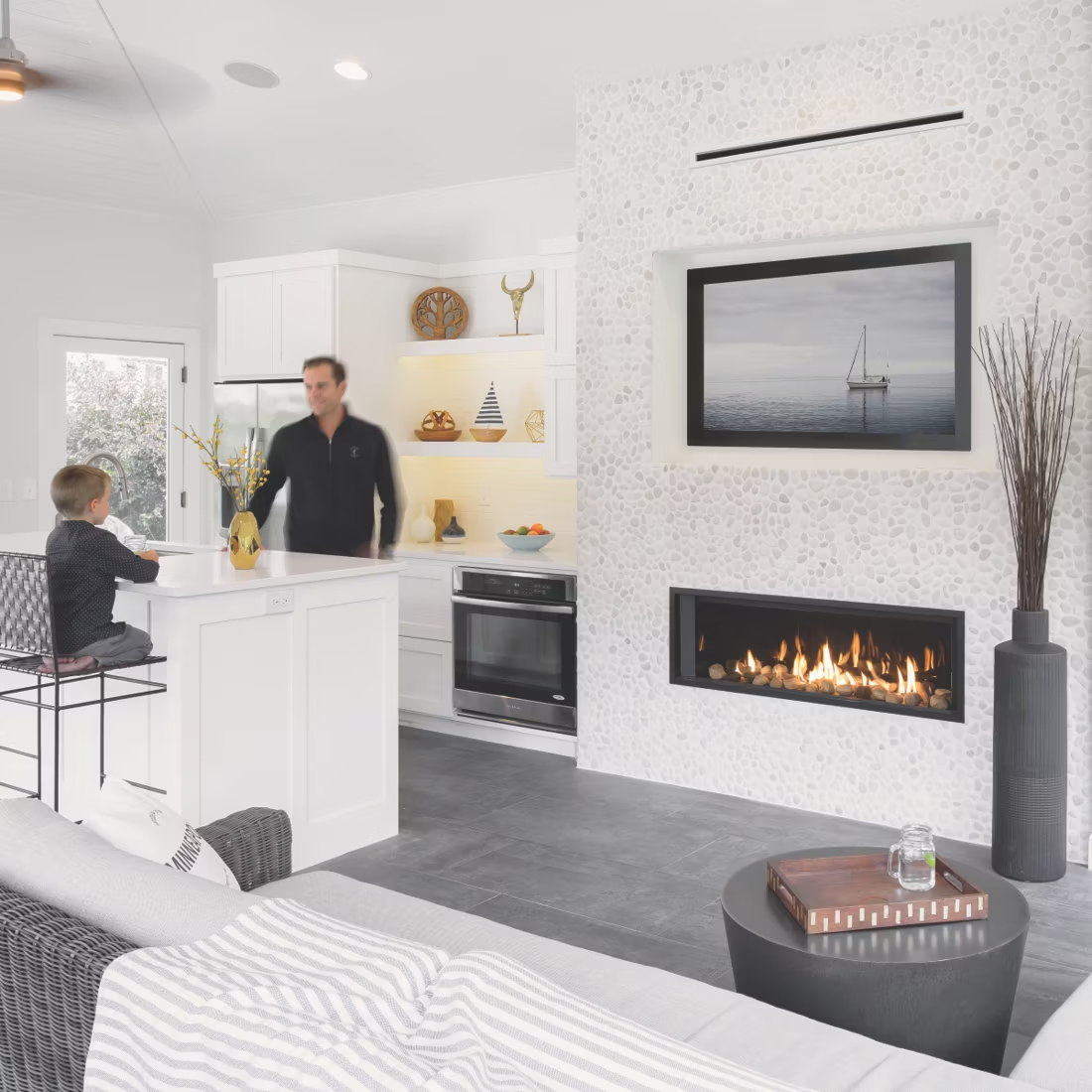
Yes—with an asterisk. Fireplaces are hot and TVs don't like heat. Either put a mantel between them to deflect rising warmth, or choose a fireplace with heat-management technology that creates a cool zone on the wall above—the wall stays around 125 degrees, barely warm, while the room still gets full heat. If you like clean lines and don't want a mantel, heat management is the answer.
Does a gas fireplace work when the power is out?
Yes—modern gas fireplaces have a battery backup for the ignition system that lasts for weeks, so no power equals no problem. Your furnace can't say that: no electricity, no blower, no heat. It's one of the most common reasons families add a fireplace, and worth confirming on any model you're considering.
Can I install a fireplace myself?
If you're putting a fire in your house on purpose, it's best to work with an expert. Unless you're genuinely experienced in framing, gas line, vent pipe, and the national code on clearances to combustibles, have a professional do it—and ideally the same company that sells you the fireplace, so warranty, service, and liability all live under one roof.
How much should I budget for a fireplace?
For an average home—covering the fireplace, the vent pipe, and basic installation—a budget between $3,900 and $5,500 gives you a lot of options across wood, gas, and pellet. By the time you add finish work, gas line, and electrical, the average complete installation lands between $5,000 and $12,000 all-in. In a remodel or new build, a good rule is to put about 2.5% of the total project cost toward the fireplace.
Nearby Dealers
Hearth shops serving Quogue and the surrounding area. Every listing shows whether it is a WhyFire partner, a dealer we have verified as authorized for the brands we recommend, or a local business carrying hearth products. No manufacturer pays for placement. How we verify dealers →
We’ve paused dealer listings for this connection today. Enter your zip or postal code above to find dealers near you, or come back tomorrow.
Popular Gas Brands
Where each brand came from, what's inside it today, and every current model. No brand pays to be here. Not every dealer carries every brand, so enter your zip code to see what's sold near Quogue.
Kozy Heat
Kozy Heat was founded in 1976 by Dudley Hussong in Lakefield, Minnesota, and incorporated as Hussong Manufacturing Co., Inc. in 1978.
28 gas models →Fireplace Xtrordinair
Fireplace Xtrordinair, now often called FireplaceX, is the fireplace brand of Travis Industries, Inc., of Mukilteo, Washington.
25 gas models →Town & Country
Town & Country Fireplaces is the luxury gas fireplace brand of Pacific Energy Fireplace Products Ltd., of Duncan, British Columbia.
14 gas models →Lopi
Lopi is a wood, pellet, and gas stove brand founded by Kurt Rumens in Bellevue, Washington, in 1979.
7 gas models →Forge & Flame
Forge & Flame is the stove brand Hearth & Home Technologies introduced in August 2023 to bring Vermont Castings, Harman, and Quadra-Fire under one name.
6 gas models →Vermont Castings
Vermont Castings was founded in 1975 by Duncan Syme, the designer, and his brother-in-law Murray Howell, the business partner, in Randolph, Vermont.
6 gas models →Get your free Project Guide & Parts List for a Quogue gas fireplace.
Tell us about your home, your lot, and whether you've got an existing propane tank, and we'll help you find a trusted local dealer and send a free Project Guide & Parts List with the exact vent kit and parts your project needs.
Find Your Fireplace →