
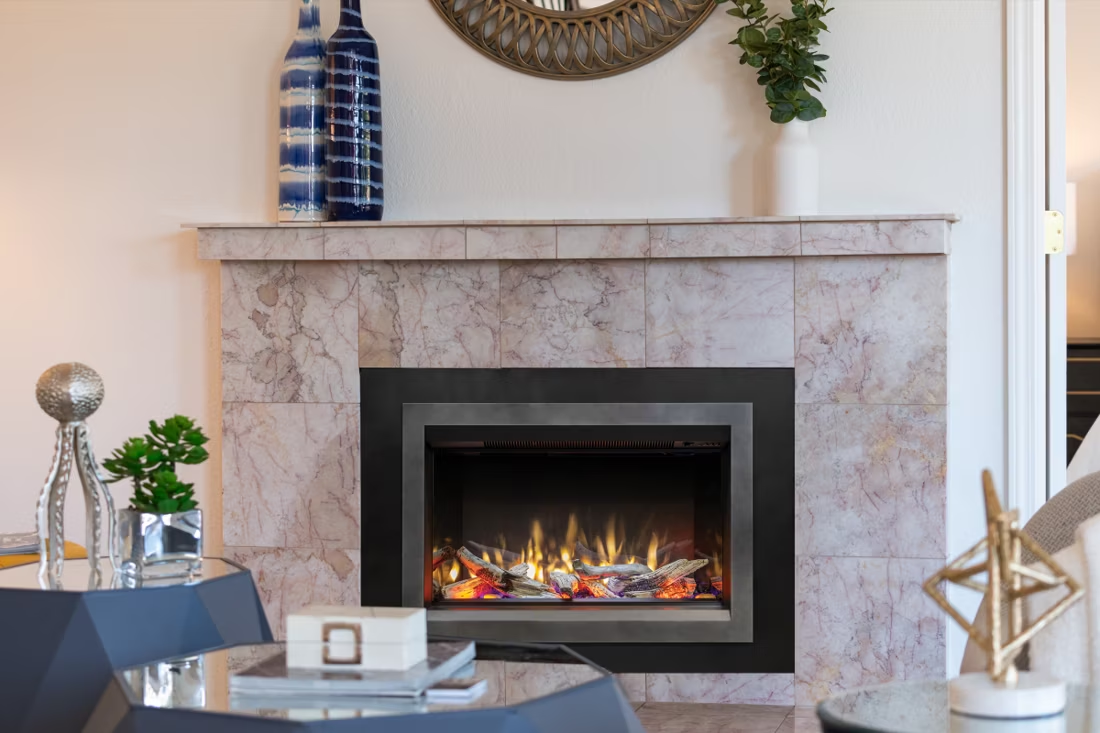
The easiest fireplace upgrade for Inwood's attached homes and co-ops.
No chimney, no venting, no gas line—just plug in or wire in and go. Find the right electric unit for your Inwood home and find a trusted local dealer.
Every Project Starts From One of These Five Situations
Built for homes without a chimney to spare.
Inwood sits at just 14 feet of elevation on Nassau County's South Shore, tucked between the Five Towns and Jamaica Bay, with the LIRR's Far Rockaway branch running straight through it. It's a hamlet of tightly packed attached homes, semi-detached houses, and a fair number of co-ops and condos—the kind of housing stock where cutting a new chimney chase or running a masonry flue simply isn't realistic. With a winter heating season that runs from fall into mid-spring and average winter lows around 26°F, Inwood needs real supplemental heat for a genuine winter, just not the kind that requires a hole in the roof.
That's exactly where electric fireplaces earn their place. A plug-in or hardwired unit installs in a single afternoon with no venting, no masonry work, and no impact on the building's exterior—which matters when a co-op or condo board has to sign off on any alteration. Long Island Power Authority delivers the electricity here at a residential rate of roughly 24.6 cents per kWh, on the higher side nationally, which is one reason most Inwood homeowners use electric units for zone heating and ambiance in a specific room rather than as a whole-house heat source. Wood stoves and pellet stoves, by contrast, are largely off the table in this part of Nassau County—most of Inwood's housing stock lacks masonry chimneys, shared walls and small lot lines make solid-fuel venting difficult, and flood-zone insurance policies common this close to Jamaica Bay often complicate solid-fuel installations anyway.
Three steps. No salesperson until you're ready.
Tell us about your project
Your zip code, your situation, and the fuel you're leaning toward—or let the answers point you to one.
See what's actually available
The brands dealers within 100 miles genuinely carry—real options, never a catalog mirage.
Get your dealer & Project Guide
A trusted local dealer, plus the free Project Guide & Parts List that names every component of the job.
Frequently Asked Questions
How much does it cost to install an electric fireplace in Inwood?
A freestanding plug-in electric fireplace or stove typically runs $150 to $600 for the unit itself and needs no electrician or permit—it plugs into a standard outlet like any appliance. A wall-mounted linear unit or a built-in electric insert set into an existing opening or new millwork generally runs $1,200 to $3,500 installed, and that figure often includes running a dedicated 120V or 240V circuit if your panel doesn't already have capacity nearby. Given how many Inwood homes are attached or semi-detached with limited electrical panel space, it's worth having a local dealer check your panel before you commit to a larger built-in unit.
Should I get an electric fireplace or a gas fireplace in Inwood?
It depends mostly on what's already run to your block. Some Inwood streets have natural gas service, and for those homes a direct-vent gas insert delivers more heat output and a more traditional flame. But gas work means coordinating a licensed gas-fitter, venting through an exterior wall, and—for co-ops and condos—board approval for penetrating a shared wall or roof. Electric skips all of that: no gas line, no venting, no exterior modification, which is why it's the more common choice in Inwood's multi-family buildings and tighter attached lots even where gas is available.
How much does it cost to run an electric fireplace with LIPA's rates?
Long Island Power Authority bills residential customers around 24.6 cents per kWh, which is above the national average. A typical 1,500-watt electric fireplace on high heat costs roughly 37 cents an hour to run, or about $2.60 for a 7-hour evening of use. Most units let you run the flame effect alone (5-30 watts, essentially free) without the heater, which is how a lot of Inwood homeowners use theirs outside of the coldest stretches—ambiance most nights, heat only when it's genuinely cold.
Do I need a permit to install an electric fireplace in Inwood?
A plug-in freestanding unit needs no permit at all—it's treated like any other appliance. If you're having a wall-mounted or built-in unit hardwired to a new dedicated circuit, that electrical work needs to be pulled through the Town of Hempstead's Building Department (Inwood is unincorporated and falls under the Town rather than a separate village), and the work should be done by a licensed electrician. If you live in a co-op or condo, check with your building's board first—most require written approval before any wall-mounted installation, even one that doesn't touch structural elements.
What kind of electric fireplace fits best in an Inwood home?
For the attached and semi-detached homes that make up most of Inwood, a slim wall-mounted linear unit is usually the best fit—it hangs on the wall like a large flat-screen TV, needs only a standard outlet or a simple dedicated circuit, and doesn't eat into floor space in a tight living room. For co-op and condo units, a freestanding or mantel-package electric fireplace is often the easier path since it requires no wall penetration and can move with you if you relocate within the building or sell. Larger single-family homes closer to the water can support a bigger built-in insert set into existing millwork or a media wall.
Will an electric fireplace keep working during a power outage?
No—electric fireplaces require power to run, so they go dark the moment LIPA's grid does. That matters in Inwood, where nor'easters and coastal storms off Jamaica Bay have knocked out power for days at a time in past storm seasons. If backup heat during outages is a real concern for your household, most local dealers will talk through pairing an electric unit (for everyday ambiance and supplemental heat) with a battery backup or generator plan, since a wood or pellet stove—the usual outage-proof option elsewhere—isn't practical in most of Inwood's attached and chimney-less housing stock.
Why doesn't Inwood really support wood or pellet stoves?
It comes down to the housing stock and the site. Most homes here are attached, semi-detached, or multi-family co-ops and condos built without masonry chimneys, so adding a Class A chimney system means significant structural work most owners and boards won't approve. Inwood also sits at just 14 feet of elevation near Jamaica Bay, and homes in FEMA flood zones often carry insurance conditions that complicate solid-fuel appliance installs. Electric sidesteps all of it—no chimney, no combustion air requirements, no insurance flags—which is why it's the fuel that actually gets installed here, even though oak, maple, and birch firewood is easy to find just a bit further out on Long Island.
Will my co-op or condo board approve an electric fireplace?
Almost always more easily than any other fuel type. Because a plug-in or simple hardwired electric unit involves no gas line, no venting through the building envelope, and no chimney, most Inwood co-op and condo boards treat it as a minor alteration rather than a major one—often just requiring notice or a simple approval form rather than a full renovation review. Wall-mounted units that require running a new circuit are the one case where you'll want board sign-off in writing before an electrician opens up a wall, since that touches shared building infrastructure.
Is an electric fireplace better than just buying a space heater?
Both use electric resistance heat, so the raw efficiency is similar—but the experience isn't. A built-in or wall-mounted electric fireplace gives you a real focal point in the room with a realistic flame effect, doesn't tip over or pose the fire risk of a freestanding space heater left running, and adds visual value if you ever sell. For a straight utility bill comparison at LIPA's roughly 24.6-cent rate, a 1,500-watt fireplace and a 1,500-watt space heater cost about the same per hour to run—the fireplace is the better long-term investment if you want the room to actually feel finished, not just warm.
Does an electric fireplace need a vent or chimney?
No—that's its superpower. An electric fireplace needs a wall and an outlet, period. No vent pipe, no gas line, no clearances to design around, which is why it works in bedrooms, offices, apartments, and walls where venting a gas or wood unit would be impractical or impossible. Installation is typically the simplest and least expensive of any fireplace type.
Can I put a TV above my fireplace?
Yes—with an asterisk. Fireplaces are hot and TVs don't like heat. Either put a mantel between them to deflect rising warmth, or choose a fireplace with heat-management technology that creates a cool zone on the wall above—the wall stays around 125 degrees, barely warm, while the room still gets full heat. If you like clean lines and don't want a mantel, heat management is the answer.
Can a fireplace actually lower my heating bill?
Yes—by creating a comfort zone. A furnace heats every square foot of the house just to warm the one room you're in; a gas fireplace on low burns roughly a sixth of the gas a typical furnace does. Set the furnace around 55–60 degrees as a baseline, then heat the rooms your family actually uses. Families who heat this way commonly save $20–$60 a month.
Does a fireplace add value to my home?
On average, a fireplace adds back to the home about the same amount you spent installing it. Add the monthly savings from heating the rooms you actually use instead of the whole house—often hundreds of dollars a year—and the value case is strong before you even count what a fire does for how your family uses the room.
Nearby Dealers
Hearth shops serving Inwood and the surrounding area. Every listing shows whether it is a WhyFire partner, a dealer we have verified as authorized for the brands we recommend, or a local business carrying hearth products. No manufacturer pays for placement. How we verify dealers →
We’ve paused dealer listings for this connection today. Enter your zip or postal code above to find dealers near you, or come back tomorrow.
Popular Electric Brands
Where each brand came from, what's inside it today, and every current model. No brand pays to be here. Not every dealer carries every brand, so enter your zip code to see what's sold near Inwood.
Fireplace Xtrordinair
Fireplace Xtrordinair, now often called FireplaceX, is the fireplace brand of Travis Industries, Inc., of Mukilteo, Washington.
5 electric models →DaVinci
DaVinci Custom Fireplaces is a brand of Travis Industries, Inc., of Mukilteo, Washington, the company behind Lopi and Fireplace Xtrordinair.
5 electric models →Kozy Heat
Kozy Heat was founded in 1976 by Dudley Hussong in Lakefield, Minnesota, and incorporated as Hussong Manufacturing Co., Inc. in 1978.
3 electric models →Forge & Flame
Forge & Flame is the stove brand Hearth & Home Technologies introduced in August 2023 to bring Vermont Castings, Harman, and Quadra-Fire under one name.
1 electric model →Electric Service in Inwood
An electric fireplace's heater draws about 1,500 watts—pennies per hour at local rates.
Long Island Power Authority
Find your electric fireplace in Inwood.
Tell us about your home and your building situation, and we'll put together a free Project Guide & Parts List—the right electric unit, the exact parts, and a trusted local Inwood-area dealer to install it.
Find Your Fireplace →