
The Fireplace Upgrade That Skips the Chimney Entirely.
No flue, no gas line, no masonry work—just real ambiance and supplemental warmth for the tight lots and older homes around Huntington Harbor. Find the right unit and connect with a trusted local dealer.
Every Project Starts From One of These Five Situations
A straightforward electrical upgrade for a hamlet built on tight lots.
Halesite sits right on Huntington Harbor, and a lot of its housing stock is older—colonials and saltboxes on small parcels, many built long before central heat was standard. Winters here aren't extreme by national standards (winter lows average 24°F, with a heating season milder than the deep snowbelt of Buffalo, NY), but coastal humidity and older, drafty construction mean most homes still want supplemental heat in the living room or den on a January evening. Wood stoves and pellet stoves aren't a realistic fit for most Halesite properties—the lots are tight, insurance carriers get particular about open-flame appliances near century-old framing, and running a new flue through a historic saltbox roofline is neither cheap nor simple.
Electric fireplaces sidestep all of that. There's no chimney to build, no gas line to run, and no combustion byproducts to vent—which matters in a hamlet where many homes are on Suffolk County's older electrical panels and can't easily accommodate a new gas service. Power here comes through PSEG Long Island under the Long Island Power Authority, and residential rates on Long Island run notably higher than the national average—worth knowing when you're comparing a 1,500-watt electric insert (used a few hours an evening) against the cost of running a full HVAC system. The right unit gives Halesite homeowners real supplemental warmth and the look of a working fireplace without touching the chimney, the gas meter, or the historic exterior.
Three steps. No salesperson until you're ready.
Tell us about your project
Your zip code, your situation, and the fuel you're leaning toward—or let the answers point you to one.
See what's actually available
The brands dealers within 100 miles genuinely carry—real options, never a catalog mirage.
Get your dealer & Project Guide
A trusted local dealer, plus the free Project Guide & Parts List that names every component of the job.
Frequently Asked Questions
How much does an electric fireplace installation cost in Halesite?
Plug-in electric fireplaces and inserts—the kind that slide into an existing masonry firebox or sit against a wall—typically run $300 to $1,500 for the unit itself, with no real installation cost if you're using an existing outlet. Built-in wall units or linear electric fireplaces that require framing, a recessed opening, and a dedicated 20-amp circuit run higher, generally $1,500 to $4,500 depending on the size of the unit and how much electrical work is involved. If your home's panel needs upgrading to support a new circuit—not uncommon in Halesite's older housing stock—add $300 to $800 for an electrician. Local dealers will give you a firm number after seeing your fireplace opening or wall space.
Do I need a permit to install an electric fireplace in Halesite?
A plug-in freestanding or insert-style electric fireplace that uses an existing outlet doesn't require a permit—it's treated like any other appliance. If you're having a built-in unit hardwired or adding a dedicated circuit, that electrical work typically needs a permit through the Town of Huntington Building Department, and it has to be pulled by a licensed electrician. This is actually one of the advantages of going electric in a hamlet like Halesite: there's no venting, chimney liner, or gas line inspection to coordinate—just the electrical work, which most licensed electricians handle in a single visit.
Why don't more homes in Halesite use wood or pellet stoves?
Halesite's lots are small and the housing stock skews old—plenty of these colonials and saltboxes were built with a single masonry fireplace and not much room to run new flue pipe or store cordwood. Insurance carriers also tend to scrutinize open-flame wood appliances more closely in older homes near the harbor, and pellet stoves need a hopper, hardware, and periodic bag deliveries that just don't fit most Halesite properties. Many of these homes still have their original wood-burning fireplace opening, though, and that opening is exactly what makes an electric insert such an easy retrofit—it drops into the existing firebox with no chimney work needed at all.
Will an electric fireplace actually heat a room, or is it just for looks?
Most electric fireplaces put out 5,000 to 9,000 BTU (roughly 1,500 watts on the heat setting), which is enough to comfortably warm a single room—a den, family room, or bedroom—but it's not a replacement for your home's primary heating system, especially on the coldest nights when Halesite's lows dip into the low 20s. Think of it as zone heating: you run it in the room you're actually using, which lets you turn down the thermostat elsewhere. For homes with an existing wood-burning fireplace opening that never gets used because of the effort involved, swapping in an electric insert usually means the room gets used—and heated—far more than it used to.
What will an electric fireplace cost to run on Long Island's electric rates?
PSEG Long Island residential rates run higher than the national average, so it's worth doing the math before you buy. A 1,500-watt unit running on high costs roughly $0.37 to $0.57 per hour depending on your specific rate. Used for a few hours on winter evenings—the way most homeowners actually run them, as supplemental heat rather than all-day background heat—that adds up to a modest monthly cost, generally well under what it costs to run an oil or propane furnace for the same hours. Most units also let you run the flame effect with the heater off, which uses only a few watts if you just want the ambiance without the electric bill.
Can I put an electric insert into my existing wood-burning fireplace?
Yes, and it's one of the most common projects in Halesite's older housing stock. An electric insert slides into your existing masonry firebox opening and plugs into a standard outlet (or gets hardwired to a dedicated circuit for larger units)—no chimney liner, no flue work, and no changes to your fireplace's exterior appearance. It's a popular option for homes with a fireplace that's structurally fine but hasn't been used in years because of chimney concerns, downdraft, or the hassle of sourcing and hauling firewood.
What's the difference between an electric fireplace, insert, and wall-mount unit?
An electric insert is built to slide into an existing masonry fireplace opening, replacing an old wood-burning setup without any structural changes. A built-in electric fireplace is designed to be framed into a new wall—common in renovations or additions where there's no existing fireplace at all. A wall-mount unit hangs directly on the wall like a large flat-screen TV and plugs into a nearby outlet, requiring no framing or venting whatsoever. For Halesite's older homes with an existing but unused fireplace, an insert is usually the simplest upgrade. For a new family room or waterfront addition, a built-in or wall-mount is more common.
How much maintenance does an electric fireplace need?
Very little, which is part of the appeal. There's no chimney to sweep and no annual combustion inspection required, since there's no flame or exhaust involved. Occasional dusting of the vents and glass, and eventually replacing the LED light strip or heating element after several years of regular use, is about all that's needed. If a built-in unit was hardwired, an electrician can service the circuit if anything ever trips, but most issues with electric fireplaces are simple fixes a local dealer can walk you through.
Electric vs. gas—which is right for my Halesite home?
Gas fireplaces put out real, sustained heat and work well as a secondary heat source during a power outage—but they require either a natural gas line (National Grid serves much of this part of Suffolk County, where available) or a propane tank, plus venting through the wall or roof, which is a bigger project on an older Halesite home. Electric fireplaces skip the gas line and venting entirely, install faster, and cost less upfront, but they depend on the power grid and produce less raw heat output than a gas unit. For homes with an existing fireplace opening and no interest in venting work, electric is usually the simpler path. For homeowners who want a fireplace that can serve as real backup heat during a winter storm and already have gas service to the house, gas is worth the extra installation complexity.
Can I put a TV above my fireplace?
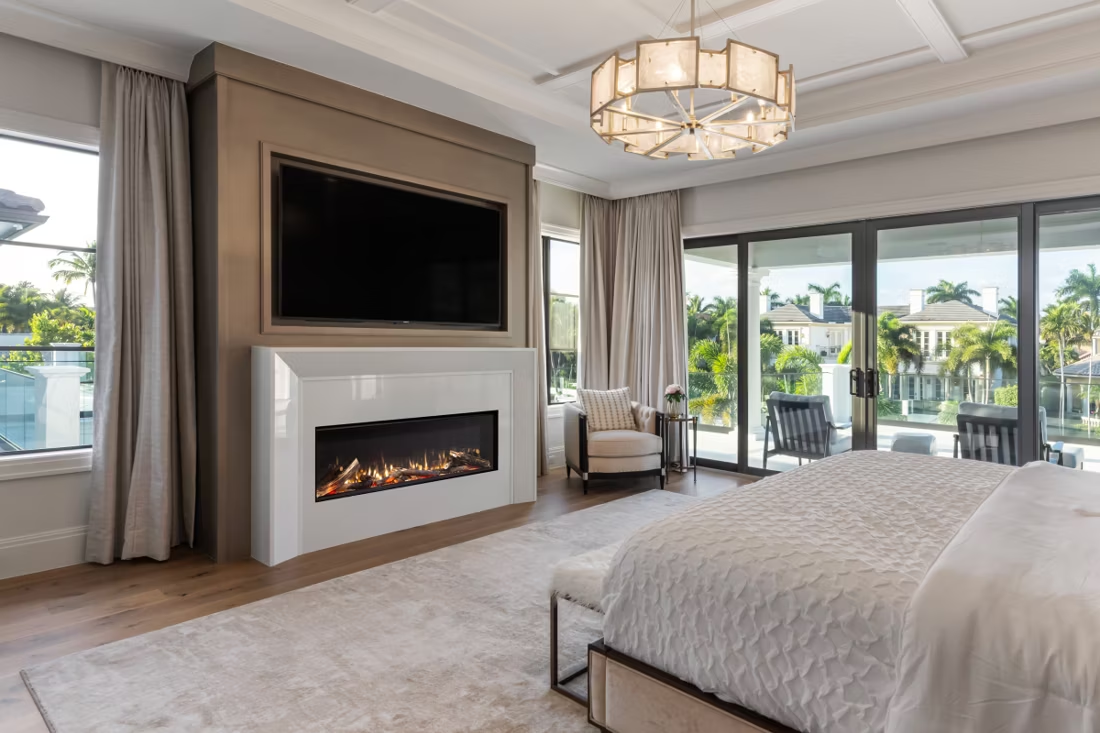
Yes—with an asterisk. Fireplaces are hot and TVs don't like heat. Either put a mantel between them to deflect rising warmth, or choose a fireplace with heat-management technology that creates a cool zone on the wall above—the wall stays around 125 degrees, barely warm, while the room still gets full heat. If you like clean lines and don't want a mantel, heat management is the answer.
Do electric fireplaces actually produce heat?
Yes—most put out around 4,800–5,000 BTUs from a standard outlet, which comfortably warms a bedroom, office, or den as a comfort-zone heater. What they won't do is carry a whole house the way wood, gas, or pellet can. Think of electric as ambiance-first with honest supplemental heat: flames on with no heat in July, flames plus warmth in January.
What is an in-home preview and do I need one?
It's a visit where a hearth professional measures your space, confirms the model you picked actually works in your home, and walks the specs—framing, gas line, venting, finish work—before anything is ordered. Some details you just can't know until you see the house. Never make a down payment without one; it's the single most-skipped step that burns buyers.
Can I install a fireplace myself?
If you're putting a fire in your house on purpose, it's best to work with an expert. Unless you're genuinely experienced in framing, gas line, vent pipe, and the national code on clearances to combustibles, have a professional do it—and ideally the same company that sells you the fireplace, so warranty, service, and liability all live under one roof.
Nearby Dealers
Hearth shops serving Halesite and the surrounding area. Every listing shows whether it is a WhyFire partner, a dealer we have verified as authorized for the brands we recommend, or a local business carrying hearth products. No manufacturer pays for placement. How we verify dealers →
We’ve paused dealer listings for this connection today. Enter your zip or postal code above to find dealers near you, or come back tomorrow.
Popular Electric Brands
Where each brand came from, what's inside it today, and every current model. No brand pays to be here. Not every dealer carries every brand, so enter your zip code to see what's sold near Halesite.
Fireplace Xtrordinair
Fireplace Xtrordinair, now often called FireplaceX, is the fireplace brand of Travis Industries, Inc., of Mukilteo, Washington.
5 electric models →DaVinci
DaVinci Custom Fireplaces is a brand of Travis Industries, Inc., of Mukilteo, Washington, the company behind Lopi and Fireplace Xtrordinair.
5 electric models →Kozy Heat
Kozy Heat was founded in 1976 by Dudley Hussong in Lakefield, Minnesota, and incorporated as Hussong Manufacturing Co., Inc. in 1978.
3 electric models →Forge & Flame
Forge & Flame is the stove brand Hearth & Home Technologies introduced in August 2023 to bring Vermont Castings, Harman, and Quadra-Fire under one name.
1 electric model →Electric Service in Halesite
An electric fireplace's heater draws about 1,500 watts—pennies per hour at local rates.
Fishers Island Utility Co Inc
Long Island Power Authority
Find your electric fireplace in Halesite.
Tell us about your home—including whether you've got an existing fireplace opening to work with—and we'll help you find a trusted local dealer and send over a free Project Guide & Parts List: the right unit, the circuit requirements, and mounting details specific to your space.
Find Your Fireplace →