
Warm, Reliable Heat for East Hampton North Winters.
Propane-fueled gas fireplaces and inserts built for Suffolk County's damp, salt-air winters—helping you find a trusted local dealer who handles the tank, the venting, and the permits.
Every Project Starts From One of These Five Situations
Clean heat where natural gas mains never reached.
East Hampton North sits low on the South Fork of Long Island, just 58 feet above sea level, where winter lows average 23°F and homes need a substantial amount of heat to get through a damp, wind-driven season. There's no wildfire smoke or winter inversion to worry about here—air quality isn't a local concern—but the coastal humidity and salt air shape how homes get heated. Gas has become the default choice for anyone who wants real, on-demand warmth without tending a fire, especially in the shingle-style and farmhouse homes that make up much of the hamlet.
Unlike much of the country, East Hampton North and the surrounding South Fork have no natural gas mains—homes run on propane, delivered and stored in a tank on the property. That changes the installation conversation slightly (tank sizing and placement matter as much as the fireplace itself), but the payoff is the same: instant heat at the flip of a switch, a unit that can keep running through a nor'easter power outage, and zone heating that takes pressure off the furnace on the coldest nights. With LIPA's residential electric rate running near 24.6 cents per kWh—and even higher on Fishers Island—propane gas heat is often the more economical choice for supplemental warmth in a house that sees regular use.
Three steps. No salesperson until you're ready.
Tell us about your project
Your zip code, your situation, and the fuel you're leaning toward—or let the answers point you to one.
See what's actually available
The brands dealers within 100 miles genuinely carry—real options, never a catalog mirage.
Get your dealer & Project Guide
A trusted local dealer, plus the free Project Guide & Parts List that names every component of the job.
Frequently Asked Questions
How much does a gas fireplace installation cost in East Hampton North?
A gas fireplace installation in East Hampton North typically runs $6,000 to $14,000—higher than many parts of the country because nearly every job here starts with propane rather than piped natural gas. A buried or pad-mounted propane tank adds roughly $1,500 to $3,000 before the fireplace itself goes in, unless the home already has a tank serving a range, water heater, or generator. A direct-vent insert into an existing masonry fireplace with propane already run to the house sits toward the lower end. New construction or a full renovation requiring a fresh tank, a new gas line, and venting through a cedar-shake exterior wall pushes toward the higher end. Local dealers size the fireplace and the tank together during a walkthrough.
Does East Hampton North have natural gas service, or is it propane only?
There's no natural gas main serving East Hampton North or most of the South Fork—homes here run on propane, delivered and stored in an above-ground or buried tank by regional suppliers. If your home already has a propane tank for the range, water heater, or a backup generator, tying in a gas fireplace is usually a straightforward line extension. If not, your installer will coordinate tank sizing—typically 120 to 500 gallons depending on total household propane use—with a local propane company as part of the installation.
Do I need a permit to install a gas fireplace in East Hampton North?
Yes. Gas fireplace installations fall under the Town of East Hampton Building Department, which requires a building permit along with sign-off from a licensed propane fitter for the fuel line. A number of properties in and around East Hampton North sit near the town's historic and scenic districts, so exterior vent placement can occasionally require a look from the town's design review process. A local hearth dealer who regularly works in East Hampton will typically fold all of this into the project timeline rather than leaving you to chase down approvals on your own.
Will my gas fireplace work if the power goes out?
Coastal storms and nor'easters make outages a real consideration on the South Fork, so most homeowners here choose a gas fireplace with intermittent pilot ignition (IPI) and battery backup, which lights on demand even when LIPA power is down. Valor fireplaces take it a step further—their pilot assembly generates its own electricity through the thermocouple, so there's no battery to remember to check. For a full-time or weekend home that may sit empty for stretches, that distinction is worth asking your local dealer about directly.
Gas fireplace, insert, or stove—what's the difference, and which fits my home?
East Hampton North's older shingle-style and farmhouse homes often have an existing masonry fireplace that rarely gets used, since opening the damper on a raw, damp coastal night does little for the room. A gas insert converts that fireplace into a sealed, high-efficiency heat source using the existing masonry as the chase. Newer construction or additions without an existing firebox are usually better suited to a built-in direct-vent gas fireplace, framed in during construction. A freestanding gas stove is a third option some owners prefer for a den, sunroom, or converted garage where a full fireplace surround isn't practical.
What's the difference between vented and vent-free gas fireplaces?
New York State permits vent-free gas fireplaces under certain conditions, but they carry minimum room-size requirements, require an oxygen depletion sensor, and can't be installed in bedrooms. Given how tightly built and well-insulated most newer East Hampton North homes are, local dealers generally steer clients toward direct-vent, sealed-combustion units instead—they draw combustion air from outside and exhaust it back outside, so they don't affect indoor air quality in a house buttoned up against coastal wind and salt air.
How often should my gas fireplace be serviced here?
An annual inspection before heating season is standard for any gas appliance, but the salt air off Gardiners Bay and the Atlantic accelerates corrosion on exterior vent caps and termination fittings faster than it would further inland. A technician should check the burner, pilot assembly, gas connections, and venting each year, and it's worth having them look closely at the exterior vent cap for salt corrosion on properties within a mile or two of the water. Plan on roughly $150 to $250 for a standard annual visit.
My home is seasonal—how does that change fireplace maintenance?
Many East Hampton North properties are weekend or seasonal homes, which changes the maintenance conversation. If the house sits empty for stretches in winter, ask your propane supplier about a will-call or automatic delivery schedule so the tank doesn't run dry in February, and have your installer confirm the pilot or IPI system is left in a safe standby setting while you're away. A local dealer who already services seasonal Hamptons homes will typically flag this during installation without being asked.
Gas vs. electric—which makes more sense for my East Hampton North home?
Wood and pellet stoves are uncommon here—there's no real cut-your-own firewood culture on this end of the South Fork, and many properties are second homes where an unattended wood fire isn't practical, so the real choice is gas versus electric. Electric fireplaces and inserts cost far less upfront, often $400 to $1,500, and need no fuel storage, but running one as a primary heat source against LIPA's residential rate of roughly $0.2457 per kWh—or the Fishers Island Utility's $0.3817 per kWh in that pocket of Suffolk County—gets expensive fast. Propane gas units cost more to install but deliver more heat per dollar over a full winter and keep working through a power outage, which matters given how often nor'easters take LIPA lines down.
Can I put a TV above my fireplace?
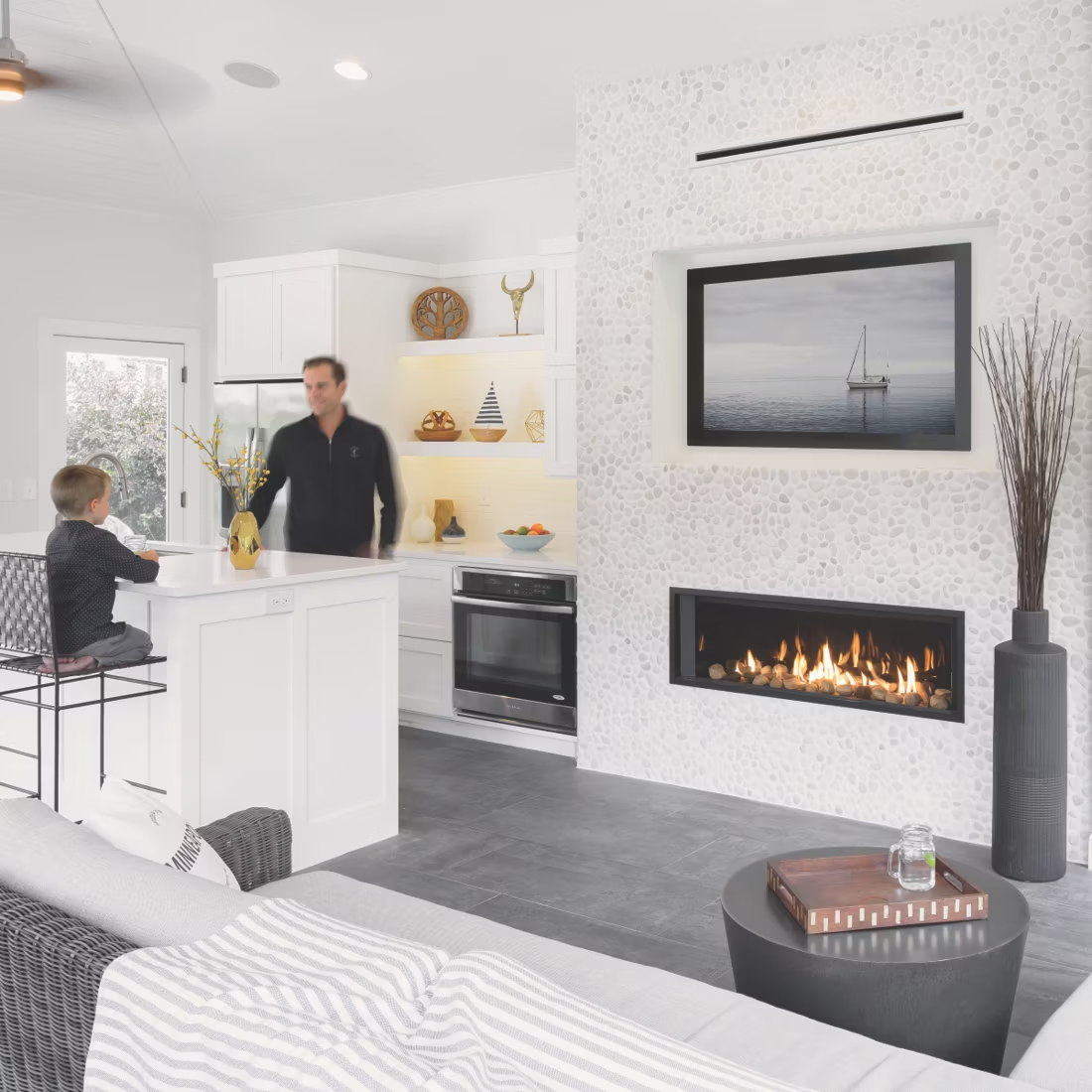
Yes—with an asterisk. Fireplaces are hot and TVs don't like heat. Either put a mantel between them to deflect rising warmth, or choose a fireplace with heat-management technology that creates a cool zone on the wall above—the wall stays around 125 degrees, barely warm, while the room still gets full heat. If you like clean lines and don't want a mantel, heat management is the answer.
Why is my open fireplace making my house colder?
Open fireplaces suck—literally. As the fire burns, it consumes air your furnace already paid to heat and pulls it out through the chimney, so the house is actually colder after the fire goes out than before you lit it. An insert fixes this: it seals the chimney, puts fixed glass across the front, and turns that hole in your house into a real heat source.
Can I install a fireplace myself?
If you're putting a fire in your house on purpose, it's best to work with an expert. Unless you're genuinely experienced in framing, gas line, vent pipe, and the national code on clearances to combustibles, have a professional do it—and ideally the same company that sells you the fireplace, so warranty, service, and liability all live under one roof.
Can a fireplace actually lower my heating bill?
Yes—by creating a comfort zone. A furnace heats every square foot of the house just to warm the one room you're in; a gas fireplace on low burns roughly a sixth of the gas a typical furnace does. Set the furnace around 55–60 degrees as a baseline, then heat the rooms your family actually uses. Families who heat this way commonly save $20–$60 a month.
Nearby Dealers
Hearth shops serving East Hampton North and the surrounding area. Every listing shows whether it is a WhyFire partner, a dealer we have verified as authorized for the brands we recommend, or a local business carrying hearth products. No manufacturer pays for placement. How we verify dealers →
We’ve paused dealer listings for this connection today. Enter your zip or postal code above to find dealers near you, or come back tomorrow.
Popular Gas Brands
Where each brand came from, what's inside it today, and every current model. No brand pays to be here. Not every dealer carries every brand, so enter your zip code to see what's sold near East Hampton North.
Kozy Heat
Kozy Heat was founded in 1976 by Dudley Hussong in Lakefield, Minnesota, and incorporated as Hussong Manufacturing Co., Inc. in 1978.
28 gas models →Fireplace Xtrordinair
Fireplace Xtrordinair, now often called FireplaceX, is the fireplace brand of Travis Industries, Inc., of Mukilteo, Washington.
25 gas models →Town & Country
Town & Country Fireplaces is the luxury gas fireplace brand of Pacific Energy Fireplace Products Ltd., of Duncan, British Columbia.
14 gas models →Lopi
Lopi is a wood, pellet, and gas stove brand founded by Kurt Rumens in Bellevue, Washington, in 1979.
7 gas models →Forge & Flame
Forge & Flame is the stove brand Hearth & Home Technologies introduced in August 2023 to bring Vermont Castings, Harman, and Quadra-Fire under one name.
6 gas models →Vermont Castings
Vermont Castings was founded in 1975 by Duncan Syme, the designer, and his brother-in-law Murray Howell, the business partner, in Randolph, Vermont.
6 gas models →Find your gas fireplace in East Hampton North.
Tell us a bit about your home and we'll help you find the right gas fireplace, insert, or stove—and hand you a free Project Guide & Parts List with a trusted local dealer who knows the propane, permitting, and venting details for this part of Suffolk County.
Find Your Fireplace →