
The clean, no-venting way to add fireplace warmth in Dutchess County.
From condos along the Poughkeepsie waterfront to farmhouses outside Millbrook and Pawling, electric fireplaces give Dutchess County homeowners real ambiance and zone heat without a chimney, a gas line, or a permit headache. Tell us about your space and we'll match you with a local dealer who installs it right.
Every Project Starts From One of These Five Situations
A supplemental heat option that fits historic homes and modern condos alike.
Dutchess County sits in climate zone 5A with a long, demanding heating season and winter lows averaging 19°F—cold enough that most homes run on oil, propane, or Central Hudson Gas & Electric-supplied heat as their primary system, especially outside the Poughkeepsie and Beacon natural gas corridor. That's exactly the situation where an electric fireplace earns its place: it's not meant to replace your furnace on a January night, but as zone heat for the room you actually live in, it can let you turn the thermostat down elsewhere and still feel warm on the couch.
The county's housing stock also matters here. Rhinebeck, Hyde Park, and the historic districts of Beacon and Poughkeepsie are full of older homes where adding a masonry chimney or running new gas line isn't realistic—and often isn't allowed under local historic-preservation rules. An electric insert dropped into an existing but unused fireplace opening, or a wall-mounted unit in a condo with no flue at all, solves that problem without touching the exterior of the house. It's also the fastest path for renters and Poughkeepsie or Beacon apartment dwellers who want real flame-effect ambiance without any structural work at all.
Three steps. No salesperson until you're ready.
Tell us about your project
Your zip code, your situation, and the fuel you're leaning toward—or let the answers point you to one.
See what's actually available
The brands dealers within 100 miles genuinely carry—real options, never a catalog mirage.
Get your dealer & Project Guide
A trusted local dealer, plus the free Project Guide & Parts List that names every component of the job.
Frequently Asked Questions
How much does an electric fireplace installation cost in Dutchess County?
A plug-in electric insert or freestanding unit that runs on a standard 120V outlet typically costs $150 to $1,000 installed, since there's often no electrical work beyond plugging it in. A built-in wall unit or a larger insert that needs a dedicated 240V circuit run from your panel—common in older Dutchess County homes with older electrical service—runs closer to $2,000 to $5,000 once an electrician is involved. Homes in Hyde Park, Rhinebeck, or other older housing stock sometimes need a panel upgrade first if the existing service can't support the added circuit, which adds to the cost. A local dealer will tell you which category your project falls into before you buy anything.
Does my electric fireplace need its own dedicated circuit?
It depends on the unit. Most compact electric inserts and freestanding stoves are designed to run on a standard 15-amp household circuit and just plug into a regular outlet—no electrician required. Larger built-in units, especially ones with higher wattage heaters meant to actually warm a room in a Dutchess County winter, often call for a dedicated 240V circuit for full heating performance. If your home still has older wiring or a smaller panel—something a licensed electrician can check in a few minutes—that's worth confirming before you commit to a specific model. Your local dealer will spec this out during the in-home consultation.
Can I install an electric fireplace in a historic home without a chimney?
Yes—this is one of the most common reasons Dutchess County homeowners choose electric in the first place. Homes in Rhinebeck's historic district, Hyde Park, and parts of Beacon and Poughkeepsie's older neighborhoods frequently have no working flue, or restrictions on altering the exterior for a new one. Because electric fireplaces produce no combustion byproducts and need no venting, they can go into an existing unused fireplace opening as an insert, be built into a wall, or stand freestanding against any interior wall with power nearby. There's no impact on the home's exterior and no historic-district review triggered by the work itself, though your local building department can confirm requirements for your specific address.
How much space can an electric fireplace actually heat?
Most electric fireplaces are rated to supplement heat in a single room of 400 to 1,000 square feet, producing roughly 4,000 to 5,000 BTUs—enough to take the edge off a living room or bedroom but not enough to replace central heat during a Dutchess County cold snap. With average winter lows around 19°F and one of the longer, more demanding heating seasons in the region, electric units are best used as zone heat layered on top of your existing furnace, boiler, or heat pump, not as a standalone system. If you're trying to heat a larger open-concept space or an entire small home, a wood or gas option will generally get you closer to whole-room warmth on the coldest nights.
Do I need a permit to install an electric fireplace in Dutchess County?
A simple plug-in unit generally doesn't require a permit since no wiring or structural work is involved. If your installation includes running a new dedicated circuit, adding an outlet, or building the unit into a wall or existing fireplace opening, an electrical permit is typically required through your local municipality's building department—Dutchess County includes multiple jurisdictions (the City of Poughkeepsie, City of Beacon, and town building departments in Hyde Park, Rhinebeck, and elsewhere), each handling permitting for their own area. A licensed local dealer or electrician will know which of those steps applies to your specific project and usually pulls the permit as part of the job.
Electric fireplace vs. gas insert—which is right for my home?
Gas gives you higher real heat output and can serve as a legitimate secondary heat source during a Dutchess County cold snap, but it requires either natural gas service (limited mostly to the Poughkeepsie and Beacon corridors served by Central Hudson) or a propane tank, plus venting work. Electric requires none of that—no gas line, no chimney, no venting—and installs in a fraction of the time and cost, but it won't meaningfully heat a large room on its own. For a condo, apartment, or historic home where altering the structure isn't an option, electric is usually the practical choice. For a primary living space in a home already on gas or propane where you want real supplemental warmth, a gas insert is worth the extra investment.
How much does it cost to run an electric fireplace on my utility bill?
Most electric fireplaces draw around 1,500 watts on the heater setting, which works out to roughly 15 to 20 cents per hour of use at typical Central Hudson Gas & Electric residential rates—so a few hours of evening use most winter nights adds a modest amount to your bill rather than a dramatic one. Running the flame effect alone, without the heater, uses only a small fraction of that. Compared to raising the thermostat on oil or propane whole-house heat, many Dutchess County homeowners find that using an electric fireplace to warm just the room they're in, and turning the rest of the house down slightly, is a net savings during the coldest stretch of the year.
I rent an apartment in Poughkeepsie or Beacon—can I still get an electric fireplace?
Yes, and it's one of the easiest hearth upgrades available to renters. A freestanding electric stove or a compact wall-mounted unit that plugs into a standard outlet requires no permanent alteration to the unit and can move with you when your lease ends. Some landlords in older Poughkeepsie and Beacon buildings will allow an insert into an existing decorative fireplace opening as well, though that's worth clearing with the property owner first since it typically involves at least minor fitting work. Either way, electric is the only fuel option that realistically works in most rental situations in the county.
Electric vs. wood—which makes more sense for my Dutchess County home?
Wood—burning local oak, maple, birch, or ash, all common species cut throughout the county—delivers far more heat output, works with no electricity at all during an outage, and has been the traditional backup heat source for rural Dutchess homes for generations. Electric offers none of that off-grid resilience, but it wins on convenience: no ash, no chimney maintenance, no wood storage, and instant on-off operation with a remote. For a primary or backup heat source in a rural home outside town, especially one already set up for wood, wood remains the stronger choice. For ambiance and light supplemental warmth in a condo, apartment, or historic home where a chimney isn't practical, electric is the realistic option.
Can I put a TV above my fireplace?
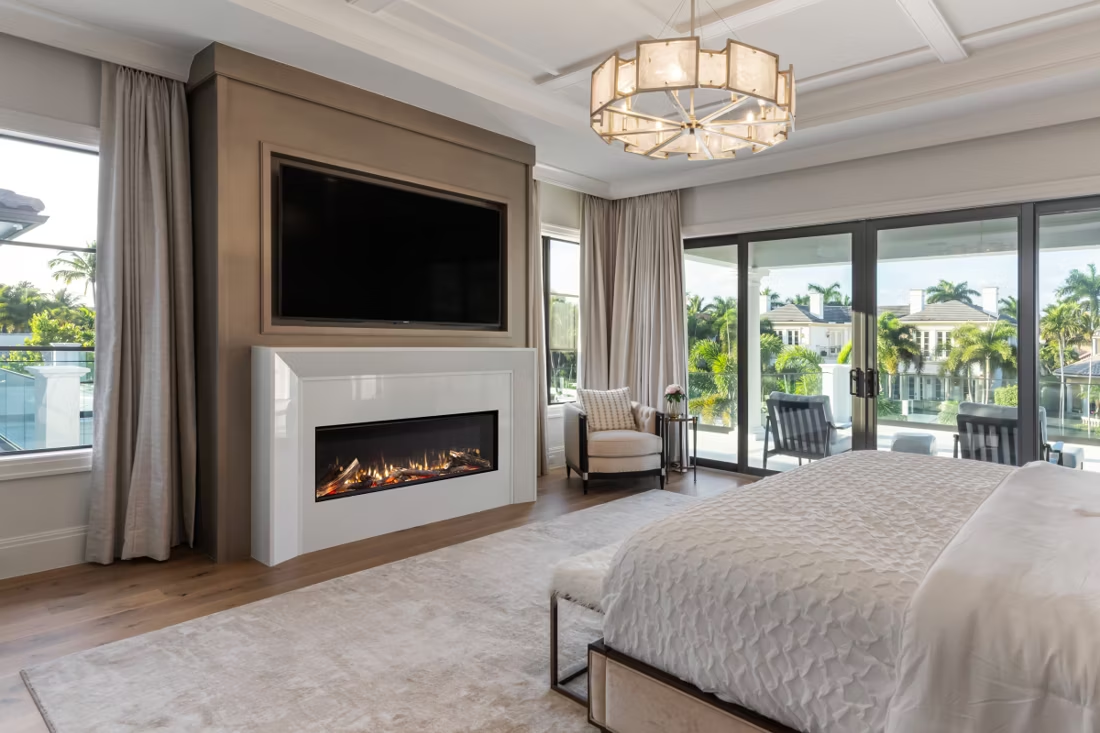
Yes—with an asterisk. Fireplaces are hot and TVs don't like heat. Either put a mantel between them to deflect rising warmth, or choose a fireplace with heat-management technology that creates a cool zone on the wall above—the wall stays around 125 degrees, barely warm, while the room still gets full heat. If you like clean lines and don't want a mantel, heat management is the answer.
Do electric fireplaces actually produce heat?
Yes—most put out around 4,800–5,000 BTUs from a standard outlet, which comfortably warms a bedroom, office, or den as a comfort-zone heater. What they won't do is carry a whole house the way wood, gas, or pellet can. Think of electric as ambiance-first with honest supplemental heat: flames on with no heat in July, flames plus warmth in January.
How much should I budget for a fireplace?
For an average home—covering the fireplace, the vent pipe, and basic installation—a budget between $3,900 and $5,500 gives you a lot of options across wood, gas, and pellet. By the time you add finish work, gas line, and electrical, the average complete installation lands between $5,000 and $12,000 all-in. In a remodel or new build, a good rule is to put about 2.5% of the total project cost toward the fireplace.
Can I install a fireplace myself?
If you're putting a fire in your house on purpose, it's best to work with an expert. Unless you're genuinely experienced in framing, gas line, vent pipe, and the national code on clearances to combustibles, have a professional do it—and ideally the same company that sells you the fireplace, so warranty, service, and liability all live under one roof.
Stove and Fireplace Dealers in Dutchess County
Find your electric fireplace in Dutchess County.
Tell us about your home—condo, historic house, or rental—and we'll send you a free Project Guide & Parts List with the exact unit and circuit requirements for your space, plus a match to a trusted local dealer.
Find Your Fireplace →