
Reliable Warmth for Somerset's Coldest Nights.
Central Jersey winters call for dependable, instant heat. Find the right gas fireplace or insert for your home, and connect with a trusted local dealer.
Every Project Starts From One of These Five Situations
The default heat source for Central Jersey homes.
Somerset sits along the Raritan River corridor in Franklin Township, just south of New Brunswick and Rutgers University, at a modest 114 feet of elevation. Winters here bring an average low around 23°F and a heating season with a workload roughly comparable to what you'd get from a moderate winter climate—nothing like harsher climates like Duluth, MN, but still enough to make reliable heat essential from November through March. Public Service Electric & Gas (PSE&G) runs extensive natural gas mains throughout Somerset County, and that infrastructure shapes how homeowners here heat their homes.
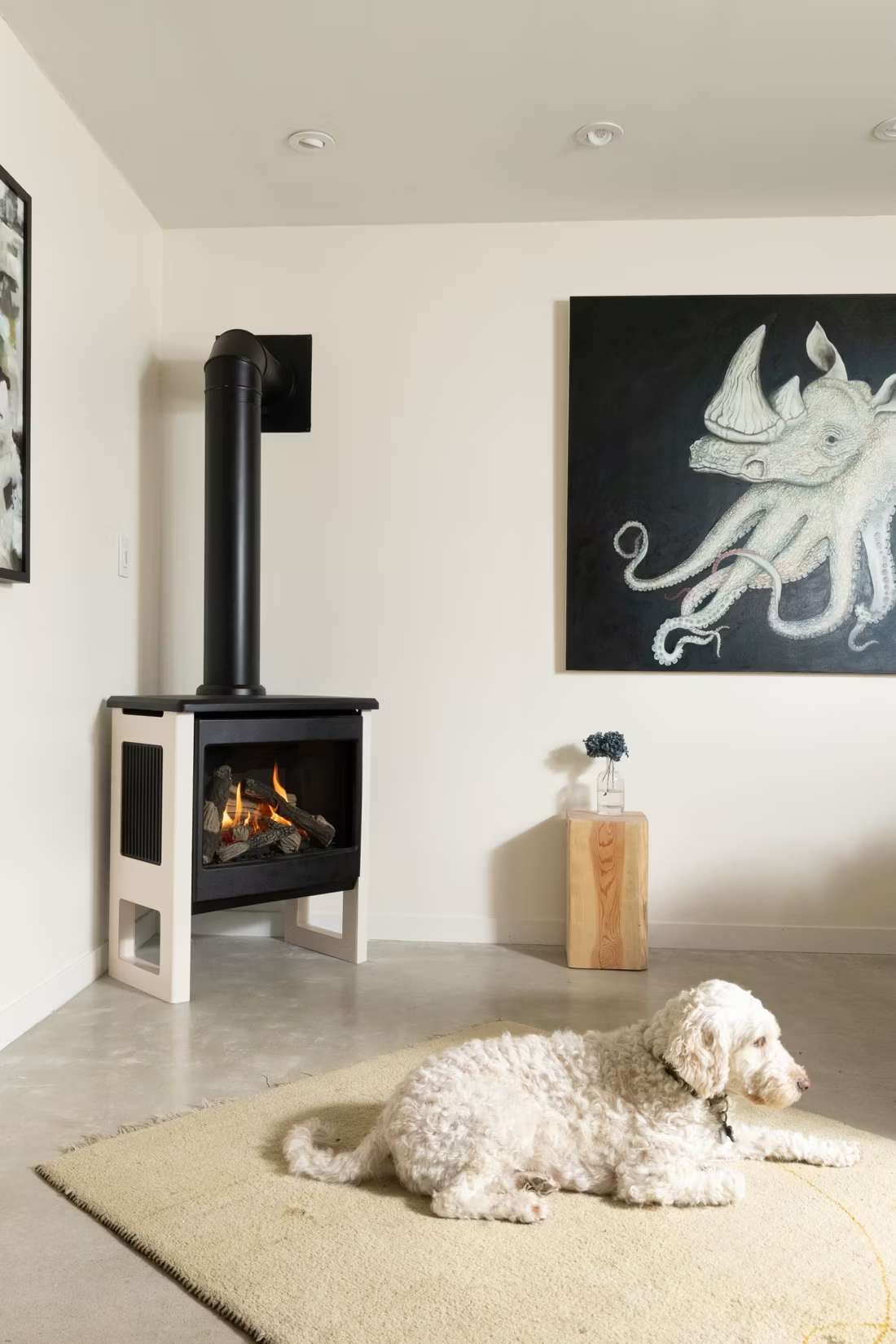
Wood-burning is genuinely rare in Somerset—the dense, close-lot suburban development typical of this part of Franklin Township, combined with near-universal PSE&G gas access, means most homeowners never consider cutting or stacking cordwood. Gas has become the default for both primary heating backup and ambiance: split-level and colonial homes built here in the 1960s through 1980s often already have a gas line run for a furnace or range, which makes adding a direct-vent fireplace or converting an existing masonry hearth to gas a straightforward upgrade. It's zone heat you can flip on instantly, without the maintenance a wood system demands.
Three steps. No salesperson until you're ready.
Tell us about your project
Your zip code, your situation, and the fuel you're leaning toward—or let the answers point you to one.
See what's actually available
The brands dealers within 100 miles genuinely carry—real options, never a catalog mirage.
Get your dealer & Project Guide
A trusted local dealer, plus the free Project Guide & Parts List that names every component of the job.
Frequently Asked Questions
How much does a gas fireplace installation cost in Somerset?
Most gas fireplace installations in Somerset fall between roughly $4,000 and $10,000, depending on the unit and the venting path. A direct-vent gas insert dropped into an existing masonry fireplace, with a gas line already run to the chimney, sits toward the lower end. A new built-in gas fireplace for a remodel or an addition—with fresh framing, direct venting through an exterior wall, and a new gas line tie-in to the PSE&G meter—runs higher. Because PSE&G gas service already reaches nearly every home in this part of Franklin Township, the gas hookup itself is rarely the expensive part; venting and framing usually drive the cost.
Can I convert my existing wood fireplace to gas?
Yes, and it's a common project among Somerset's older split-level and colonial homes, many of which were built with a working masonry fireplace decades before gas fireplaces became widespread. A gas insert typically slides into the existing firebox with a stainless liner run up the original chimney, and costs generally land between $4,500 and $8,500 depending on the insert and whether the gas line needs to be extended from an existing appliance run. Since almost every home in the area is already on PSE&G gas service for the furnace or water heater, tying in a fireplace line is usually a modest add rather than a new utility hookup.
Do I need natural gas, or should I consider propane?
Natural gas is the near-universal choice in Somerset. PSE&G's distribution network covers this section of Franklin Township thoroughly, so if your home already has gas heat, a gas water heater, or a gas range, adding a fireplace on the same line is straightforward. Propane shows up mainly in a handful of more rural pockets farther out in Somerset County—it's not the typical path for homeowners inside the 08873 zip code. Ask your installer to confirm your home's existing gas service before assuming a tank installation is needed.
Will my gas fireplace work during a power outage?
Most modern gas fireplaces will, which matters in a PSE&G service area that sees its share of outages from Nor'easters and summer thunderstorms. Units with IPI (intermittent pilot ignition) run on a battery backup that kicks in the moment power drops, so the fireplace lights on demand just like normal. Valor's gas fireplaces go a step further—their pilot assembly generates its own electricity through the thermocouple, so there's no battery to remember at all. If storm-driven outages are a real concern for your household, ask your local dealer to walk you through the ignition options before you choose a unit.
What's the difference between a gas fireplace, gas insert, and gas stove?
A gas fireplace is a fully built-in unit framed into a wall—the right choice for new construction or a remodel where no fireplace currently exists. A gas insert is sized to fit into an existing masonry firebox, which is common in Somerset's older colonials and split-levels, and it reuses the existing chimney as its vent path with a liner. A gas stove is a freestanding cast-iron or steel unit that sits on the floor and vents through a wall or existing chimney, without needing a built-in enclosure. For most homes in this area with an existing hearth, an insert is the simplest upgrade; homes without one usually go with a built-in unit or a freestanding stove.
Do I need a permit to install a gas fireplace in Somerset?
Yes. Somerset falls under Franklin Township, and the Franklin Township Building Department requires both a building permit and a gas line permit for new gas fireplace or insert installations, along with a licensed gas-fitter for the line work. Most hearth retailers in the area coordinate this as part of the install, scheduling the gas inspection and the final building sign-off together so you're not managing separate trades yourself.
What's the difference between vented and vent-free gas fireplaces?
Vented (direct-vent) units draw combustion air from outside and exhaust it back outside through a sealed pipe—they're the cleanest, most universally approved option and the one most Somerset homeowners choose. Vent-free units burn directly into the room without external venting; New Jersey permits them, but only within strict room-size and oxygen-depletion-sensor requirements, and they're not appropriate for tightly sealed newer construction or bedrooms. Given how widely PSE&G gas service is already run through Somerset homes, most local installers steer customers toward direct-vent models for both performance and simplicity.
How often should my gas fireplace be serviced?
Plan on an annual inspection, ideally in early fall before the heating season ramps up. A certified technician checks the burner, pilot assembly, venting, and gas connections, and cleans the glass and interior—a much smaller job than chimney sweeping for a wood system, but still important. Local gas appliance service providers in the Somerset/Franklin Township area typically charge $150 to $250 for a standard annual visit.
Why is gas so much more common than wood in Somerset?
Wood-burning fireplaces and stoves are genuinely uncommon here. Somerset's lots tend to be smaller and closer together than in more rural parts of the state, which makes storing and seasoning cordwood impractical for most households, and PSE&G's gas mains already reach nearly every home in this part of Franklin Township. The oak, hickory, and maple that grow throughout central New Jersey would burn well enough, but almost nobody is set up to source, season, and store it here—a small number of homeowners still install a wood stove for occasional ambiance or a vacation property elsewhere, but for year-round heat in Somerset, gas is the practical default.
Why is my open fireplace making my house colder?
Open fireplaces suck—literally. As the fire burns, it consumes air your furnace already paid to heat and pulls it out through the chimney, so the house is actually colder after the fire goes out than before you lit it. An insert fixes this: it seals the chimney, puts fixed glass across the front, and turns that hole in your house into a real heat source.
What's the difference between an insert and a zero-clearance fireplace?
An insert is a fireplace that slides into a pre-existing wood-burning fireplace—if you don't have one, there's nothing to insert it into. A zero-clearance fireplace is built into a framed wall, which makes it the answer for remodels and new construction. Simple test: existing masonry fireplace means insert; blank or framed wall means zero-clearance.
What is an in-home preview and do I need one?
It's a visit where a hearth professional measures your space, confirms the model you picked actually works in your home, and walks the specs—framing, gas line, venting, finish work—before anything is ordered. Some details you just can't know until you see the house. Never make a down payment without one; it's the single most-skipped step that burns buyers.
How much should I budget for a fireplace?
For an average home—covering the fireplace, the vent pipe, and basic installation—a budget between $3,900 and $5,500 gives you a lot of options across wood, gas, and pellet. By the time you add finish work, gas line, and electrical, the average complete installation lands between $5,000 and $12,000 all-in. In a remodel or new build, a good rule is to put about 2.5% of the total project cost toward the fireplace.
Nearby Dealers
Hearth shops serving Somerset and the surrounding area.
Costello's Hearth & Spa - Bernardsville
Find your gas fireplace in Somerset.
Tell us about your home and we'll match you with a trusted local dealer, plus a free Project Guide & Parts List—the exact parts, vent kit, and recommended installer for your Somerset gas fireplace project.
Find Your Fireplace →