
Real fire ambiance, zero chimney required.
Guttenberg's high-rises and rowhomes weren't built for chimneys. Electric fireplaces deliver heat and ambiance anyway—find the right unit and a trusted local dealer.
Every Project Starts From One of These Five Situations
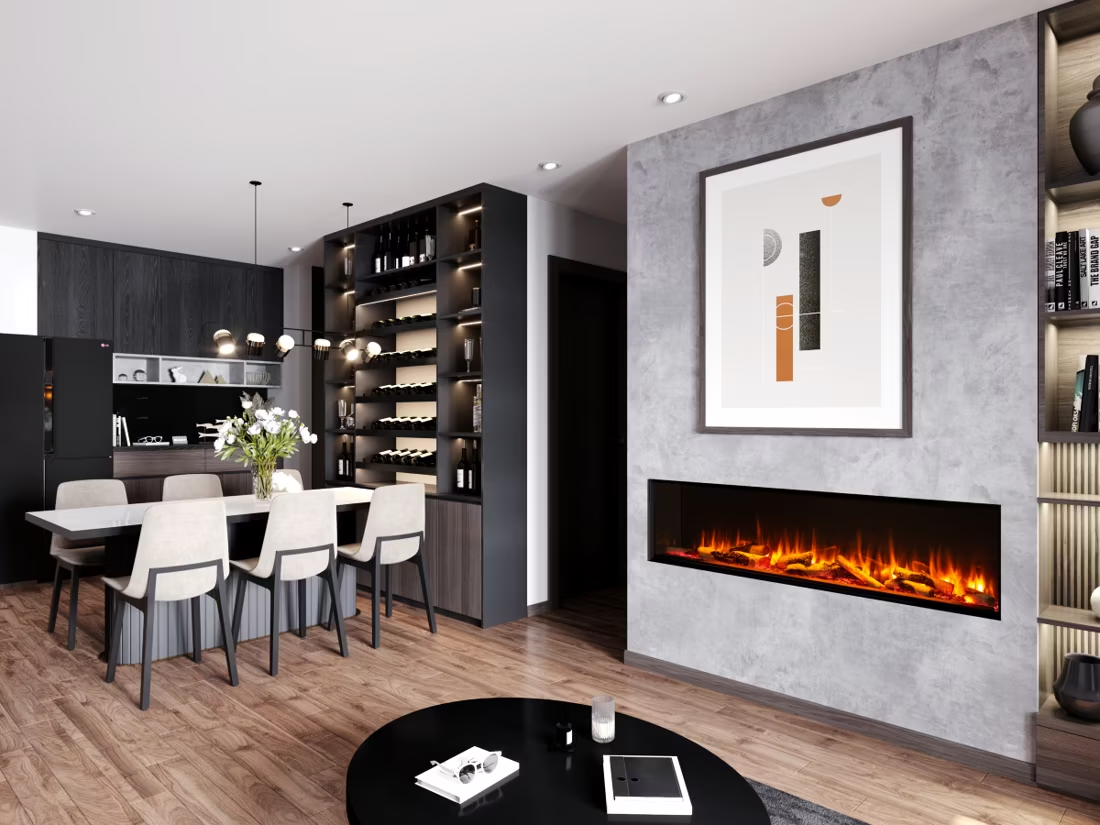
Built for high-rise living on the Palisades.
Guttenberg is one of the most densely populated municipalities in the country—a one-square-mile town of mid-rise and high-rise apartment buildings stacked along the Hudson Palisades, most with sweeping Manhattan views and none with a place to run a masonry chimney. At 190 feet elevation with a climate zone 4A profile, winters here are real but moderate: average lows around 28°F and a heating season meaningfully milder than Buffalo, NY or Burlington, VT. That combination—cold enough to want supplemental heat, but no chimney infrastructure to speak of—is exactly why electric fireplaces have become the default choice in town rather than a fallback.
Wood stoves and pellet stoves are essentially non-existent in Guttenberg's housing stock; between co-op and condo board restrictions, shared walls, and buildings with no venting path to the exterior, they're simply not a fit here, and most local dealers won't even carry them for this market. Gas fireplaces remain a solid option where a unit already has a gas line or venting chase, but for renters, condo owners, and anyone without a masonry fireplace, electric wins on flexibility—plug into an existing outlet or have a licensed electrician run a dedicated 120V or 240V circuit, and you're done. Public Service Electric & Gas (PSE&G) serves the town at a residential rate around $0.1981 per kWh, a bit above the national average, which is worth factoring into how you think about running cost versus a gas alternative.
Three steps. No salesperson until you're ready.
Tell us about your project
Your zip code, your situation, and the fuel you're leaning toward—or let the answers point you to one.
See what's actually available
The brands dealers within 100 miles genuinely carry—real options, never a catalog mirage.
Get your dealer & Project Guide
A trusted local dealer, plus the free Project Guide & Parts List that names every component of the job.
Frequently Asked Questions
How much does an electric fireplace installation cost in Guttenberg?
Plug-in electric fireplace inserts and stoves that use a standard 120V outlet typically run $300 to $1,200 installed, with no electrician or permit needed in most cases—this covers the bulk of what's practical in Guttenberg's apartment and condo buildings. Built-in linear electric fireplaces or wall units that require a dedicated circuit run higher, typically $2,000 to $5,000, once you add an electrician to run new wiring and a carpenter or installer to frame the surround. Given PSE&G's residential rate near $0.1981 per kWh, most owners run these units a few hours a day rather than continuously—a 1,500-watt heater setting costs roughly 30 cents an hour to operate.
Can I install an electric fireplace in my Guttenberg condo or rental?
In most cases, yes, and it's the main reason electric has become the standard fuel choice in town. Plug-in units need no chimney, no gas line, and no exterior venting, which sidesteps the restrictions most Guttenberg co-op and condo boards place on wood or gas appliances. That said, always check your building's house rules before a built-in installation that involves cutting into a wall or adding a dedicated circuit—some boards require sign-off even for electrical work that doesn't touch shared systems. Freestanding and mantel-style units you simply plug in generally don't require any board approval at all.
Do I need a permit to install an electric fireplace in Guttenberg?
A plug-in electric fireplace or insert that runs off an existing outlet typically doesn't require a permit. If you're having an electrician install a new dedicated circuit for a built-in unit, that electrical work does require a permit through the Guttenberg Building Department, and it should be pulled by the licensed electrician doing the work rather than left to you. There's no fire-suppression or venting inspection involved the way there would be with gas or wood—the permit, when needed, is strictly about the electrical circuit.
How much does it cost to run an electric fireplace in Guttenberg?
Most electric fireplaces draw around 1,500 watts on the heat setting and much less (often under 100 watts) running flame-effect only with no heat. At PSE&G's residential rate of roughly $0.1981 per kWh, that works out to about 30 cents an hour on full heat, or a few cents an hour for ambiance-only use. Running one for three hours a night, five nights a week, on heat costs somewhere around $18 to $20 a month—modest compared to running central heat harder to compensate for a cold room, which is often the actual use case in a drafty older Guttenberg rowhome or top-floor unit.
What's the difference between a plug-in electric insert and a built-in electric fireplace?
A plug-in insert or freestanding stove connects to a standard 120V outlet and can be installed by pretty much anyone in an afternoon—no electrician, no permit, no board approval in most buildings. A built-in electric fireplace, often a linear wall unit, is recessed into a wall or custom surround and frequently wired to a dedicated 240V circuit for stronger heat output, which does require an electrician and typically a permit. For most Guttenberg apartments and condos, a quality plug-in insert delivers nearly the same look and warmth without touching your building's electrical system or requiring board sign-off—it's the lower-friction option for renters especially.
Electric vs. gas fireplace—which makes more sense in Guttenberg?
Gas fireplaces deliver more real heat output and a closer approximation of a live flame, but they need either an existing gas line and venting chase or significant work to add one—a real constraint in Guttenberg's high-rise and rowhome stock where running new gas lines through shared walls is often impractical or board-restricted. Electric fireplaces install almost anywhere with a standard outlet, work in rentals without landlord sign-off, and avoid combustion byproducts entirely, though they cost more per hour to run given PSE&G's residential rate near $0.1981/kWh and top out around 5,000-6,000 BTU of supplemental heat rather than serving as a real primary heat source. For most condo and apartment situations in town, electric is the practical default; homes or units already plumbed for gas may still prefer it for the heat output.
Is an electric fireplace enough heat for a Guttenberg apartment?
Electric fireplaces are supplemental heaters, not replacements for central heat—most units max out around 5,000 to 6,000 BTU, enough to take the edge off a single room but not to carry a whole apartment through a Guttenberg winter with lows averaging around 28°F. They work well paired with existing radiator or forced-air heat, especially in older buildings with one persistently cold room, or as ambiance with the heat function left off entirely. If you're hoping to meaningfully lower a heating bill rather than just add comfort to one room, talk to a local dealer about realistic expectations for your specific unit and room size before buying.
Why don't wood or pellet stoves show up as options in Guttenberg?
Wood and pellet stoves need a real venting path—a chimney or an exterior wall for a pellet vent pipe—and Guttenberg's housing stock, dominated by mid-rise and high-rise apartment buildings with shared walls and no chimney infrastructure, simply doesn't offer that in most units. Co-op and condo boards also routinely prohibit combustion appliances that require exterior venting. It's not that wood or pellet heat wouldn't work technically in this climate zone—plenty of homes an hour outside the city burn oak, hickory, and maple without issue—it's that Guttenberg's building types make it a non-starter for the vast majority of residents. Electric and, where gas lines already exist, gas fireplaces are what local dealers actually stock and install here.
Can I install an electric fireplace myself, or do I need a professional?
A basic plug-in insert or freestanding electric stove is genuinely a DIY-friendly project—plug it in, and in many cases mount a bracket to the wall if it's a wall-hung unit. Built-in linear fireplaces or any installation involving a new dedicated circuit should go through a licensed electrician, both for safety and because that's the work a Guttenberg Building Department permit would apply to. A local dealer can also help make sure the unit you're buying actually fits your wall cavity or surround dimensions—a detail that matters more in older Guttenberg buildings with non-standard stud spacing than it does in new construction.
Can I put a TV above my fireplace?
Yes—with an asterisk. Fireplaces are hot and TVs don't like heat. Either put a mantel between them to deflect rising warmth, or choose a fireplace with heat-management technology that creates a cool zone on the wall above—the wall stays around 125 degrees, barely warm, while the room still gets full heat. If you like clean lines and don't want a mantel, heat management is the answer.
Does an electric fireplace need a vent or chimney?
No—that's its superpower. An electric fireplace needs a wall and an outlet, period. No vent pipe, no gas line, no clearances to design around, which is why it works in bedrooms, offices, apartments, and walls where venting a gas or wood unit would be impractical or impossible. Installation is typically the simplest and least expensive of any fireplace type.
Can a fireplace actually lower my heating bill?
Yes—by creating a comfort zone. A furnace heats every square foot of the house just to warm the one room you're in; a gas fireplace on low burns roughly a sixth of the gas a typical furnace does. Set the furnace around 55–60 degrees as a baseline, then heat the rooms your family actually uses. Families who heat this way commonly save $20–$60 a month.
What is an in-home preview and do I need one?
It's a visit where a hearth professional measures your space, confirms the model you picked actually works in your home, and walks the specs—framing, gas line, venting, finish work—before anything is ordered. Some details you just can't know until you see the house. Never make a down payment without one; it's the single most-skipped step that burns buyers.
Nearby Dealers
Hearth shops serving Guttenberg and the surrounding area. Every listing shows whether it is a WhyFire partner, a dealer we have verified as authorized for the brands we recommend, or a local business carrying hearth products. No manufacturer pays for placement. How we verify dealers →
Big Apple Fireplaces
Harris Hearth And Home
D & D Design Center
Flue Tech
Hot Concepts Fireplaces
All Shore Appliance
County Woodstoves Inc
Costello's Hearth & Spa - Garden City Park
Mcnamara Fireplace And Stove
Kjb Fireplaces
Westchester Fireplace
The Valley Fireplace
L&R Fireplace & Barbecue
Light N Grid
Fireplaces R Us
Fireplaces By Design
Electric Service in Guttenberg
An electric fireplace's heater draws about 1,500 watts—pennies per hour at local rates.
Public Service Elec & Gas Co
Find your electric fireplace in Guttenberg.
Tell us about your space and we'll put together a free Project Guide & Parts List—the right unit, the exact parts, and a trusted local Guttenberg-area dealer to install it.
Find Your Fireplace →