
Add heat and ambiance without a chimney in Washington County.
From Blair to Fort Calhoun, Arlington, Kennard, and Herman, electric fireplaces give Washington County homes zone heat and real flame-effect ambiance with no venting, no masonry, and no gas line. Find the right unit and connect with a trusted local dealer.
Every Project Starts From One of These Five Situations
The easiest fireplace upgrade in the county.
Washington County sits along the Missouri River bluffs northwest of Omaha, with a winter heating load nearly as demanding as Fargo, ND and average winter lows around 13°F—a cold-climate profile closer to Fargo, ND than most people expect from eastern Nebraska. Farmhouses scattered between Blair, Fort Calhoun, and Herman have long relied on wood and propane for serious winter heat, but as the county has grown as an Omaha bedroom community—new construction near Blair, finished basements, additions, and older homes without a working chimney—electric fireplaces have become one of the most common upgrades homeowners make.
Omaha Public Power District (OPPD) serves most of Washington County, and that reliable grid is exactly what makes electric fireplaces work so well here for supplemental, zone-based heat. There's no chimney to build, no gas line to run, and in most cases no venting at all—which matters in condos and apartments around Blair, rental properties, and any room where a masonry fireplace was never an option. A local dealer can size the right unit for a den, basement rec room, or primary bedroom and have it running the same day in many cases, with a built-in unit requiring only a licensed electrician for the circuit.
Three steps. No salesperson until you're ready.
Tell us about your project
Your zip code, your situation, and the fuel you're leaning toward—or let the answers point you to one.
See what's actually available
The brands dealers within 100 miles genuinely carry—real options, never a catalog mirage.
Get your dealer & Project Guide
A trusted local dealer, plus the free Project Guide & Parts List that names every component of the job.
Frequently Asked Questions
How much does an electric fireplace installation cost in Washington County?
A plug-in electric fireplace or mantel package typically runs $400 to $1,200 installed, since most units simply plug into a standard outlet with no electrical work required. Built-in electric fireplaces or wall-mounted linear units that need a dedicated 120V or 240V circuit run closer to $1,200 to $2,200 once a licensed electrician is involved. Costs are generally lower than wood or gas installs in Washington County because there's no chimney, venting, or gas line to account for—the bulk of the cost is the unit itself and any surround or built-in cabinetry work.
Do I need a permit to install an electric fireplace in Washington County?
Most plug-in electric fireplaces don't require a permit since they use a standard outlet like any other appliance. If you're installing a built-in unit that requires a new dedicated circuit or any rewiring, an electrical permit is typically required through the Washington County Building Department, or through the City of Blair if the home is within city limits. Local dealers who install built-in units generally coordinate the electrician and permit as part of the job, so there's rarely anything you need to file yourself.
What size electric fireplace do I need for my room?
Sizing an electric fireplace is mostly about the room, not the whole house—most units top out around 5,000 to 9,000 BTU of supplemental heat, enough to comfortably warm a single room like a den, basement rec room, or primary bedroom in the 300 to 500 square foot range. For larger open-concept spaces common in newer Blair-area construction, you may want two zones of heat or a wider linear unit rather than relying on one fireplace to cover the whole room. Given Washington County's long, demanding winter heating season, an electric fireplace should be planned as a supplement to your furnace, not a replacement for it.
Will my electric fireplace work during a power outage?
No—electric fireplaces require power to run the heater and flame-effect display, so they go dark along with the rest of the house during an outage. Washington County sees occasional ice storms and high-wind events that can knock out OPPD service for hours at a time, so if backup heat during outages is a priority, a wood stove or a gas unit with battery-backed ignition is a better fit as either a primary or secondary heat source. Electric fireplaces are best understood as a convenience and ambiance upgrade rather than storm-ready heat.
What's the difference between an electric fireplace, insert, and mantel package?
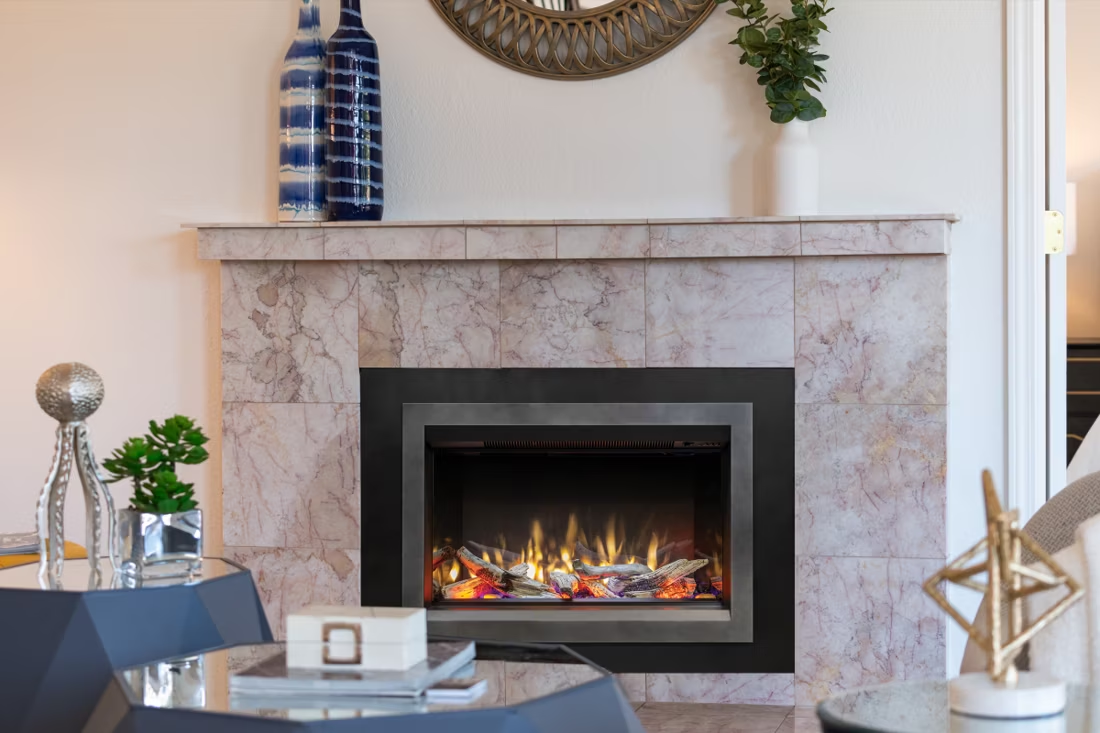
An electric fireplace insert is built to slide into an existing fireplace opening, often replacing an old wood-burning setup without any venting changes. A built-in electric fireplace is designed to be framed into a wall—common in new construction and remodels around Blair and Arlington—and typically needs a dedicated circuit. A mantel package pairs a freestanding or wall-mount electric unit with a surround and shelf, requiring nothing more than an outlet, which makes it the fastest and lowest-cost option for most Washington County homes.
What's the best electric fireplace for Washington County's climate?
Since Washington County's winters run cold enough—average lows near 13°F—that no electric fireplace alone will carry a whole home, the best choice is usually a unit with a strong secondary heater output paired with your existing furnace. Linear electric fireplaces with realistic LED flame technology work well in basements and additions where you want ambiance most of the year and real supplemental warmth on the coldest days. Local dealers can match the heater capacity to your specific room size and insulation level rather than relying on a generic BTU-per-square-foot rule.
How much does it cost to run an electric fireplace?
Most electric fireplaces draw around 1,500 watts on the heater setting, which at typical OPPD residential rates costs roughly 12 to 18 cents per hour of heater use—flame-only mode with the heater off costs only a fraction of that. Compared to running a furnace to heat an entire home through a Washington County winter, using an electric fireplace to zone-heat one occupied room while keeping the thermostat lower elsewhere can meaningfully reduce a winter electric bill.
Electric vs. gas fireplace—which is right for my home?
Gas fireplaces put out real, sustained heat and a genuine flame, and propane or natural gas service is available to most of the county for homeowners who want a primary or serious secondary heat source. Electric fireplaces trade some heat output and flame realism for near-zero installation complexity—no gas line, no venting, and often no permit at all. For a rental unit, basement remodel, or a room where running gas isn't practical, electric wins on simplicity. For a main living area where you want a fireplace to genuinely contribute to heating the house through a Washington County winter, gas is usually the stronger choice.
Electric vs. wood—which is right for my home?
Wood heat has deep roots in Washington County's farm country, where oak, hickory, and cottonwood are the common local species people burn, and a wood stove keeps working with zero electricity during storm outages. Electric fireplaces can't match that resilience or heat output, but they skip the wood handling, ash cleanup, and chimney maintenance entirely—a real advantage for townhomes in Blair, rental properties, or anyone who wants fireplace ambiance without the upkeep of a wood-burning setup. Many households end up with both: wood or gas for genuine winter heat, electric for the rooms where convenience matters more.
Do electric fireplaces actually produce heat?
Yes—most put out around 4,800–5,000 BTUs from a standard outlet, which comfortably warms a bedroom, office, or den as a comfort-zone heater. What they won't do is carry a whole house the way wood, gas, or pellet can. Think of electric as ambiance-first with honest supplemental heat: flames on with no heat in July, flames plus warmth in January.
Can I put a TV above my fireplace?
Yes—with an asterisk. Fireplaces are hot and TVs don't like heat. Either put a mantel between them to deflect rising warmth, or choose a fireplace with heat-management technology that creates a cool zone on the wall above—the wall stays around 125 degrees, barely warm, while the room still gets full heat. If you like clean lines and don't want a mantel, heat management is the answer.
Can I install a fireplace myself?
If you're putting a fire in your house on purpose, it's best to work with an expert. Unless you're genuinely experienced in framing, gas line, vent pipe, and the national code on clearances to combustibles, have a professional do it—and ideally the same company that sells you the fireplace, so warranty, service, and liability all live under one roof.
Can a fireplace actually lower my heating bill?
Yes—by creating a comfort zone. A furnace heats every square foot of the house just to warm the one room you're in; a gas fireplace on low burns roughly a sixth of the gas a typical furnace does. Set the furnace around 55–60 degrees as a baseline, then heat the rooms your family actually uses. Families who heat this way commonly save $20–$60 a month.
Find your electric fireplace in Washington County.
Tell us a bit about your home and we'll put together a free Project Guide & Parts List for your electric fireplace project—the right unit, the parts you'll need, and a trusted local Washington County dealer to install it.
Find Your Fireplace →