
Electric heat that never touches a historic wall.
No flue, no gas line, no exterior venting—just plug-in warmth for the stone Creole houses, vertical-log cabins, and river-bottom homes of Ste. Genevieve County. Find the right unit and a trusted local dealer to install it.
Every Project Starts From One of These Five Situations
Heat that respects three centuries of French colonial architecture.
Ste. Genevieve County, home to about 7,400 people, holds the oldest permanent European settlement west of the Mississippi—a town of poteaux-en-terre (post-in-ground) vertical log houses and stone Creole cottages now protected as part of Ste. Genevieve National Historical Park. Winters here are climate zone 4A, with an average low around 24°F and roughly 4,576 heating degree days a year—a real but moderate heating season, nothing like the sustained deep freeze you'd find in Duluth or Fargo, but enough that most homes run supplemental heat from November through March.
For homes inside the historic core along Merchant and Main, adding a wood-burning insert or a gas line often means cutting into 200-year-old stone or squared timber walls—something the historic district review process doesn't take lightly. Electric fireplaces sidestep that entirely: no chimney, no gas line, no exterior penetration, and nothing for a review board to weigh in on. Out in the county's rural stretches—near the vineyards around Chaumette or down in the river-bottom acreage prone to spring flooding—electric units also mean no propane tank to maintain and no combustion byproducts to vent in a tightly sealed newer build. Because this is a small, spread-out county, matching with a dealer who sizes the circuit correctly and knows the local wiring quirks in older homes matters more than it would in a bigger market.
Three steps. No salesperson until you're ready.
Tell us about your project
Your zip code, your situation, and the fuel you're leaning toward—or let the answers point you to one.
See what's actually available
The brands dealers within 100 miles genuinely carry—real options, never a catalog mirage.
Get your dealer & Project Guide
A trusted local dealer, plus the free Project Guide & Parts List that names every component of the job.
Frequently Asked Questions
How much does it cost to install an electric fireplace in Ste. Genevieve County?
A basic plug-in freestanding or insert electric fireplace typically runs $300 to $1,500 for the unit itself, and if it plugs into an existing 120V outlet, that's often the entire cost. If your home needs a dedicated 20-amp or 240V circuit—common for larger built-in wall units—expect to add $200 to $600 for a licensed electrician, and a bit more if you're out toward Bloomsdale or Coffman and the electrician has to travel. Built-in wall units that require framing and finish work in a remodel typically land between $1,500 and $4,000 all in. Homes in the historic district often come out on the lower end simply because there's no masonry, venting, or exterior work involved.
Do I need a permit for an electric fireplace in Ste. Genevieve County?
Generally, no—plug-in electric fireplaces don't involve gas lines, venting, or chimney work, so they don't trigger the mechanical permits that wood and gas installs require. If your installer needs to run a new dedicated circuit, that electrical work may need a permit through the county, but that's a wiring matter, not a fireplace permit. This is also part of the appeal for homes within the National Historical Park's historic district: because nothing penetrates an exterior wall, there's no historic review board sign-off required, unlike venting a wood stove through an 18th-century stone facade.
What's the difference between an electric insert and a built-in electric fireplace?
An electric insert is sized to slide into an existing fireplace opening—a natural fit for the stone hearths common in Ste. Genevieve's older French colonial homes, since it uses the opening you already have without altering the surround. A built-in electric fireplace is framed into a wall like a piece of built-in furniture, typically for new construction or a remodel where there's no existing fireplace opening. For historic homes with an old, unused masonry hearth, an insert is usually the simpler and less invasive option.
Can I plug my electric fireplace into a regular outlet, or do I need a dedicated circuit?
Most freestanding and insert electric fireplaces draw around 1,500 watts and run fine on a standard 120V, 15-to-20-amp household outlet, as long as it's not already loaded down with other appliances. Larger built-in units, or a second unit added to heat a detached space like a workshop or a guest cabin near the river, may call for a dedicated circuit. This is a spec-and-wiring question best answered by a local dealer walking your specific room, especially in older county homes where the electrical panel may already be near capacity.
How does electric heat compare to wood heat for Ste. Genevieve County winters?
With an average winter low around 24°F and about 4,576 heating degree days, Ste. Genevieve County's winters are real but moderate—nothing close to what a place like Bozeman or Duluth deals with. That means an electric fireplace can genuinely take the edge off a single room without straining a circuit, but it's rarely the whole-house answer on its own. Plenty of county homes still lean on wood—local oak, hickory, walnut, and maple are all common firewood species—for primary heat or backup, and use electric fireplaces for the rooms where running a chimney doesn't make sense or isn't allowed.
Will an electric fireplace actually heat my room, or is it just for looks?
Most electric fireplace inserts and freestanding units produce roughly 4,000 to 5,000 BTU of fan-forced heat, enough to noticeably warm a single room in the 300-to-500-square-foot range—a bonus room, a sunroom addition, or a bedroom in an older stone home with single-pane windows. They're not designed to heat an entire house on their own, but for supplemental warmth in a specific space, especially one that's harder to heat evenly with central HVAC, they do real work, not just ambiance.
Are electric fireplaces a good fit for the historic homes in downtown Ste. Genevieve?
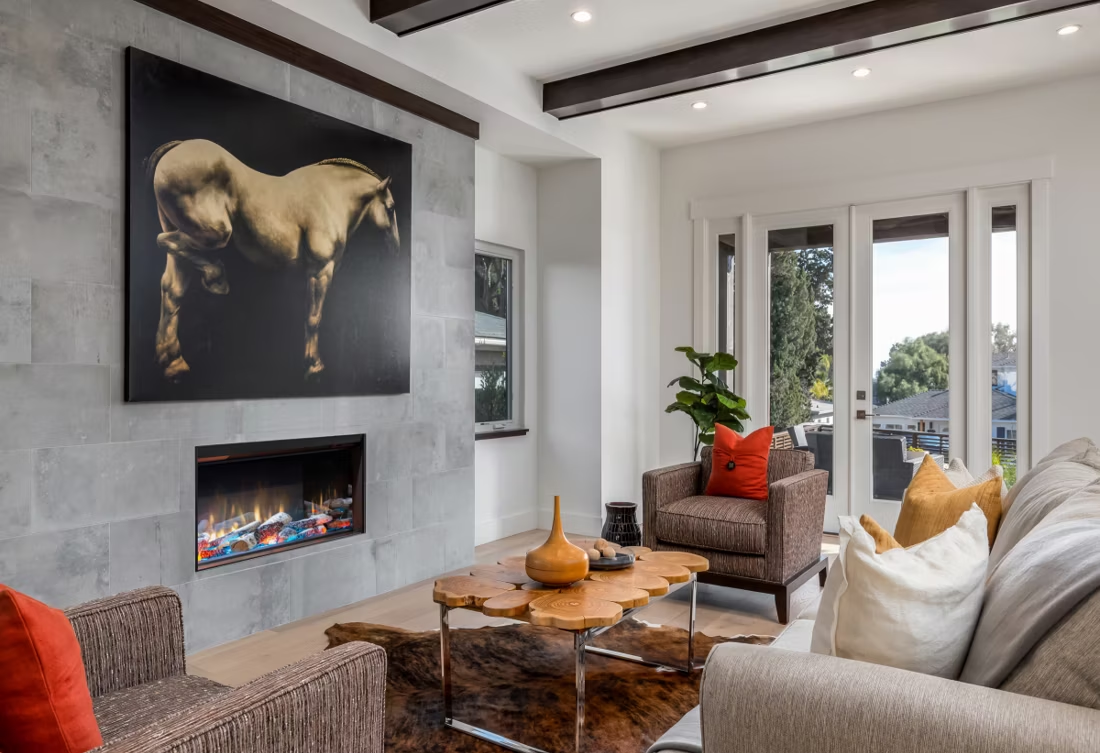
They're arguably the best fit available. Homes within the National Historical Park's protected district—the vertical-log poteaux-en-terre houses and stone Creole cottages—face real restrictions on altering exterior walls, and cutting a new flue or running a gas line through 200-year-old construction is a significant project even when it's allowed. An electric insert or built-in unit adds heat and the look of a fire without touching the exterior, the masonry, or the roofline at all, which is exactly why several homeowners in the historic core have gone this route.
What about power outages—does electric heat still work?
No—electric fireplaces need power to run, so during an ice storm outage along the river bluffs or out in the rural parts of the county, they'll go dark along with everything else. Homeowners who want backup heat for outages typically pair an electric fireplace for everyday convenience with a wood stove or fireplace burning local oak or hickory for the nights when the power is actually down.
Electric vs. pellet—which is right for my home?
Electric fireplaces plug in, need no fuel storage, produce zero emissions, and work in almost any room without venting—but they're supplemental heaters, not a primary heat source. Pellet stoves, using regional brands like Lignetics and Indeck Energy Services, burn hotter and can genuinely serve as primary heat for a room or small home, but they require venting, a hopper to load, and—like electric units—electricity to run the auger and blower, so they're also down during an outage. For a low-commitment, no-venting upgrade to a single room, especially in a historic or hard-to-vent home, electric usually wins. For homeowners wanting real heat output and don't mind the venting and pellet deliveries, pellet is worth a look from a local dealer.
Can I put a TV above my fireplace?
Yes—with an asterisk. Fireplaces are hot and TVs don't like heat. Either put a mantel between them to deflect rising warmth, or choose a fireplace with heat-management technology that creates a cool zone on the wall above—the wall stays around 125 degrees, barely warm, while the room still gets full heat. If you like clean lines and don't want a mantel, heat management is the answer.
Does an electric fireplace need a vent or chimney?
No—that's its superpower. An electric fireplace needs a wall and an outlet, period. No vent pipe, no gas line, no clearances to design around, which is why it works in bedrooms, offices, apartments, and walls where venting a gas or wood unit would be impractical or impossible. Installation is typically the simplest and least expensive of any fireplace type.
Can a fireplace actually lower my heating bill?
Yes—by creating a comfort zone. A furnace heats every square foot of the house just to warm the one room you're in; a gas fireplace on low burns roughly a sixth of the gas a typical furnace does. Set the furnace around 55–60 degrees as a baseline, then heat the rooms your family actually uses. Families who heat this way commonly save $20–$60 a month.
How much should I budget for a fireplace?
For an average home—covering the fireplace, the vent pipe, and basic installation—a budget between $3,900 and $5,500 gives you a lot of options across wood, gas, and pellet. By the time you add finish work, gas line, and electrical, the average complete installation lands between $5,000 and $12,000 all-in. In a remodel or new build, a good rule is to put about 2.5% of the total project cost toward the fireplace.
Find your electric fireplace in Ste. Genevieve County.
Tell us about your home and we'll match you with the right electric fireplace or insert—and connect you with a trusted local dealer for a free Project Guide & Parts List.
Find Your Fireplace →