
The simplest way to add heat and ambiance in Ralls County.
No chimney, no gas line, no county permit chase—just a plug-in or hardwired unit that warms a farmhouse addition, a finished basement, or a bonus room from New London to Perry.
Every Project Starts From One of These Five Situations
Zone heat without the venting.
Ralls County sits along the Mississippi River bluffs in northeast Missouri, just upriver from Hannibal, with New London as the county seat and small communities like Center and Perry spread across the farmland in between. At around 2,700 residents, this is rural country—older farmhouses, manufactured homes, and newer builds mixed together, most heated by a furnace or a wood stove burning the oak, hickory, walnut, and maple that grow throughout the county. Climate zone 5A means real winter here: nights regularly drop into the teens and single digits, and a drafty back bedroom or converted porch can stay cold no matter how hard the central system works.
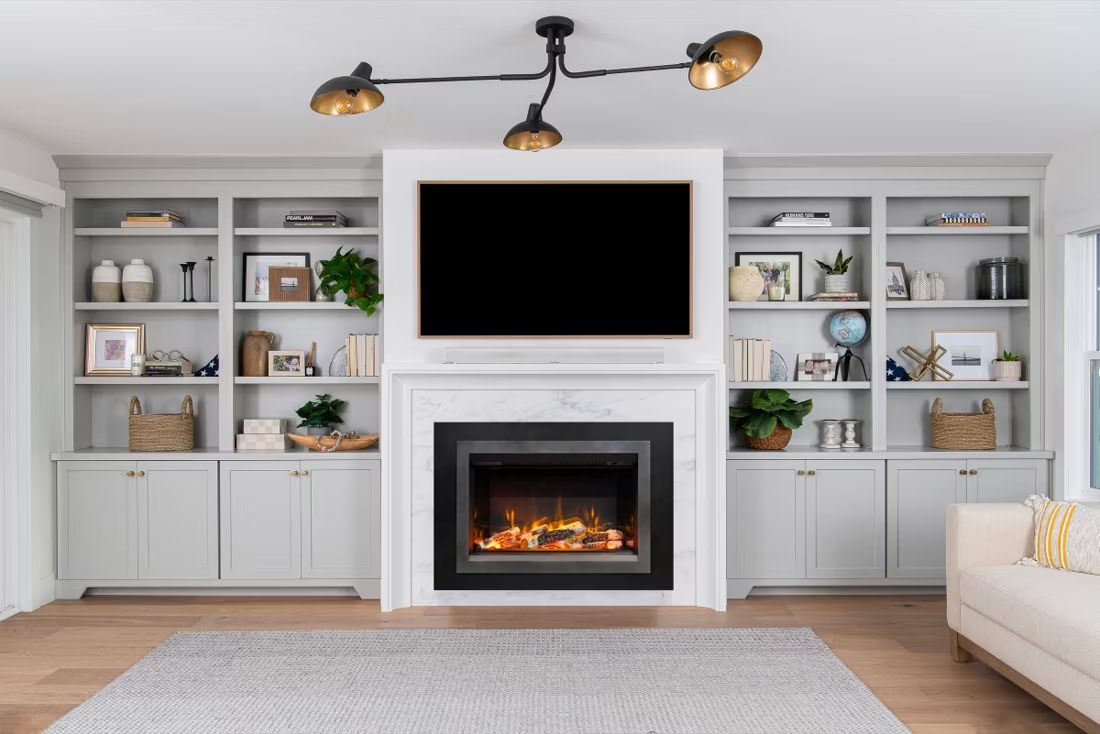
That's where electric fireplaces earn their keep. There's no combustion, no chimney, and—for a plug-in unit—often no electrical work beyond a standard outlet, which matters in a county served by Ralls County Electric Cooperative where new circuit runs mean coordinating with a licensed electrician. An electric insert can also revive an old, unused masonry fireplace in one of the county's older farmhouses without the cost of relining a chimney. For homes where wood is the tradition but not always practical—a rental, a room far from the wood stove, an aging homeowner who no longer wants to split and haul—electric fills that gap with real, safe, zero-clearance heat and none of the smoke.
Three steps. No salesperson until you're ready.
Tell us about your project
Your zip code, your situation, and the fuel you're leaning toward—or let the answers point you to one.
See what's actually available
The brands dealers within 100 miles genuinely carry—real options, never a catalog mirage.
Get your dealer & Project Guide
A trusted local dealer, plus the free Project Guide & Parts List that names every component of the job.
Frequently Asked Questions
How much does an electric fireplace installation cost in Ralls County?
A plug-in electric insert or freestanding stove that runs on a standard 120-volt outlet typically costs $200 to $600 installed, since there's usually no wiring work involved beyond setting the unit in place. Built-in wall units or larger linear fireplaces that require a dedicated 20-amp circuit run by a licensed electrician generally land between $800 and $2,500, depending on the unit size and how far the new circuit has to travel—a real consideration in older Ralls County farmhouses where the electrical panel may be a good distance from the room you're heating. Full mantel surrounds or built-in remodels with custom framing push toward the higher end of that range.
Do I need a permit to install an electric fireplace in Ralls County?
In most cases, no—a plug-in electric fireplace or insert that uses an existing outlet doesn't require a building permit. If your installation calls for a new dedicated circuit or panel work, that electrical work should be pulled through a licensed electrician, who will handle any permitting with the county as part of the job. Because Ralls County is largely rural and unincorporated outside New London, Center, and Perry, permit requirements can vary slightly by jurisdiction—your installer will know what applies to your address.
Will an electric fireplace actually heat my room, or is it just for looks?
Most electric fireplaces put out 5,000 to 9,000 BTU, which is enough to noticeably warm a 400 to 1,000 square foot space—plenty for a bedroom, den, or finished basement room. It's not designed to replace your furnace on a 5A-zone January night when the temperature sits in the teens, but it's an effective way to zone-heat a room you use often without running the whole-house system harder. Many Ralls County homeowners use electric fireplaces exactly this way: as a supplemental source that lets them turn down the thermostat in the rest of the house while keeping one room comfortable.
What's the difference between an electric insert, an electric fireplace, and an electric stove?
An electric insert is built to slide into an existing masonry fireplace opening—a common option in older Ralls County farmhouses that have an unused wood-burning fireplace they'd rather not relight but still want to look at. A built-in electric fireplace is a wall-mounted or fully framed unit, typically chosen for new construction or a remodel where there's no existing fireplace opening. An electric stove is a freestanding, cabinet-style unit that mimics a wood stove's look—a good fit for renters, manufactured homes, or anyone who wants heat and ambiance without any construction at all.
Electric vs. wood—which makes more sense for my Ralls County home?
Wood remains the backbone of heating in much of Ralls County, and for good reason: it works without grid power, which matters when winter ice storms take down lines served by Ralls County Electric Cooperative, and the oak and hickory that grow locally burn hot and long. Electric can't provide backup heat during an outage since it depends entirely on the grid, but it wins on convenience—no cutting, splitting, or hauling, no ash, and instant on-off operation. Many households here run both: a wood stove as the primary or backup heat source, and an electric unit in a secondary room where running a chimney doesn't make sense.
Electric vs. gas—which fits better for a room without existing utilities?
Gas fireplaces need either a natural gas line or a propane tank, plus in most cases venting to the outside, which adds cost and complexity if the room doesn't already have gas service—a real factor in parts of rural Ralls County without natural gas access. Electric sidesteps all of that: no line, no tank, no venting, just power. For an addition, a converted porch, or a room on the far end of the house from your propane tank, electric is usually the faster and cheaper path to real heat.
Will my electric fireplace work during a power outage?
No—electric fireplaces run entirely on grid power, so an outage from Ralls County Electric Cooperative's lines means the unit goes dark along with everything else in the house. In a county where ice storms and downed lines aren't rare in a hard winter, that's worth factoring into your heating plan. If backup heat during an outage matters to you, a wood stove is the better complement—many Ralls County homes keep one specifically for that reason, with electric handling the everyday convenience heat elsewhere in the house.
How do I size an electric fireplace for my room?
Sizing comes down to square footage, ceiling height, and how well-insulated the room is—older farmhouses around New London and Center with single-pane windows and minimal insulation will need a higher-output unit than a tightly built newer room of the same size. As a rough guide, smaller units (around 400-750 watts of heat output) handle a bedroom or small den, while larger linear or built-in models with 1,500-watt heaters can cover an open living area. A local dealer can walk your space and recommend the right size rather than guessing off a box label.
What electric fireplace brands are available through local dealers in Ralls County?
Ralls County is small enough that most homeowners work with dealers based in Hannibal or the greater northeast Missouri region rather than a shop within the county itself. Reputable brands commonly stocked by these dealers include Dimplex, Napoleon, and Amantii, covering everything from simple insert units to full linear wall installations. Working through a trusted local dealer—rather than ordering blind online—means someone actually measures your fireplace opening or wall space and confirms the unit will fit and perform before it's installed.
Does an electric fireplace need a vent or chimney?
No—that's its superpower. An electric fireplace needs a wall and an outlet, period. No vent pipe, no gas line, no clearances to design around, which is why it works in bedrooms, offices, apartments, and walls where venting a gas or wood unit would be impractical or impossible. Installation is typically the simplest and least expensive of any fireplace type.
Do electric fireplaces actually produce heat?
Yes—most put out around 4,800–5,000 BTUs from a standard outlet, which comfortably warms a bedroom, office, or den as a comfort-zone heater. What they won't do is carry a whole house the way wood, gas, or pellet can. Think of electric as ambiance-first with honest supplemental heat: flames on with no heat in July, flames plus warmth in January.
What is an in-home preview and do I need one?
It's a visit where a hearth professional measures your space, confirms the model you picked actually works in your home, and walks the specs—framing, gas line, venting, finish work—before anything is ordered. Some details you just can't know until you see the house. Never make a down payment without one; it's the single most-skipped step that burns buyers.
How much should I budget for a fireplace?
For an average home—covering the fireplace, the vent pipe, and basic installation—a budget between $3,900 and $5,500 gives you a lot of options across wood, gas, and pellet. By the time you add finish work, gas line, and electrical, the average complete installation lands between $5,000 and $12,000 all-in. In a remodel or new build, a good rule is to put about 2.5% of the total project cost toward the fireplace.
Find your electric fireplace in Ralls County.
Tell us about your home and we'll match you with a trusted local dealer and send over a free Project Guide & Parts List—sized right for your room, with the parts you need and a dealer who can actually install it.
Find Your Fireplace →