
Add heat to any room in Monroe County—no chimney required.
From Paris to Holliday to the farmhouses scattered around Florida and Stoutsville, electric fireplaces give Monroe County homes a way to add real warmth to a room without a flue, a gas line, or a building permit. Find the right unit and get matched with a trusted local dealer.
Every Project Starts From One of These Five Situations
Electric heat that fits where a chimney can't.
Monroe County is rural north-central Missouri—about 5,193 people spread across the county seat of Paris, small communities like Holliday, Madison, and Santa Fe, and the farmland surrounding Florida, the birthplace of Mark Twain. Winters here sit in climate zone 4A with a solid, moderately long heating season and average lows around 18°F—cold enough for a real heating season, though nowhere near the sustained sub-zero stretches of places like Duluth or Fargo. Wood heat has deep roots in the county, with oak, hickory, walnut, and maple all common in local woodlots, and plenty of homes still run a wood stove as primary or backup heat.
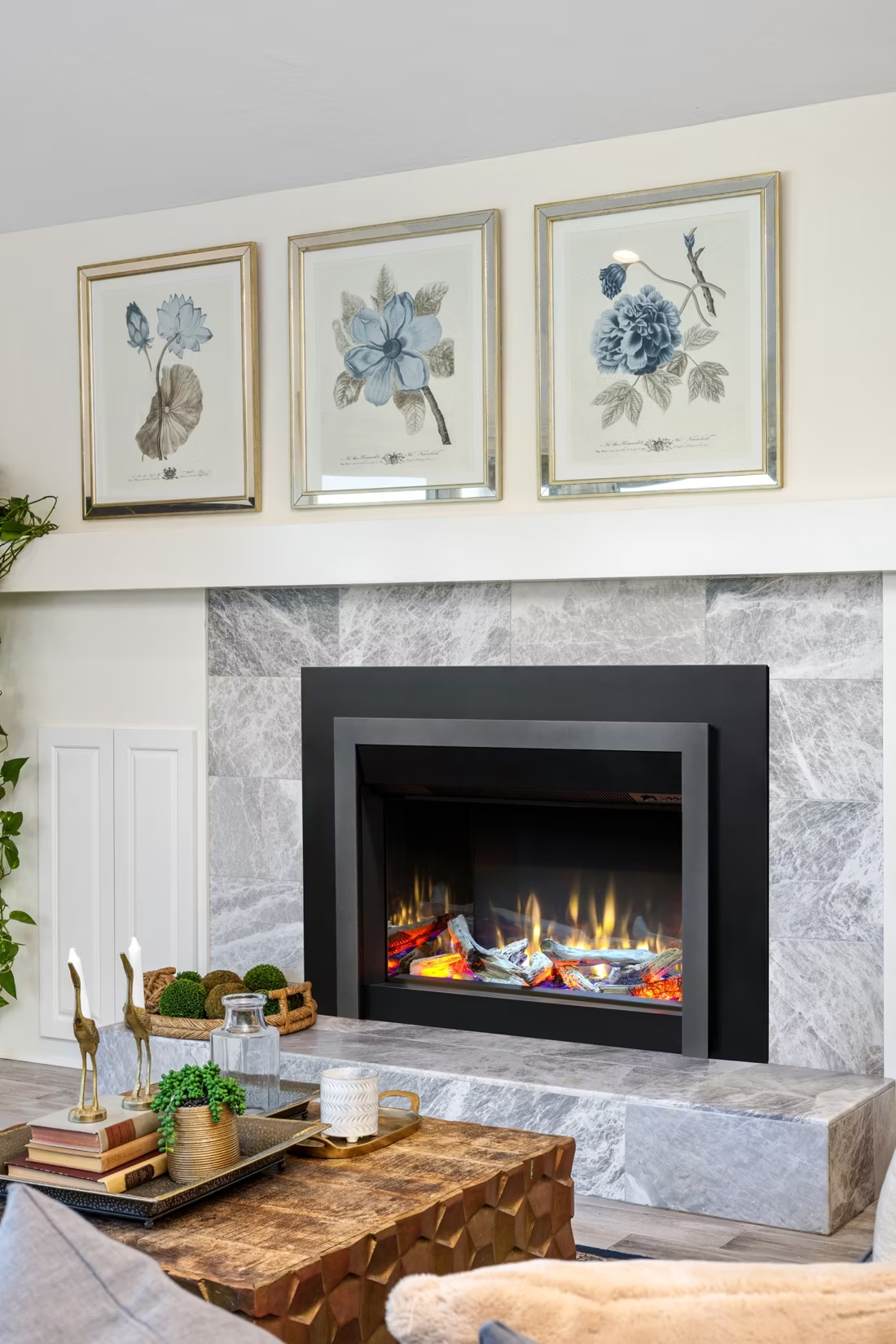
Electric fireplaces fill a different niche. A lot of Monroe County's housing stock is older farmhouses, additions, or manufactured homes where running a chimney or a gas line just isn't practical—a finished basement room, a converted porch, a rental property, or a mobile home where roof penetrations are a headache. An electric insert or built-in unit adds supplemental zone heat and real ambiance without any venting at all, and pairs naturally with a wood stove or propane furnace already doing the heavy lifting during a Monroe County ice storm, when the power itself can be the thing that goes out.
Three steps. No salesperson until you're ready.
Tell us about your project
Your zip code, your situation, and the fuel you're leaning toward—or let the answers point you to one.
See what's actually available
The brands dealers within 100 miles genuinely carry—real options, never a catalog mirage.
Get your dealer & Project Guide
A trusted local dealer, plus the free Project Guide & Parts List that names every component of the job.
Frequently Asked Questions
How much does an electric fireplace installation cost in Monroe County?
A freestanding or plug-in electric fireplace typically costs $150 to $600 for the unit itself, with no installation cost beyond plugging it into a standard outlet. A built-in electric insert or wall-mounted unit that needs a dedicated circuit—common when homeowners want it hardwired rather than cord-and-plug—usually runs $800 to $2,500 installed, including the electrician's time to run a new line. Because there's no chimney, no gas line, and no venting to size, electric installs in Monroe County are consistently the fastest and least expensive fireplace project a local dealer will quote.
Do I need a permit to install an electric fireplace in Monroe County?
Usually not for a freestanding, plug-in unit—it's treated like any other appliance. If you're having a built-in insert wired to its own circuit, an electrical permit may be required depending on whether the home is inside Paris city limits or out in unincorporated Monroe County, and most licensed electricians pull that permit as part of the job. Either way, you're skipping the building-permit and chimney-code review that wood and gas installs require in this county, which is a big part of why electric is the simplest project on the list.
Will an electric fireplace actually heat a room in a Monroe County winter?
It'll heat one room well, not the whole house. Most electric fireplace inserts top out around 1,500 watts (roughly 5,000 to 5,200 BTU), enough to noticeably warm a 300 to 400 square foot space—a bedroom, a den, a finished basement—but not enough to replace a furnace when overnight lows are sitting around 18°F. Think of it as zone heat: it lets you turn down the thermostat in the rest of the house and warm the one room you're actually using, which is where most of the fuel savings come from.
Electric vs. wood—which makes sense for my Monroe County home?
A lot of homes in Monroe County already burn oak, hickory, or walnut in a wood stove as primary or supplemental heat, and that's not likely to change—wood is cheap here and the heat output is real. The catch is that wood requires a chimney, hauling, and upkeep, and it won't help in a room where there's no flue. Electric fills that gap: it's the option for the converted porch, the basement rec room, or the addition that was never built with a chimney in mind. It also has the opposite weakness of wood—an electric unit does nothing during a power outage, so most rural Monroe County households that lose power in ice storms keep a wood stove or propane heater as the actual backup plan and use electric for everyday convenience.
Is electric a good option for a manufactured or mobile home?
Yes, and it's one of the more common uses for electric fireplaces in a county with as much manufactured housing as Monroe County has in its rural areas. Because there's no roof penetration, no clearance-to-combustibles chimney chase, and no gas line, an electric insert or wall unit can go into a manufactured home without the structural and code complications that come with a wood or gas appliance. Most manufacturers also list their electric units as zero-clearance, which simplifies placement against interior walls.
Where can I find a local dealer to install an electric fireplace near me?
Because installation is straightforward, a lot of homeowners are tempted to buy an electric fireplace online and handle it themselves—and for a simple plug-in unit, that's often fine. Where a local dealer earns their fee is on built-in installs: sizing the unit to the wall opening, running the dedicated circuit correctly, and making sure the trim kit and surround actually fit the space, especially in older Paris and Holliday-area homes with non-standard wall cavities. A trusted local dealer will also tell you honestly when a plug-in unit is the better call and you don't need a built-in at all.
How much does it cost to run an electric fireplace?
A typical 1,500-watt electric fireplace costs somewhere in the range of $0.10 to $0.20 per hour to run, depending on your local electric rate—Monroe County's rural cooperative and municipal rates both fall in a fairly typical range for northeast Missouri. Run a few hours a night through a cold stretch and you're looking at modest pennies-on-the-dollar heating for that one room, which is generally cheaper than running central heat to warm a space you're only using part of the day.
Can I put an electric insert into my existing wood fireplace?
Yes—this is a common project for older homes around Paris and Florida with a masonry fireplace nobody wants to keep sweeping or feeding. An electric log insert slides into the existing firebox opening, plugs into an outlet (or gets hardwired), and gives you the look of a fire with none of the smoke, ash, or chimney maintenance. It's a good option for a fireplace that's structurally sound but rarely used, especially if the chimney itself needs repair work that isn't worth the cost for occasional use.
Electric vs. pellet stove—which is right for my home?
Pellet stoves, using brands like Lignetics or Indeck Energy Services that are common through this part of Missouri, put out real heat—enough to serve as a primary or near-primary heat source for a room or small home—but they need electricity to run the auger and blower, plus a hopper you have to keep loaded with bagged pellets and a flue for venting. Electric fireplaces need none of that: no venting, no fuel to store, no moving parts to maintain, but also meaningfully less heat output. If you want supplemental warmth and ambiance in a room without a flue, electric is simpler. If you want an appliance that can genuinely carry the heating load in a space, pellet is the better match—talk to a local dealer about which one fits the room you actually have in mind.
Can I put a TV above my fireplace?
Yes—with an asterisk. Fireplaces are hot and TVs don't like heat. Either put a mantel between them to deflect rising warmth, or choose a fireplace with heat-management technology that creates a cool zone on the wall above—the wall stays around 125 degrees, barely warm, while the room still gets full heat. If you like clean lines and don't want a mantel, heat management is the answer.
Do electric fireplaces actually produce heat?
Yes—most put out around 4,800–5,000 BTUs from a standard outlet, which comfortably warms a bedroom, office, or den as a comfort-zone heater. What they won't do is carry a whole house the way wood, gas, or pellet can. Think of electric as ambiance-first with honest supplemental heat: flames on with no heat in July, flames plus warmth in January.
Does a fireplace add value to my home?
On average, a fireplace adds back to the home about the same amount you spent installing it. Add the monthly savings from heating the rooms you actually use instead of the whole house—often hundreds of dollars a year—and the value case is strong before you even count what a fire does for how your family uses the room.
Can a fireplace actually lower my heating bill?
Yes—by creating a comfort zone. A furnace heats every square foot of the house just to warm the one room you're in; a gas fireplace on low burns roughly a sixth of the gas a typical furnace does. Set the furnace around 55–60 degrees as a baseline, then heat the rooms your family actually uses. Families who heat this way commonly save $20–$60 a month.
Find your electric fireplace in Monroe County.
Tell us a bit about your home and we'll put together a free Project Guide & Parts List—the right electric fireplace or insert for your space, the exact parts you'll need, and a trusted local dealer near Monroe County to install it.
Find Your Fireplace →