
Find the right electric fireplace for your Howell County home.
No gas line, no chimney, no permit headaches—just plug-in warmth and ambiance for homes from West Plains to Willow Springs. Get matched with a trusted local dealer.
Every Project Starts From One of These Five Situations
Zone heat that installs almost anywhere.
Howell County sits in the Missouri Ozarks, at climate zone 4A with roughly 4,617 heating degree days and average winter lows around 22°F—a real but moderate winter, nothing like the sub-zero stretches that hit Duluth or Fargo. That's exactly the kind of climate where electric fireplaces make the most sense: homeowners in West Plains, Willow Springs, and Mountain View aren't usually asking a single unit to carry the whole heating load through a brutal January. They're looking for supplemental warmth in a bedroom, den, or finished basement, plus the visual of a fire without the woodpile.
Because oak, hickory, and walnut are so plentiful locally, plenty of Howell County households still burn wood as their primary or backup heat. Electric fills a different role: a built-in wall unit in a renovated room, a freestanding stove in a home office, or an insert dropped into an old masonry fireplace that no one wants to keep sweeping. There's no venting to size, no cutting permit to track down, and most models run on a standard 120-volt outlet—which matters if you're finishing a room where running gas line or a chimney isn't practical.
Three steps. No salesperson until you're ready.
Tell us about your project
Your zip code, your situation, and the fuel you're leaning toward—or let the answers point you to one.
See what's actually available
The brands dealers within 100 miles genuinely carry—real options, never a catalog mirage.
Get your dealer & Project Guide
A trusted local dealer, plus the free Project Guide & Parts List that names every component of the job.
Frequently Asked Questions
How much does an electric fireplace installation cost in Howell County?
Most electric fireplace installations in Howell County run $400 to $1,200. A plug-in insert or wall-mount unit on a standard 120-volt circuit sits at the low end—often just the cost of the unit and mounting hardware. Built-in units that require a dedicated 20-amp circuit, in-wall wiring, or a licensed electrician to run new line push toward the higher end. Compare that to a wood stove installation in the county, which typically runs several thousand dollars once chimney work is factored in—electric is the low-cost, low-disruption option for most rooms.
Do I need an electrician to install an electric fireplace?
It depends on the unit. Plug-in electric fireplaces and inserts that use a standard household outlet don't require an electrician—many homeowners in West Plains and Willow Springs install these themselves. Built-in electric fireplaces, especially larger models, often call for a dedicated circuit to avoid tripping breakers when the heater kicks on at full output. A local dealer can tell you which category your chosen model falls into and, if needed, connect you with a licensed electrician who's done the work before in the county.
Do I need a building permit for an electric fireplace in Howell County?
In most cases, no—a plug-in electric fireplace doesn't trigger a building permit the way a wood stove or gas insert does, since there's no venting, gas line, or chimney involved. If your installation requires new electrical wiring or a dedicated circuit, that electrical work may need to be permitted and inspected depending on your specific jurisdiction within the county. A local dealer or electrician can confirm what applies to your address before work begins.
How much does it cost to run an electric fireplace?
Running costs depend on your local electric rate and how much you use the heater function versus just the flame effect. Most electric fireplaces draw around 1,500 watts on high heat—roughly comparable to a space heater—while the flame-only, no-heat setting uses only a few watts and costs almost nothing to run for ambiance. For Howell County homeowners using an electric fireplace as supplemental heat in one room rather than whole-home heating, the operating cost is generally far lower than running central heat harder to compensate for a cold room.
Can an electric fireplace actually heat a room, or is it just for looks?
A properly sized electric fireplace can meaningfully heat a room—most models are rated to warm 400 to 1,000 square feet, which covers a bedroom, den, or basement family room in a typical Howell County home. It won't replace central heat or a wood stove as a whole-house solution, but as zone heat for a specific space—letting you turn down the thermostat elsewhere in the house—it does real work. If you want supplemental heat for a larger open area, ask your local dealer about wattage and square-footage ratings before buying.
What's the difference between an electric fireplace, insert, and stove?
An electric fireplace is typically a wall-mounted or built-in unit designed to look like a framed fireplace, often used in new construction or remodels. An electric insert is sized to slide into an existing masonry firebox—a common choice for older Howell County homes with a wood fireplace that no one uses anymore but the owner doesn't want to remove. An electric stove is a freestanding unit styled like a wood or pellet stove, good for a room without any existing fireplace opening. All three plug into standard household power in most cases, with the main differences being footprint and installation location.
Will an electric fireplace work during a power outage?
No—electric fireplaces require power to run, whether it's the heater, the flame effect, or both. That's a meaningful difference from a wood stove, which several Howell County households keep specifically because oak and hickory are locally abundant and a wood stove keeps working when the power lines go down. If backup heat during outages matters to your household, an electric fireplace should be considered a comfort and ambiance feature, not a storm-preparedness tool.
Electric vs. wood—which is right for my Howell County home?
Wood offers real backup heat during outages, lower fuel cost if you're cutting or sourcing oak and hickory locally, and the traditional fire experience—but it means chimney maintenance and a wood supply. Electric offers instant on-off operation, zero venting or chimney work, and installation in almost any room of the house—but it needs grid power and works best as supplemental zone heat rather than a primary heat source through a full Ozarks winter. Many local homeowners run both: wood in a main living space for real heat and backup capability, electric in a bedroom, basement, or office where convenience matters more than heat output.
Electric vs. gas—which should I choose?
Gas fireplaces produce real radiant heat with higher output and can be configured to run on battery backup during outages, but installation involves gas line work and, for propane households outside natural gas service areas, a tank. Electric fireplaces install almost anywhere without any gas line or venting, cost less upfront, and are simpler to add to a finished room—but they draw grid power only and produce less heat per unit. For a converted basement room or a secondary living space in Howell County, electric is often the simpler, lower-cost path. For a primary living area where you want real heat output, gas is worth the extra installation complexity.
Can I put a TV above my fireplace?
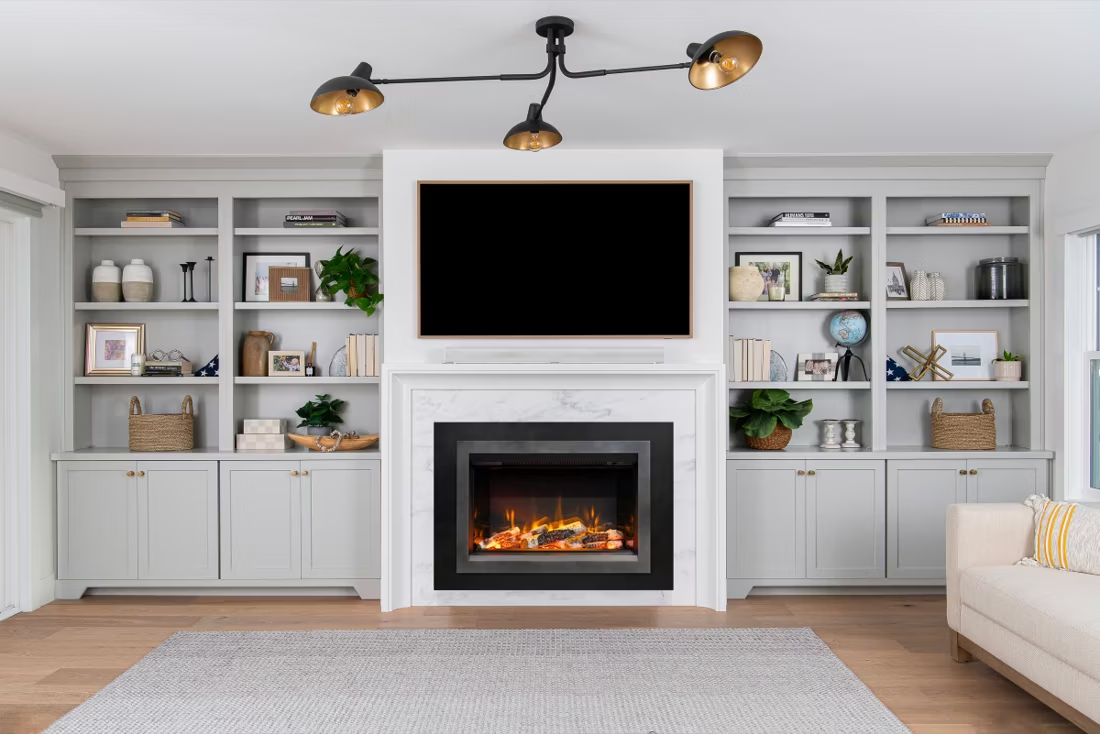
Yes—with an asterisk. Fireplaces are hot and TVs don't like heat. Either put a mantel between them to deflect rising warmth, or choose a fireplace with heat-management technology that creates a cool zone on the wall above—the wall stays around 125 degrees, barely warm, while the room still gets full heat. If you like clean lines and don't want a mantel, heat management is the answer.
Do electric fireplaces actually produce heat?
Yes—most put out around 4,800–5,000 BTUs from a standard outlet, which comfortably warms a bedroom, office, or den as a comfort-zone heater. What they won't do is carry a whole house the way wood, gas, or pellet can. Think of electric as ambiance-first with honest supplemental heat: flames on with no heat in July, flames plus warmth in January.
How much should I budget for a fireplace?
For an average home—covering the fireplace, the vent pipe, and basic installation—a budget between $3,900 and $5,500 gives you a lot of options across wood, gas, and pellet. By the time you add finish work, gas line, and electrical, the average complete installation lands between $5,000 and $12,000 all-in. In a remodel or new build, a good rule is to put about 2.5% of the total project cost toward the fireplace.
Can a fireplace actually lower my heating bill?
Yes—by creating a comfort zone. A furnace heats every square foot of the house just to warm the one room you're in; a gas fireplace on low burns roughly a sixth of the gas a typical furnace does. Set the furnace around 55–60 degrees as a baseline, then heat the rooms your family actually uses. Families who heat this way commonly save $20–$60 a month.
Stove and Fireplace Dealers in Howell County
Get your Howell County electric fireplace project guide.
Tell us about your room and we'll match you with a trusted local dealer and send a free Project Guide & Parts List—sized, specced, and ready to install.
Find Your Fireplace →