
Warm Up South St. Paul Without the Woodpile.
With winter lows averaging 9°F and a heating season as long and demanding as the rest of the Twin Cities, South St. Paul homes need dependable heat that doesn't depend on stacked cordwood. Find the right gas unit and connect with a trusted local dealer.
Every Project Starts From One of These Five Situations
Clean, instant heat built for river-valley winters.
South St. Paul sits along the Mississippi River in Dakota County, part of the greater Twin Cities metro, at 825 feet elevation. Winters here are long and genuinely cold—average lows near 9°F and a heating season as demanding as the Minneapolis-St. Paul area's overall, firmly in climate zone 6A. That's a heating season that demands equipment which starts reliably and keeps producing heat for months straight, not just on the coldest nights.
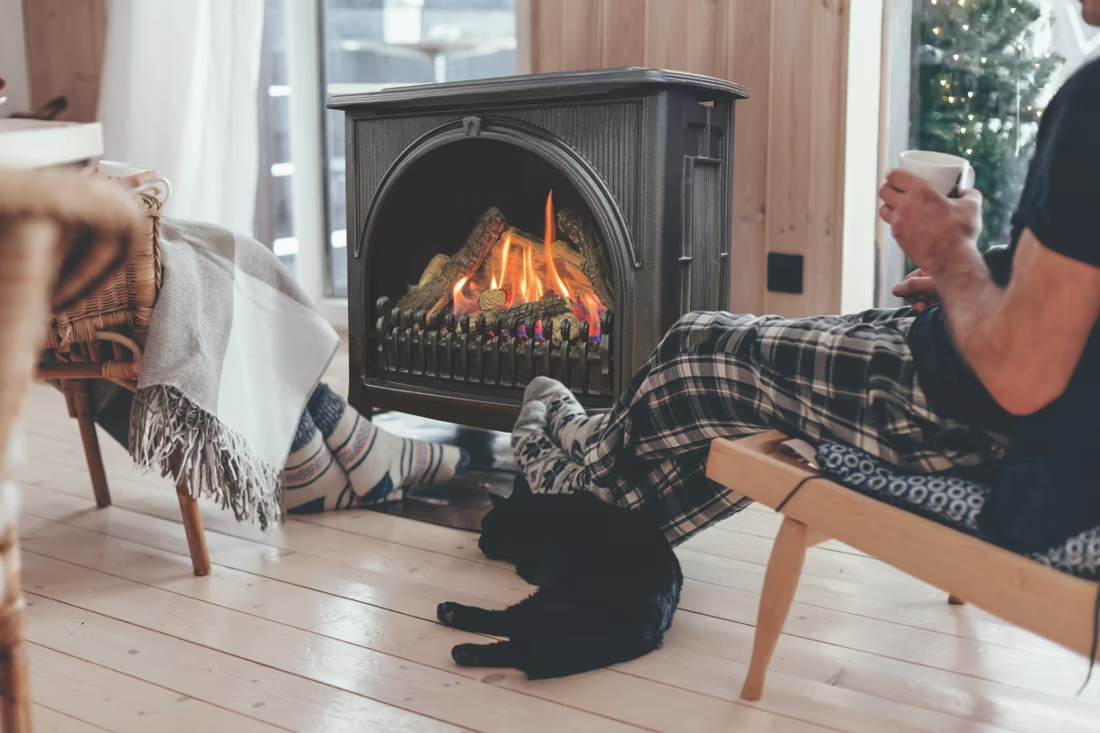
Unlike more rural parts of Minnesota, South St. Paul's older neighborhoods near the historic Stockyards district and its newer subdivisions alike are built on tight urban and suburban lots—there's rarely room for a woodpile, and there's no nearby public timberland or cutting-permit system homeowners here rely on. Natural gas service (through CenterPoint Energy in most of this part of Dakota County) reaches nearly every home, which is why gas fireplaces, inserts, and stoves are the dominant hearth choice in this city rather than wood. A gas unit gives you real, radiant zone heat at the flip of a switch or a wall switch remote, without ash, smoke, or a chimney full of creosote to manage every fall.
Three steps. No salesperson until you're ready.
Tell us about your project
Your zip code, your situation, and the fuel you're leaning toward—or let the answers point you to one.
See what's actually available
The brands dealers within 100 miles genuinely carry—real options, never a catalog mirage.
Get your dealer & Project Guide
A trusted local dealer, plus the free Project Guide & Parts List that names every component of the job.
Frequently Asked Questions
How much does a gas fireplace installation cost in South St. Paul?
Most gas fireplace and insert installations in South St. Paul run between roughly $4,000 and $10,000, depending on the unit, the venting path, and whether new gas line work is needed. A direct-vent insert going into an existing masonry fireplace with a gas line already nearby sits toward the lower end. A new built-in gas fireplace in a remodeled room or an addition—with framing, venting through an exterior wall, and a longer gas line run from the meter—lands toward the higher end. Because nearly every home in this part of Dakota County already has natural gas service, propane tank installs (which add cost) are the exception rather than the rule here. A local dealer will give you a firm number after an in-home visit.
Can I convert my existing wood-burning fireplace to gas?
Yes, and it's one of the more common projects in South St. Paul's older housing stock, especially in homes built in the mid-20th century near the historic Stockyards area that still have their original open masonry fireplaces. A gas insert typically slides into that existing firebox, running a stainless liner up the chimney you already have, and costs somewhere in the $4,000 to $8,500 range depending on the insert and whether a new gas line needs to be run to the hearth. The conversion keeps the look of the original fireplace while giving you real, controllable heat instead of a fireplace that mostly just draws warm air out of the house.
Do I need natural gas, or is propane an option?
Almost every home in South St. Paul is already within the natural gas service territory, so if you have a gas furnace, water heater, or range, adding a gas fireplace usually just means tapping into your existing gas line. Propane is available as a fallback for the rare property that isn't on the gas main, but in this dense a suburb, that's uncommon. Most gas fireplace models can be configured for either fuel—your installer sets the correct orifice and regulator—so the choice mostly comes down to what's already running to your house.
Will my gas fireplace still work if the power goes out?
Most modern gas fireplaces will, which matters in a climate where ice storms and heavy snow can knock out power to Northern States Power/Xcel Energy customers for hours at a time. Units with IPI (intermittent pilot ignition) run on a small battery backup—typically AA batteries built into the unit—that lights the fireplace on demand even with no power. Valor's lineup takes a different approach: their pilot assembly generates its own electricity through the thermocouple, so there's no battery to remember to replace. Given how many hours of darkness a South St. Paul winter can bring, ask your local dealer about the ignition system on any model you're considering.
What's the difference between a gas fireplace, insert, and stove?
A gas fireplace is a fully built-in unit framed into a wall, typically chosen for new construction or a remodel. A gas insert is sized to slide into an existing masonry firebox, converting an old wood fireplace into a sealed, efficient heat source using the chimney that's already there. A gas stove is a freestanding cabinet unit, similar in footprint to a wood stove, that can sit against nearly any wall with the right venting. For South St. Paul's older homes with an existing fireplace, an insert is usually the straightforward upgrade; newer builds or rooms without a fireplace already are better candidates for a built-in unit or freestanding stove.
Do I need a permit to install a gas fireplace in South St. Paul?
Yes—installing a new gas fireplace or insert requires a building permit through the City of South St. Paul, and any new or modified gas line requires work by a licensed gas-fitter as part of that permit. Most established hearth dealers in the area handle the permit application and inspection scheduling as part of the installation, so you're not left coordinating separate trades yourself. It's worth confirming any installer you're considering is pulling permits rather than skipping that step—it matters both for safety and for resale disclosures down the line.
Should I get a vented or vent-free gas fireplace?
Vented (direct-vent) gas fireplaces draw combustion air from outside and exhaust the byproducts back outside through sealed venting—they're the standard, code-friendly choice everywhere, including Minnesota. Vent-free units burn directly into the room air and are legal here under strict room-size and ventilation rules, but South St. Paul's homes are increasingly built or renovated to tighter, more energy-efficient standards typical of climate zone 6A, which means less natural air exchange to dilute any indoor combustion byproducts. For that reason, most local dealers steer homeowners toward direct-vent units, especially for a primary living space where the fireplace runs for hours at a time.
How often does a gas fireplace need to be serviced?
Plan on an annual inspection, ideally in early fall before you're relying on it through a South St. Paul winter. A technician checks the burner, pilot or ignition system, venting, and gas connections, and cleans the glass and interior. It's a lighter lift than chimney sweeping for a wood unit, typically running $150 to $250, but skipping it for a few seasons is how minor issues—a dirty flame sensor, a cracked gasket—turn into a fireplace that won't light on the coldest night of the year.
Why doesn't Find My Fireplace show wood-burning options for South St. Paul?
Wood-burning fireplaces and stoves are essentially not part of the hearth market in South St. Paul. The city's lots are tight, there's no nearby public forest land with a cutting-permit system the way there is in more rural parts of Minnesota, and natural gas service reaches almost every home already. A small number of homeowners keep an old wood fireplace for occasional ambiance, but virtually no one here installs a new wood stove as a primary or backup heat source. Gas is the practical, dominant choice—it's why this page, rather than a wood page, is the one that matches how South St. Paul actually heats its homes.
What's the difference between an insert and a zero-clearance fireplace?
An insert is a fireplace that slides into a pre-existing wood-burning fireplace—if you don't have one, there's nothing to insert it into. A zero-clearance fireplace is built into a framed wall, which makes it the answer for remodels and new construction. Simple test: existing masonry fireplace means insert; blank or framed wall means zero-clearance.
Why is my open fireplace making my house colder?
Open fireplaces suck—literally. As the fire burns, it consumes air your furnace already paid to heat and pulls it out through the chimney, so the house is actually colder after the fire goes out than before you lit it. An insert fixes this: it seals the chimney, puts fixed glass across the front, and turns that hole in your house into a real heat source.
How much should I budget for a fireplace?
For an average home—covering the fireplace, the vent pipe, and basic installation—a budget between $3,900 and $5,500 gives you a lot of options across wood, gas, and pellet. By the time you add finish work, gas line, and electrical, the average complete installation lands between $5,000 and $12,000 all-in. In a remodel or new build, a good rule is to put about 2.5% of the total project cost toward the fireplace.
Can a fireplace actually lower my heating bill?
Yes—by creating a comfort zone. A furnace heats every square foot of the house just to warm the one room you're in; a gas fireplace on low burns roughly a sixth of the gas a typical furnace does. Set the furnace around 55–60 degrees as a baseline, then heat the rooms your family actually uses. Families who heat this way commonly save $20–$60 a month.
Nearby Dealers
Hearth shops serving South St. Paul and the surrounding area. Every listing shows whether it is a WhyFire partner, a dealer we have verified as authorized for the brands we recommend, or a local business carrying hearth products. No manufacturer pays for placement. How we verify dealers →
The Chimney Pro’s Mn
Fireside Hearth & Home - Eagan
Fireside Hearth & Home - Roseville
Minnesota Gas Grills & Fireplaces
Comfort By Design
Pure Design Environments
Condor Fireplace & Stone
Ferguson Enterprises
Fireside Hearth & Home - Eden Prairie
Fireside Hearth & Home - Minnetonka
Scotts Heating And Ac
Custom Fireplace & Chimney Care
Fireside Hearth & Home - Maple Grove
Get your South St. Paul Project Guide & Parts List.
Tell us about your home and we'll match you with a trusted local dealer and put together a free Project Guide & Parts List—the exact parts, including the vent kit, for your gas fireplace project in South St. Paul.
Find Your Fireplace →