
Find the right gas fireplace for Shakopee's long, cold winters.
With average winter lows near 8°F and a heating season nearly as heavy as Fargo's, Shakopee homes need heat they can count on through a long Minnesota season. Find the right gas fireplace or insert, and get matched with a trusted local dealer who installs it correctly the first time.
Every Project Starts From One of These Five Situations
Instant heat built for Scott County winters.
Shakopee sits along the Minnesota River in Scott County, in climate zone 6A, with heating demand that rivals Fargo, North Dakota—a heating season nearly as heavy as Fargo's and winter lows that average around 8°F. As one of the fastest-growing suburbs in the Twin Cities metro, with newer neighborhoods like Southbridge and Dean Lake filling in alongside the older downtown grid near First Avenue, most Shakopee homes are built with natural gas service and forced-air furnaces already in place—which makes a direct-vent gas fireplace or insert a natural add-on rather than a major retrofit.
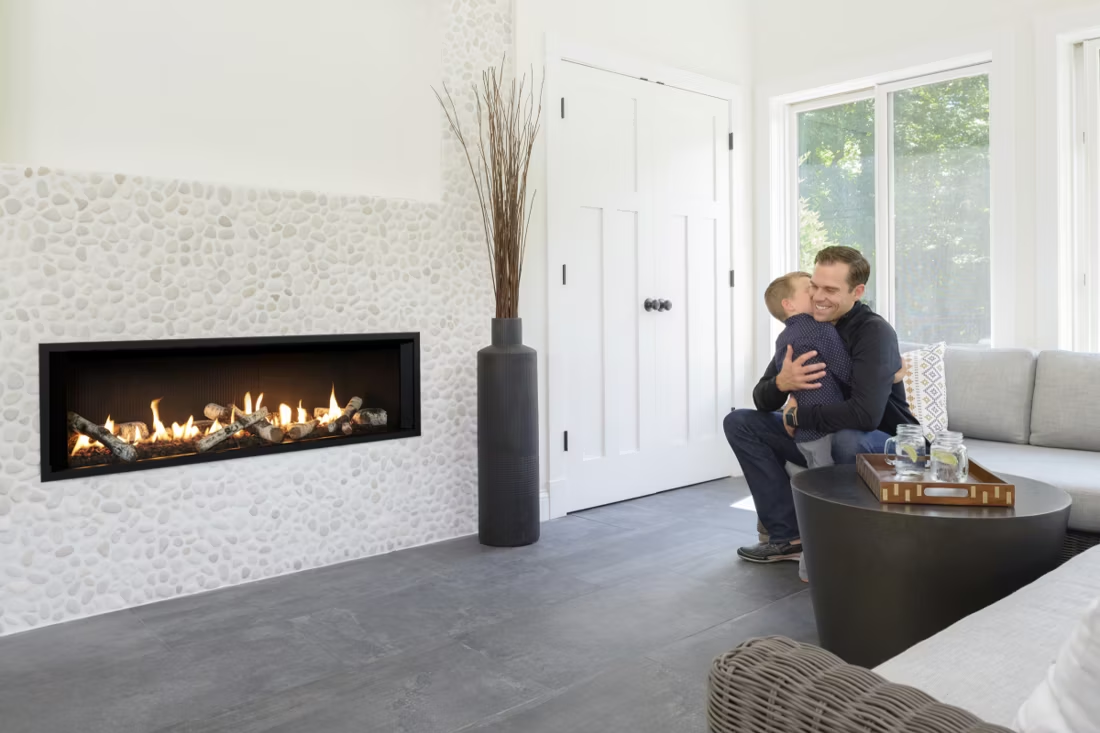
Wood-burning fireplaces and stoves are uncommon here—many of Shakopee's newer subdivisions have lot sizes and covenants that don't favor cordwood storage or solid-fuel appliances, and with natural gas broadly available through the area's utility infrastructure, most homeowners skip wood entirely. A gas fireplace delivers zone heat at the flip of a switch, works alongside your existing furnace during the coldest stretches of a Minnesota River valley winter, and adds real ambiance to a living room or basement rec space without ash, smoke, or a wood pile in the backyard.
Three steps. No salesperson until you're ready.
Tell us about your project
Your zip code, your situation, and the fuel you're leaning toward—or let the answers point you to one.
See what's actually available
The brands dealers within 100 miles genuinely carry—real options, never a catalog mirage.
Get your dealer & Project Guide
A trusted local dealer, plus the free Project Guide & Parts List that names every component of the job.
Frequently Asked Questions
How much does a gas fireplace installation cost in Shakopee?
In the Twin Cities market, a direct-vent gas insert installed into an existing masonry fireplace typically runs $3,800 to $7,500, while a new built-in gas fireplace for a remodel or new-construction wall—including framing, venting, and a gas line run—usually lands between $6,000 and $10,000. Homes in newer Shakopee developments that already have a gas line stubbed near the fireplace location tend to fall on the lower end; older homes near downtown that need a new gas line run from the meter will run higher. A local dealer will give you a firm number after seeing your space.
Can I convert my existing wood fireplace to gas?
Yes, and it's a common project in Shakopee's older neighborhoods near downtown, where many homes still have the original masonry fireplace. A gas insert slides into that existing firebox and vents through a stainless liner run up the same chimney, so you keep the look of the fireplace while gaining real, controllable heat. Expect $3,500 to $7,000 depending on the insert and whether new gas line work is needed to reach the fireplace.
Do I need natural gas, or can I use propane?
Most of Shakopee proper has natural gas service, so if your home already has a gas furnace, water heater, or range, adding a fireplace is usually a straightforward tie-in to the existing line. In parts of unincorporated Scott County or newer developments still building out utility infrastructure, propane is the standard fallback, supplied from a tank on the property. Nearly every gas fireplace model on the market can be set up for either fuel—your installer selects the correct orifice and regulator for whichever you have.
Will my gas fireplace work if the power goes out?
Most modern gas fireplaces will, which matters in a climate where an ice storm or a subzero cold snap along the Minnesota River valley can knock out power for hours. Units with intermittent pilot ignition (IPI) run on a small battery backup that automatically kicks in when the power drops, so the fireplace lights on demand just like normal. Valor fireplaces take a different approach—their pilot assembly generates its own electricity through the thermocouple, so there's no battery to remember at all. Either way, ask your local dealer about the ignition system before you buy if backup heat during an outage is a priority.
What's the difference between a gas fireplace, gas insert, and gas stove?
A gas fireplace is a fully built-in unit framed into a wall—the standard choice for new construction, which describes a lot of Shakopee's recent growth. A gas insert is sized to slide into an existing masonry firebox, turning a drafty old fireplace into a sealed, efficient heat source using the existing chimney as the vent path. A gas stove is a freestanding cabinet unit that sits on the floor, useful in a basement or addition where there's no existing fireplace opening to work with. For the newer two-story and split-level homes common across Shakopee's subdivisions, a built-in fireplace or freestanding stove is typical; for older homes near downtown with an existing masonry hearth, an insert is usually the better fit.
Do I need a permit to install a gas fireplace in Shakopee?
Yes—the City of Shakopee requires a building permit for new gas fireplace installations, and the gas line work itself has to be done or inspected by a licensed gas-fitter. Most established local dealers handle this paperwork as part of the installation, coordinating the permit, the gas line, and the final inspection so you're not left managing multiple trades yourself. If you're outside city limits in unincorporated Scott County, the permitting runs through the county rather than the city.
What's the difference between vented and vent-free gas fireplaces?
Vented (direct-vent) gas fireplaces pull combustion air from outside and exhaust the byproducts back outside through a sealed pipe—they're the cleanest and most widely recommended option, especially in tightly built, well-insulated Minnesota homes where you don't want combustion byproducts trapped indoors. Vent-free units burn directly into the room and are legal in Minnesota within specific room-size and ventilation limits, but they release some moisture and combustion gas into the living space. Given how well-sealed newer Shakopee construction tends to be for energy efficiency, most local dealers steer homeowners toward direct-vent units for both safety and comfort.
How often should a gas fireplace be serviced?
Plan on an annual inspection, ideally in early fall before the heating season ramps up. A technician checks the burner, pilot or ignition system, venting, and gas connections, and cleans the glass and interior. It's a quicker visit than a wood-stove chimney sweep, but skipping it is how minor issues—a dirty flame sensor, a cracked gasket—turn into a fireplace that won't light on the coldest night of the year. Most Twin Cities service providers charge in the $150 to $250 range for a standard annual visit.
Should I consider wood or pellet instead of gas?
For most Shakopee homes, no—wood and pellet appliances are genuinely uncommon here. Local hardwoods like oak, maple, birch, and aspen grow throughout Scott County, but between newer subdivision covenants, smaller lot sizes, and the fact that natural gas is already run to most homes, very few Shakopee homeowners install a wood stove or pellet appliance as their heat source. A handful of rural properties or hobbyist wood-burners exist, but they're the exception. If you want fire without hauling fuel or cleaning ash, gas is the practical choice for the vast majority of homes in and around Shakopee.
What's the difference between an insert and a zero-clearance fireplace?
An insert is a fireplace that slides into a pre-existing wood-burning fireplace—if you don't have one, there's nothing to insert it into. A zero-clearance fireplace is built into a framed wall, which makes it the answer for remodels and new construction. Simple test: existing masonry fireplace means insert; blank or framed wall means zero-clearance.
Why is my open fireplace making my house colder?
Open fireplaces suck—literally. As the fire burns, it consumes air your furnace already paid to heat and pulls it out through the chimney, so the house is actually colder after the fire goes out than before you lit it. An insert fixes this: it seals the chimney, puts fixed glass across the front, and turns that hole in your house into a real heat source.
Can I install a fireplace myself?
If you're putting a fire in your house on purpose, it's best to work with an expert. Unless you're genuinely experienced in framing, gas line, vent pipe, and the national code on clearances to combustibles, have a professional do it—and ideally the same company that sells you the fireplace, so warranty, service, and liability all live under one roof.
Can a fireplace actually lower my heating bill?
Yes—by creating a comfort zone. A furnace heats every square foot of the house just to warm the one room you're in; a gas fireplace on low burns roughly a sixth of the gas a typical furnace does. Set the furnace around 55–60 degrees as a baseline, then heat the rooms your family actually uses. Families who heat this way commonly save $20–$60 a month.
Nearby Dealers
Hearth shops serving Shakopee and the surrounding area.
Get your Shakopee gas fireplace project moving.
Tell us about your home and heating goals, and we'll match you with a trusted local dealer serving Shakopee—plus a free Project Guide & Parts List spelling out the exact parts, including the vent kit, your installer will need.
Find Your Fireplace →