
Warm up your Hopkins home without a chimney or gas line.
No venting, no gas permit, no masonry work—just plug-in or dedicated-circuit warmth built for Hopkins condos, townhomes, and single-family homes alike. Find the right unit and connect with a trusted local dealer.
Every Project Starts From One of These Five Situations
Zone heat and ambiance for Minnesota's coldest months.
Hopkins sits in climate zone 6A, an inner-ring Twin Cities suburb just west of Minneapolis with a long, cold winter season and an average winter low that hovers around 7°F. That's the kind of cold that makes a working furnace non-negotiable—but Hopkins is also a market where a large share of the housing stock is condos, townhomes, and redeveloped apartments along the Excelsior Boulevard and Mainstreet corridors, many without a masonry chimney or any option to run a flue. That's where electric fireplaces do their best work: instant supplemental heat and real ambiance from a unit that plugs into a standard outlet or ties into a dedicated circuit, no venting required.
Northern States Power Company (Xcel Energy) serves most of Hopkins, with a residential rate around 16.98 cents per kWh—high enough that running an electric fireplace as a whole-home heat source doesn't pencil out against a natural gas furnace across a Minnesota winter. What does make sense is zone heating: warming the room you're actually in—a family room, a primary bedroom, a finished basement—while the furnace holds the rest of the house at a lower baseline. It's also simply the most practical fireplace option for the renters and condo owners who make up a large share of Hopkins's population.
Three steps. No salesperson until you're ready.
Tell us about your project
Your zip code, your situation, and the fuel you're leaning toward—or let the answers point you to one.
See what's actually available
The brands dealers within 100 miles genuinely carry—real options, never a catalog mirage.
Get your dealer & Project Guide
A trusted local dealer, plus the free Project Guide & Parts List that names every component of the job.
Frequently Asked Questions
How much does it cost to install an electric fireplace in Hopkins?
Costs vary widely by unit type. A plug-in wall-mount or freestanding electric fireplace runs $200 to $1,200 for the unit itself, with no professional installation required beyond hanging it and plugging it in. A built-in electric insert set into a wall or existing fireplace opening, framed and trimmed with a mantel, typically runs $1,500 to $4,000 installed, including a licensed electrician running a dedicated 120V or 240V circuit if the unit calls for one. Custom cabinetry or a full media-wall build can push the total higher. Because there's no venting, gas line, or chimney work involved, electric installs are consistently the fastest and least expensive fireplace project in Hopkins.
Do I need a permit to install an electric fireplace in Hopkins?
In most cases, no separate fireplace permit is required—electric units don't touch the mechanical or venting code the way gas or wood appliances do. But if the installation involves new wiring or a dedicated circuit, that work needs to be pulled under permit by a licensed electrician, and the City of Hopkins Building Inspections Division may require an electrical permit for that portion of the job. Simple plug-in units on an existing outlet don't trigger any permit at all. Ask your installer to confirm before work begins.
Can an electric fireplace heat my whole Hopkins house?
Not economically, and it's worth being honest about that upfront. Hopkins has a long, demanding winter heating season with winter lows averaging around 7°F, and at Xcel Energy's residential rate of roughly 17 cents per kWh, resistance electric heat costs several times more per BTU than a natural gas furnace. Most electric fireplaces top out around 5,000 to 9,000 BTU (roughly 1,500 watts)—enough to comfortably warm a single room, not a whole house. Think of it as zone heat for the room you're actually in, working alongside your furnace, not replacing it.
What's the difference between an electric insert, a wall-mount, and a freestanding electric fireplace?
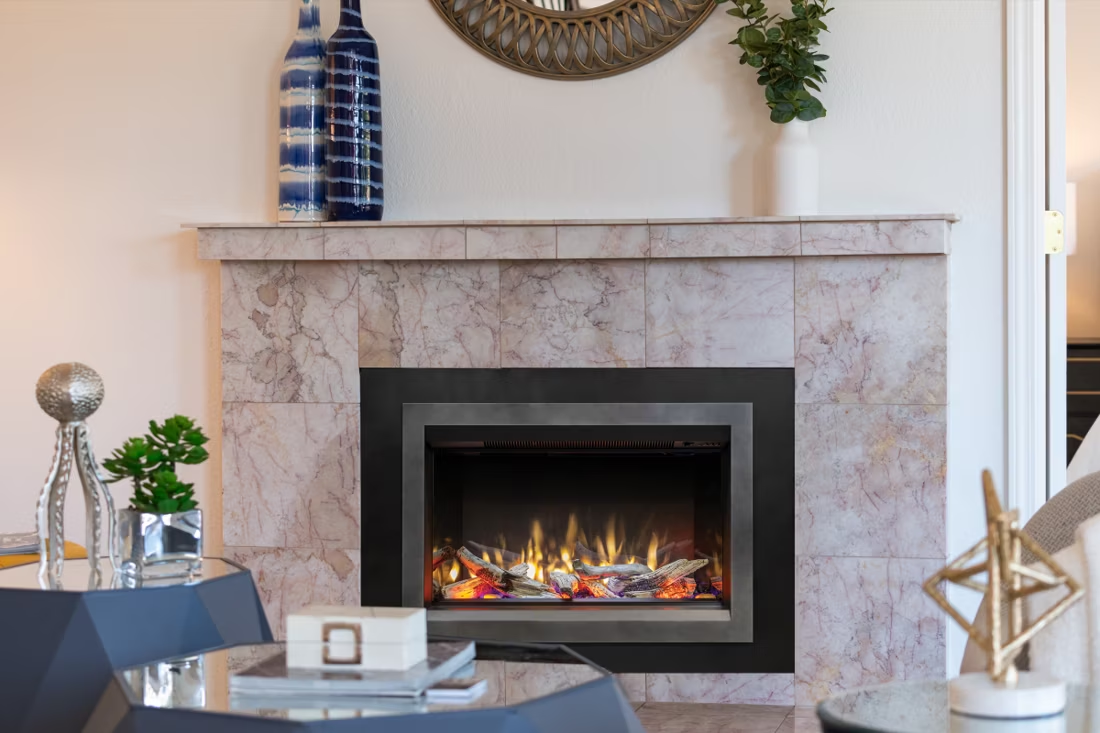
An electric insert is built into an existing fireplace opening or a custom-framed wall cavity, usually finished with a mantel or surround for a built-in look. A wall-mount unit hangs directly on the wall like a flat-screen TV and needs only a nearby outlet. A freestanding or media-console electric fireplace sits on the floor and can be moved between rooms or even between homes if you relocate—a real advantage for Hopkins renters. All three use the same basic technology, an LED flame effect paired with a resistance or infrared heater, so the choice mostly comes down to how permanent you want the installation to be.
Are electric fireplaces a good fit for condos and townhomes in Hopkins?
Yes, and it's one of the main reasons electric fireplaces do well here. A large share of Hopkins's housing along Excelsior Boulevard and the Mainstreet redevelopment corridor is condos, townhomes, and apartments with no masonry chimney and, in many buildings, rules that prohibit gas lines or wood-burning appliances entirely. An electric fireplace sidesteps all of that: no venting, no gas permit, no combustion byproducts, and often no HOA approval needed at all for a plug-in unit. It's the one fireplace option nearly every Hopkins resident can install regardless of building type.
How much does it cost to run an electric fireplace in Hopkins?
At Xcel Energy's residential rate of about 16.98 cents per kWh, a typical 1,500-watt electric fireplace costs roughly 25 cents per hour to run on heat mode. Used for five hours a night through a cold Minnesota evening, that's about $1.25 a day, or somewhere around $35 a month if you run it nightly through the coldest stretch of winter. Running the flame effect alone, without the heater engaged, costs a fraction of a cent per hour—most units draw under 50 watts in ambiance-only mode.
Electric vs. gas fireplace—which makes more sense for my Hopkins home?
Gas fireplaces, run on natural gas service common throughout the Twin Cities metro, put out more heat per dollar and can genuinely offset furnace use in a room—a real consideration given Hopkins's long, cold winters. But gas requires venting and a gas line, which means real installation cost and, in many condos and townhomes, isn't an option at all. Electric skips the venting and gas work entirely, installs in an afternoon, and works in any unit with an outlet—but it won't move the needle on your whole-home heating bill the way gas can. For Hopkins homeowners with an existing gas line and a home that allows venting, gas is worth a look. For condo owners, renters, and anyone who wants supplemental warmth without construction, electric is the simpler answer.
Why don't more Hopkins homes have wood-burning fireplaces or stoves?
Wood-burning appliances are essentially uncommon in new installations here. Hopkins is a dense, largely redeveloped inner-ring suburb—much of its housing stock along Excelsior Boulevard and Mainstreet is condos, townhomes, and apartments built without masonry chimneys, and new wood stove installations in that kind of housing are rare to nonexistent. A handful of older bungalows in Hopkins's original neighborhoods still have legacy wood fireplaces burning local oak, maple, or birch, but they're the exception, not the rule. For homeowners who want radiant, real-flame heat, that's typically a project reserved for a detached single-family home with an existing chimney—for nearly everyone else in Hopkins, electric is the practical route.
What should I look for in an electric fireplace for a Minnesota winter?
Look at heat output first if you want the unit to do real supplemental work—1,500 watts, or about 5,100 BTU, is the standard for a meaningful heat contribution in a room. Check that the heater has a thermostat rather than a simple on/off switch, and look for a unit rated for continuous use instead of one built only for occasional ambiance. If you're mounting it in a finished basement or three-season porch, confirm the unit is rated for that space's actual winter temperatures—some flame-effect-only units aren't designed to run their heaters in a cold, uninsulated room. A local dealer can match wattage and features to the specific space you're heating.
Can I put a TV above my fireplace?
Yes—with an asterisk. Fireplaces are hot and TVs don't like heat. Either put a mantel between them to deflect rising warmth, or choose a fireplace with heat-management technology that creates a cool zone on the wall above—the wall stays around 125 degrees, barely warm, while the room still gets full heat. If you like clean lines and don't want a mantel, heat management is the answer.
Does an electric fireplace need a vent or chimney?
No—that's its superpower. An electric fireplace needs a wall and an outlet, period. No vent pipe, no gas line, no clearances to design around, which is why it works in bedrooms, offices, apartments, and walls where venting a gas or wood unit would be impractical or impossible. Installation is typically the simplest and least expensive of any fireplace type.
Does a fireplace add value to my home?
On average, a fireplace adds back to the home about the same amount you spent installing it. Add the monthly savings from heating the rooms you actually use instead of the whole house—often hundreds of dollars a year—and the value case is strong before you even count what a fire does for how your family uses the room.
Can a fireplace actually lower my heating bill?
Yes—by creating a comfort zone. A furnace heats every square foot of the house just to warm the one room you're in; a gas fireplace on low burns roughly a sixth of the gas a typical furnace does. Set the furnace around 55–60 degrees as a baseline, then heat the rooms your family actually uses. Families who heat this way commonly save $20–$60 a month.
Nearby Dealers
Hearth shops serving Hopkins and the surrounding area. Every listing shows whether it is a WhyFire partner, a dealer we have verified as authorized for the brands we recommend, or a local business carrying hearth products. No manufacturer pays for placement. How we verify dealers →
Fireside Hearth & Home - Minnetonka
Pure Design Environments
Ferguson Enterprises
Fireside Hearth & Home - Eden Prairie
Minnesota Gas Grills & Fireplaces
Fireside Hearth & Home - Maple Grove
Fireside Hearth & Home - Roseville
Fireside Hearth & Home - Eagan
Timberwall
Condor Fireplace & Stone
Custom Fireplace & Chimney Care
Fireplace Gallery, Inc.
Glowing Hearth & Home - Coon Rapids
West Metro Fire And Stone
The Chimney Pro’s Mn
DJ's Heating & Air Cond. Inc.
Electric Service in Hopkins
An electric fireplace's heater draws about 1,500 watts—pennies per hour at local rates.
Northern States Power Co - Minnesota
City Of St Paul - (Ne)
Find your electric fireplace in Hopkins.
Tell us about your Hopkins home and we'll match you with a trusted local dealer and a free Project Guide & Parts List—the exact electric fireplace, mounting or insert components, and electrical requirements for your space.
Find Your Fireplace →