
Gas heat that holds up through a Minnesota winter.
With a winter heating load on par with Fargo, ND and average winter lows near 8°F, Eden Prairie homes lean on gas for dependable, instant zone heat. Find the right fireplace or insert and get matched with a trusted local dealer.
Every Project Starts From One of These Five Situations
Instant heat for one of the coldest metro climates in the Lower 48.
Eden Prairie sits in climate zone 6A on the southwest edge of the Twin Cities, with a cold-climate winter heating load in the same range as Fargo, ND or Bismarck, ND. Average winter lows hover around 8°F, and this built-out suburb of roughly 63,600 residents was largely developed from the 1970s through the 2000s, meaning most homes already have central forced-air furnaces and either an existing masonry fireplace or a framed opening ready for a gas unit.
Natural gas service is widely available across Eden Prairie's neighborhoods through CenterPoint Energy, and electric service comes from Xcel Energy (listed on utility records as Northern States Power Co – Minnesota). Wood-burning installations are uncommon here—many newer developments and HOA covenants in Eden Prairie discourage open burning and masonry wood fireplaces, and there's little of the self-cut firewood culture you'd find farther north. Gas has become the default: flip-a-switch heat, zero ash or creosote, and a clean install that fits the city's modern building stock.
Three steps. No salesperson until you're ready.
Tell us about your project
Your zip code, your situation, and the fuel you're leaning toward—or let the answers point you to one.
See what's actually available
The brands dealers within 100 miles genuinely carry—real options, never a catalog mirage.
Get your dealer & Project Guide
A trusted local dealer, plus the free Project Guide & Parts List that names every component of the job.
Frequently Asked Questions
How much does a gas fireplace installation cost in Eden Prairie?
Most Eden Prairie gas fireplace and insert installations run $4,000 to $10,000, with the low end covering a direct-vent insert dropped into an existing masonry opening where a gas line is already nearby, and the high end covering new construction or remodels that require framing, a new venting run through an exterior wall, and a fresh gas line pulled from the meter. Homes in Eden Prairie's older sections near Round Lake and Purgatory Creek often already have masonry fireplaces suited to an insert conversion, which tends to land on the lower end of that range. The City of Eden Prairie Inspections Division requires a permit for the work, and most local dealers fold that into the installation quote.
Can I convert my existing wood-burning fireplace to gas?
Yes, and it's one of the more common projects local installers see in Eden Prairie, since a large share of the city's housing stock from the 1970s through 1990s was built with a standard masonry wood fireplace that's rarely used. A gas insert typically slides into that existing opening, uses a stainless liner run up the original chimney for venting, and connects to a new gas line from the nearest CenterPoint Energy service point. Conversions usually run $4,500 to $9,000 depending on chimney condition and how far the gas line has to travel from an existing appliance.
Do I need natural gas service, or is propane an option in Eden Prairie?
Nearly every neighborhood in Eden Prairie has natural gas service through CenterPoint Energy, so most installations simply tap into existing service—especially in homes that already have a gas furnace, water heater, or range. Propane is rarely necessary here and mostly comes into play for detached structures, lake cabins outside city limits, or the small number of unserved rural pockets elsewhere in Hennepin County. If your home already runs on natural gas, adding a fireplace is straightforward; your installer will size the line and regulator either way.
Will my gas fireplace still work if the power goes out?
Most gas fireplaces with IPI (intermittent pilot ignition) run on a small battery backup that kicks in automatically when Xcel Energy service drops during an ice storm or high-wind event—common causes of outages in the southwest metro. The unit lights on demand off the batteries until power returns, so it's worth checking those batteries each fall before burning season. Valor fireplaces take a different approach: their pilot assembly generates its own electricity through a thermocouple, so there's no battery to remember at all. For a Minnesota winter where an outage can mean a house dropping below 50°F overnight, that detail is worth asking your local dealer about.
What's the difference between a gas fireplace, gas insert, and gas stove?
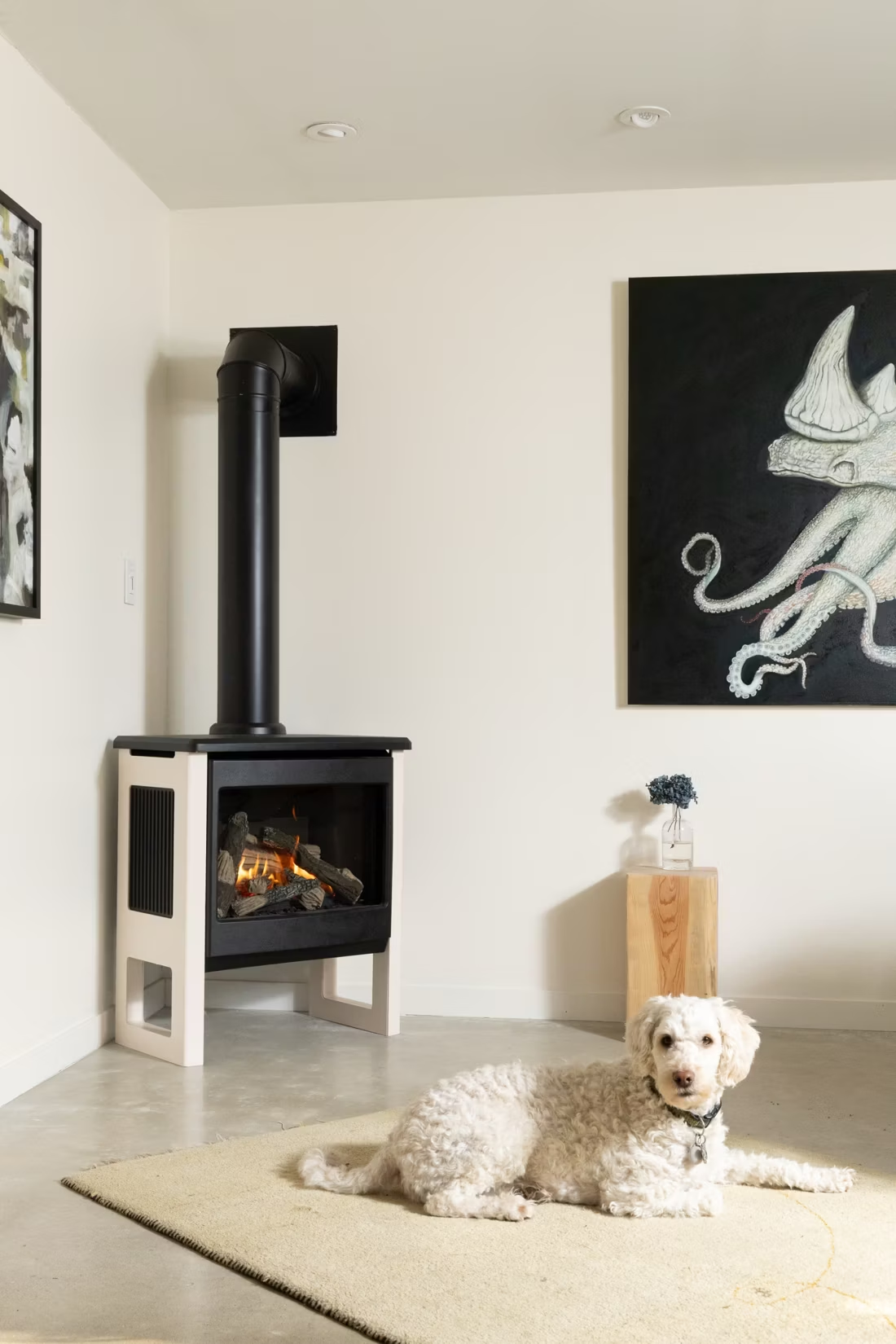
A gas fireplace is a fully built-in unit framed into a wall—the standard choice for new construction or a room without an existing hearth. A gas insert slides into an existing masonry fireplace opening and uses the existing chimney (lined) as its vent path, which fits a lot of Eden Prairie's 1970s-through-1990s housing stock. A gas stove is a freestanding cabinet-style unit that sits on the floor, useful in a room without any existing fireplace opening at all—a finished basement or a three-season porch, for example. For most Eden Prairie homeowners with an old, underused masonry fireplace, an insert is the simplest upgrade.
Do I need a permit to install a gas fireplace in Eden Prairie?
Yes. The City of Eden Prairie Inspections Division requires both a building permit and a mechanical/gas permit for a new gas fireplace or insert, and the gas line connection itself has to be run by a licensed gas-fitter. Most established hearth dealers in the metro handle the permitting and inspection scheduling as part of the installation, so you're not coordinating separate trades yourself. Expect a rough-in inspection and a final inspection before the unit is signed off.
Should I get a vented or vent-free gas fireplace?
For Eden Prairie, direct-vent (sealed combustion, vented outside) is the far more common and recommended choice, and there's a specific local reason: Minnesota's energy code pushes new and remodeled homes toward very tight building envelopes, and vent-free units release combustion byproducts—including water vapor—directly into that tightly sealed living space. In a well-insulated Eden Prairie home, that extra moisture load can contribute to window condensation and mold risk over a long winter. Direct-vent units draw combustion air from outside and exhaust it back outside, avoiding that issue entirely, which is why nearly every local dealer defaults to direct-vent for full-time Minnesota use.
How often does a gas fireplace need to be serviced?
Plan on an annual inspection, ideally in early fall before regular use ramps up. A technician checks the burner, pilot or ignition system, venting, and gas connections, and cleans the glass and interior—a much lighter task than wood chimney sweeping but still important, since a cracked or blocked vent seal is a real safety issue in a house buttoned up tight against a Minnesota winter. Local gas appliance service providers in the southwest metro typically charge $150 to $250 for this annual visit.
Why is gas so much more common than wood in Eden Prairie?
Eden Prairie's housing stock, mostly built from the 1970s onward, was designed around central forced-air heating with a fireplace as a secondary or ambiance feature rather than a primary heat source—and many subdivisions carry HOA covenants or lot restrictions that make active wood-burning installations impractical. There's also little of the self-cut firewood tradition you'd find in more rural parts of Minnesota; oak, maple, birch, and aspen are the regional species, but few Eden Prairie households source and season their own cordwood. Gas fits the suburb's built environment better: it's instant, needs no storage or ash removal, and works cleanly within a tight, modern envelope. Electric fireplaces are also a reasonable option here for rooms without gas access, though they produce far less real heat than a direct-vent gas unit.
What's the difference between an insert and a zero-clearance fireplace?
An insert is a fireplace that slides into a pre-existing wood-burning fireplace—if you don't have one, there's nothing to insert it into. A zero-clearance fireplace is built into a framed wall, which makes it the answer for remodels and new construction. Simple test: existing masonry fireplace means insert; blank or framed wall means zero-clearance.
Is my gas fireplace wasting gas?
If it was installed more than 15 years ago, probably. Older gas fireplaces keep a standing pilot light burning all the time, and that little flame can cost a couple hundred dollars a year. Newer models use pilot-on-demand ignition—the pilot lights only when you use the fireplace and goes out when you turn it off.
How much should I budget for a fireplace?
For an average home—covering the fireplace, the vent pipe, and basic installation—a budget between $3,900 and $5,500 gives you a lot of options across wood, gas, and pellet. By the time you add finish work, gas line, and electrical, the average complete installation lands between $5,000 and $12,000 all-in. In a remodel or new build, a good rule is to put about 2.5% of the total project cost toward the fireplace.
What is an in-home preview and do I need one?
It's a visit where a hearth professional measures your space, confirms the model you picked actually works in your home, and walks the specs—framing, gas line, venting, finish work—before anything is ordered. Some details you just can't know until you see the house. Never make a down payment without one; it's the single most-skipped step that burns buyers.
Nearby Dealers
Hearth shops serving Eden Prairie and the surrounding area. Every listing shows whether it is a WhyFire partner, a dealer we have verified as authorized for the brands we recommend, or a local business carrying hearth products. No manufacturer pays for placement. How we verify dealers →
Fireside Hearth & Home - Eden Prairie
Pure Design Environments
Fireside Hearth & Home - Minnetonka
Ferguson Enterprises
Timberwall
Minnesota Gas Grills & Fireplaces
Fireside Hearth & Home - Eagan
Fireside Hearth & Home - Maple Grove
Fireside Hearth & Home - Roseville
West Metro Fire And Stone
Condor Fireplace & Stone
Custom Fireplace & Chimney Care
The Chimney Pro’s Mn
Fireplace Gallery, Inc.
Glowing Hearth & Home - Coon Rapids
Find your gas fireplace in Eden Prairie.
Tell us about your home and your existing fireplace, and we'll put together a free Project Guide & Parts List—the exact unit, venting, and gas line plan for an Eden Prairie install—and match you with a trusted local dealer to get it done.
Find Your Fireplace →