
Supplemental warmth for Anoka County's coldest nights.
Centerville has a long, demanding heating season with winter lows averaging 8°F—a heating load closer to Madison, Wisconsin than to the mild end of the Twin Cities metro. An electric fireplace won't replace your furnace, but it can carry a lake room, basement, or addition on its own. I'll match you with a trusted local dealer who can spec it correctly.
Every Project Starts From One of These Five Situations
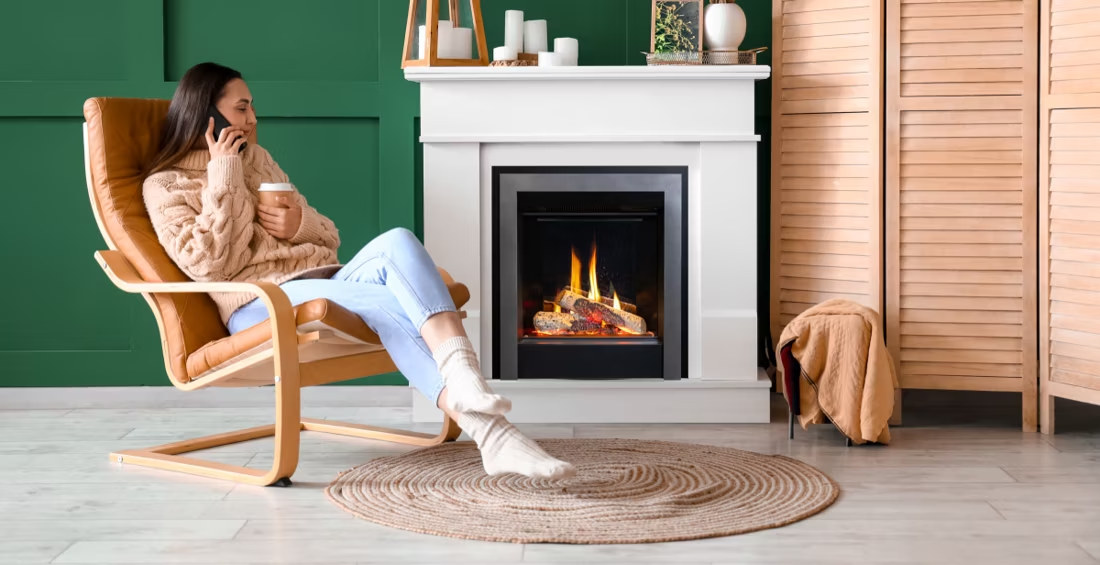
Electric fireplaces add heat exactly where you need it.
Centerville sits in Anoka County on the connected chain of Centerville and Peltier Lakes, in climate zone 6A at roughly 911 feet elevation. With an average winter low of 8°F and a long, demanding heating season, this is a genuinely cold-climate town, even by Minnesota standards—the heating load runs closer to what Madison, Wisconsin sees than to a mild Twin Cities winter. Lots along the lakeshore tend to be tight and older cabins and additions here often weren't built with a chimney or gas line in mind, which is exactly the situation an electric fireplace is built to solve.
Most Centerville addresses are billed by Xcel Energy, listed with the state as Northern States Power Company – Minnesota, though a small pocket near the city's southeastern edge falls under the City of St. Paul's municipal electric utility for northeast accounts. At a residential rate around 16.98 cents per kWh, running a 1,500-watt electric fireplace insert for a few hours on a cold evening costs about a dollar—a lot cheaper than cranking the whole-house thermostat to warm up one room. Because these units need no chimney, no vent, and no gas line, they're a practical fit for lake cabins, finished basements, and additions around Centerville that were never plumbed for combustion heat in the first place.
Three steps. No salesperson until you're ready.
Tell us about your project
Your zip code, your situation, and the fuel you're leaning toward—or let the answers point you to one.
See what's actually available
The brands dealers within 100 miles genuinely carry—real options, never a catalog mirage.
Get your dealer & Project Guide
A trusted local dealer, plus the free Project Guide & Parts List that names every component of the job.
Frequently Asked Questions
How much does an electric fireplace installation cost in Centerville?
A freestanding plug-in unit needs no wiring work at all and typically runs $200 to $600 for the unit itself, since it just plugs into a standard 120-volt outlet. A built-in electric fireplace or insert wired to a dedicated 240-volt circuit—the more common choice for a finished basement or lake-room remodel—usually runs $1,200 to $3,500 installed, with an electrician's time and any wall or surround finishing work making up most of that spread. Larger units built into new framing during a remodel land at the higher end.
Do I need a permit for an electric fireplace in Centerville?
A plug-in freestanding unit generally doesn't require a permit since it's just an appliance in an existing outlet. Wiring a new dedicated circuit for a built-in insert is electrical work, though, and that typically does need an electrical permit—your electrician usually pulls it as part of the job. Check with the City of Centerville for jurisdiction on your address, since some outlying parcels route permitting through Anoka County instead.
Will an electric fireplace actually heat my Centerville home through a Minnesota winter?
Not as your primary heat source—with a long, demanding heating season and lows regularly in the single digits, a furnace still needs to carry the whole house. What an electric fireplace does well is zone heating: closing off a lake-facing sunroom, a finished basement, or a bedroom over an unheated garage and running the fireplace instead of pushing warm air from the furnace into a space that loses heat fast anyway. A lot of Centerville lake homes use them exactly this way in the shoulder months and as backup once the furnace is already working hard.
What's the difference between a plug-in electric fireplace and a built-in insert?
A plug-in unit is a self-contained appliance—set it against a wall, plug it into a standard outlet, and it's running. A built-in insert or wall unit is hardwired to a dedicated circuit, usually framed into a wall or dropped into an existing masonry opening, and gives a more finished, fireplace-like look. For a lake cabin or a room without much existing electrical capacity, the plug-in route is faster and cheaper; for a permanent installation in a remodeled basement or living room, most Centerville homeowners go with a built-in.
How much does it cost to run an electric fireplace on Xcel Energy rates?
At the local residential rate of about 16.98 cents per kWh, a typical 1,500-watt electric fireplace costs roughly $0.25 an hour to run. Used for four hours on a cold evening, that's about a dollar a day, or somewhere around $30 a month if you're running it nightly through the coldest stretch of a Centerville winter. That's usually cheaper than raising the whole-house thermostat just to keep one room comfortable.
Can I put an electric fireplace in my cabin or lake home on Centerville Lake?
Yes, and it's one of the more common uses locally. Cabins and older lake homes around Centerville and Peltier Lakes often don't have a masonry chimney or gas line, and adding either just to get fireplace ambiance and some supplemental heat rarely pencils out. An electric insert or freestanding unit sidesteps both problems—no venting, no combustion, and it can run off existing wiring or a small dedicated circuit an electrician adds in an afternoon.
Would wood or gas make more sense than electric for my Centerville home?
Wood stoves are genuinely uncommon in Centerville—even though oak, maple, birch, and aspen all grow locally, the tight lots around the lakes and the convenience of existing gas and electric service mean very few area homeowners install a wood-burning system. Gas is the more realistic alternative to electric here: most Centerville homes already run a gas furnace, so adding a gas fireplace or insert is often straightforward. Electric still wins for detached structures, lake cabins without a gas line, or any room where running new gas piping isn't practical.
What size electric fireplace do I need for my room?
A standard 1,500-watt electric fireplace insert comfortably supplements a room in the 400 to 1,000 square foot range, depending on ceiling height and how well-insulated the space is—older lake cabins with single-pane windows will sit at the lower end of that. For an open basement or a larger addition, some homeowners install two smaller units on separate zones rather than one oversized unit, which gives more control over which part of the room gets heat.
Electric vs. gas fireplace—which is the better fit in Centerville?
Gas fireplaces put out more heat and can serve as a legitimate secondary heat source during an extended cold stretch, which matters given Centerville's long, demanding heating season. Electric fireplaces put out less heat but need no gas line, no venting, and almost no ongoing maintenance—a real advantage for a lake cabin, a garage conversion, or any space off the main gas run. Plenty of Centerville homeowners end up choosing gas for a main living space that's already piped for it, and electric for secondary rooms or outbuildings where running new gas service isn't worth the cost.
Can I put a TV above my fireplace?
Yes—with an asterisk. Fireplaces are hot and TVs don't like heat. Either put a mantel between them to deflect rising warmth, or choose a fireplace with heat-management technology that creates a cool zone on the wall above—the wall stays around 125 degrees, barely warm, while the room still gets full heat. If you like clean lines and don't want a mantel, heat management is the answer.
Does an electric fireplace need a vent or chimney?
No—that's its superpower. An electric fireplace needs a wall and an outlet, period. No vent pipe, no gas line, no clearances to design around, which is why it works in bedrooms, offices, apartments, and walls where venting a gas or wood unit would be impractical or impossible. Installation is typically the simplest and least expensive of any fireplace type.
Can I install a fireplace myself?
If you're putting a fire in your house on purpose, it's best to work with an expert. Unless you're genuinely experienced in framing, gas line, vent pipe, and the national code on clearances to combustibles, have a professional do it—and ideally the same company that sells you the fireplace, so warranty, service, and liability all live under one roof.
How much should I budget for a fireplace?
For an average home—covering the fireplace, the vent pipe, and basic installation—a budget between $3,900 and $5,500 gives you a lot of options across wood, gas, and pellet. By the time you add finish work, gas line, and electrical, the average complete installation lands between $5,000 and $12,000 all-in. In a remodel or new build, a good rule is to put about 2.5% of the total project cost toward the fireplace.
Nearby Dealers
Hearth shops serving Centerville and the surrounding area. Every listing shows whether it is a WhyFire partner, a dealer we have verified as authorized for the brands we recommend, or a local business carrying hearth products. No manufacturer pays for placement. How we verify dealers →
Condor Fireplace & Stone
Custom Fireplace & Chimney Care
Fireside Hearth & Home - Roseville
Glowing Hearth & Home - Coon Rapids
The Chimney Pro’s Mn
2nd Generation Chimneys
Fireplace Gallery, Inc.
Fireside Hearth & Home - Maple Grove
Comfort By Design- Osceola
Ferguson Enterprises
Fireside Hearth & Home - Minnetonka
Fireside Hearth & Home - Eagan
Electric Service in Centerville
An electric fireplace's heater draws about 1,500 watts—pennies per hour at local rates.
Northern States Power Co - Minnesota
City Of St Paul - (Ne)
Get your free Project Guide & Parts List for an electric fireplace in Centerville.
Tell me about your room, your electrical panel, and whether you're near the lake or off the gas grid, and I'll match you with a trusted local dealer and send a free Project Guide & Parts List—sized for the space, with the circuit and parts spelled out.
Find Your Fireplace →