
Clean, instant zone heat for Carlton County's long winters.
No chimney, no gas line, no propane tank—just a dedicated circuit and real warmth for a Cloquet apartment, a Moose Lake cabin, or a finished basement anywhere in Carlton County. Find the right unit and connect with a trusted local dealer.
Every Project Starts From One of These Five Situations
Reliable zone heat without a flue, chimney, or gas line.
Carlton County sits in climate zone 7—one of the coldest zones in the Lower 48—with a long, brutal winter heating season and winter lows that average just 2°F, cold enough to rival International Falls to the north. Cloquet, Carlton, Moose Lake, Wrenshall, and the outlying townships along the St. Louis River see real winter from October into April. An electric fireplace isn't going to replace a furnace in that kind of cold, but it's become a common way to add supplemental warmth and ambiance to a finished basement, a bedroom addition, a lake cabin near Moose Lake, or a Cloquet apartment where a chimney or gas line was never in the cards.
Minnesota Power serves Cloquet and the Highway 33 corridor, with Lake Country Power's rural cooperative covering much of the outlying county—both deliver the clean, on-demand heat an electric fireplace runs on, with no combustion byproducts and nothing to split or haul. That's a real contrast to the county's deep wood-burning tradition, where oak, maple, birch, and aspen cut under Superior National Forest permits ($10 to $20 per cord, May through October season) still heat plenty of local homes. Electric is the low-maintenance option: install is usually just an electrician running a circuit, not a masonry or venting project, which keeps both the cost and the hassle down.
Three steps. No salesperson until you're ready.
Tell us about your project
Your zip code, your situation, and the fuel you're leaning toward—or let the answers point you to one.
See what's actually available
The brands dealers within 100 miles genuinely carry—real options, never a catalog mirage.
Get your dealer & Project Guide
A trusted local dealer, plus the free Project Guide & Parts List that names every component of the job.
Frequently Asked Questions
How much does it cost to install an electric fireplace in Carlton County?
Most electric fireplace installations in Carlton County run $400 to $2,500. Plug-in wall-mount units that use a standard household outlet sit at the low end—$400 to $800—since no electrician is required. Built-in units, mantel packages, and inserts that need a dedicated 20-amp circuit run higher, typically $1,200 to $2,500, especially in older Cloquet and Carlton homes where the electrical panel needs an added breaker slot. Either way, costs stay well below wood or gas installs because there's no chimney, no venting, and no gas line to run.
Can an electric fireplace actually heat a room in a Carlton County winter?
Within limits, yes. Most electric fireplace heaters top out around 1,500 watts (roughly 5,000-5,200 BTU), which comfortably handles a 400 to 500 square foot room under normal conditions. But with Carlton County's winter low averaging 2°F and such a long, demanding heating season, that's realistically zone heat—supplementing a furnace, not replacing one, particularly in older, less-insulated farmhouses out in the county's rural townships. Homeowners in Cloquet condos or newer, tighter-built additions tend to get the most out of an electric unit as a standalone heat source.
What types of electric fireplaces are available—insert, wall-mount, mantel, built-in?
An electric insert drops into an existing masonry firebox, which works well for older Carlton and Cloquet homes with a fireplace that's rarely used for wood anymore. A wall-mount unit hangs like a flat-screen TV and needs only wall framing and an outlet or circuit behind it. A mantel package pairs a freestanding or built-in unit with a surround for a more traditional look. A built-in unit gets framed into a wall during a remodel or new construction, similar to how a gas fireplace would be installed, but without any venting requirement. A local dealer can walk through which fits your wall, your framing, and your budget.
Do I need a permit or electrician for an electric fireplace in Carlton County?
Plug-in units that run off a standard 120V outlet typically need no permit at all. Built-in or insert units wired to a dedicated circuit generally do need an electrical permit, since Carlton County requires inspection on new hardwired circuits under the state electrical code—most electricians pull this as part of the job, so it's not something you have to manage yourself. Unlike a wood stove or gas fireplace, there's no building permit tied to venting or chimney work, since an electric unit doesn't produce combustion byproducts.
Will my electric fireplace work during a power outage?
No—and this is the honest trade-off. An electric fireplace is entirely dependent on grid power, so it goes dark the moment the power does. Carlton County sees ice storms and heavy lake-effect snow off Lake Superior that can knock out power for hours or longer, so if backup heat during an outage matters to you, an electric unit shouldn't be your only source. Many local homes pair an electric fireplace for everyday convenience with a wood stove or gas unit as backup for when the power actually goes out.
What's the best electric fireplace for a cold climate like Carlton County?
Look for a unit with a true 1,500-watt heater rated to actually deliver that output (some decorative-only models advertise the wattage but underperform on real heat), an adjustable thermostat so it can run unattended overnight, and realistic flame technology—Dimplex Optimyst and Amantii both make models with a convincing ember bed and flame effect, which matters when you're relying on it for ambiance through Carlton County's long, dark winter stretch. For rooms you actually want to keep warm rather than just brighten, size toward the higher end of the heater's rated square footage.
Electric vs. wood vs. gas—which is right for my Carlton County home?
Wood offers backup heat during outages and pairs with cheap Superior National Forest cutting permits ($10-$20 per cord), but it means splitting, stacking, and tending a fire. Gas offers instant heat and can be configured with battery backup for outages, but it requires either a natural gas line or a propane tank. Electric is the simplest to install and run—no fuel to manage, no venting, no combustion byproducts—but it offers no heat at all when the power's out, and in a climate with such a long, demanding heating season it works best as supplemental zone heat rather than a home's primary source. A lot of Carlton County homes end up with two: wood or gas for real heat and outage backup, electric for the room that never had a chimney option.
Can I install an electric fireplace in a Cloquet apartment or rental?
Yes, and it's one of the more common uses for a plug-in electric unit in Carlton County. A wall-mount or freestanding electric fireplace that runs off a standard outlet requires no permit, no landlord sign-off for gas or venting work, and no permanent modification to the unit. It's a practical option for Cloquet apartments, Carlton rentals, or a Moose Lake cabin where a wood or gas installation isn't realistic or allowed under a lease.
How much does an electric fireplace cost to run in Carlton County?
With Minnesota Power residential rates generally in the $0.13 to $0.15 per kWh range, a 1,500-watt heater running eight hours a day costs roughly $1.50 to $1.80 in electricity—call it $20 to $45 a month depending on how much you actually run the heater versus just the flame effect on its own (which draws very little power). That's a modest add to a winter electric bill, though it's worth comparing against what you're already paying to heat with propane or wood if you're deciding between a standalone unit and supplemental electric heat.
Can I put a TV above my fireplace?
Yes—with an asterisk. Fireplaces are hot and TVs don't like heat. Either put a mantel between them to deflect rising warmth, or choose a fireplace with heat-management technology that creates a cool zone on the wall above—the wall stays around 125 degrees, barely warm, while the room still gets full heat. If you like clean lines and don't want a mantel, heat management is the answer.
Does an electric fireplace need a vent or chimney?
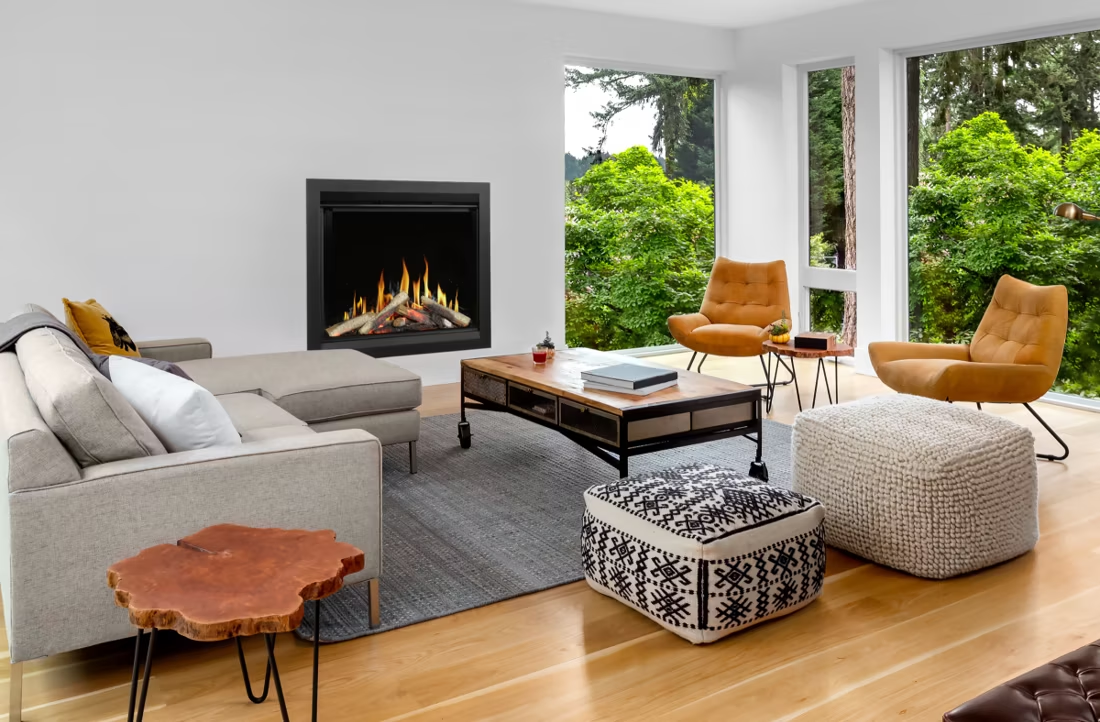
No—that's its superpower. An electric fireplace needs a wall and an outlet, period. No vent pipe, no gas line, no clearances to design around, which is why it works in bedrooms, offices, apartments, and walls where venting a gas or wood unit would be impractical or impossible. Installation is typically the simplest and least expensive of any fireplace type.
Can a fireplace actually lower my heating bill?
Yes—by creating a comfort zone. A furnace heats every square foot of the house just to warm the one room you're in; a gas fireplace on low burns roughly a sixth of the gas a typical furnace does. Set the furnace around 55–60 degrees as a baseline, then heat the rooms your family actually uses. Families who heat this way commonly save $20–$60 a month.
Does a fireplace add value to my home?
On average, a fireplace adds back to the home about the same amount you spent installing it. Add the monthly savings from heating the rooms you actually use instead of the whole house—often hundreds of dollars a year—and the value case is strong before you even count what a fire does for how your family uses the room.
Find your electric fireplace in Carlton County.
Tell us a bit about your home and we'll put together a free Project Guide & Parts List—a plan for your electric fireplace project in Carlton County with the exact parts you'll need and a recommended local dealer who can install it.
Find Your Fireplace →