
Warm up any room in Beltrami County—no chimney required.
From Bemidji to Blackduck to the cabins along Lake Bemidji, electric fireplaces add real zone heat and ambiance without venting, gas lines, or masonry work. Find the right unit and connect with a trusted local dealer.
Every Project Starts From One of These Five Situations
The cleanest way to add heat where you actually live.
Beltrami County sits in climate zone 7 with roughly 9,639 heating degree days and a winter low averaging -3°F—cold enough to sit alongside International Falls on any map of Minnesota's harshest winters. Most homes and cabins here, whether in Bemidji, Blackduck, Solway, or out past Turtle River and Puposky, rely on wood, propane, or fuel oil for primary heat, with plenty of oak, maple, birch, and aspen cut locally through Chippewa National Forest permits. Electric fireplaces don't compete with that primary system—they solve a different problem: the bonus bedroom over the garage that never gets warm, the finished basement rec room, the three-season porch, or a cabin on Lake Bemidji where running a gas line or masonry chimney isn't practical.
Because Beltrami Electric Cooperative rates apply here like anywhere else, running an electric fireplace as your only heat source through a full zone-7 winter gets expensive fast—resistance heat simply isn't cheap fuel at this HDD level. That's why most local installs are supplemental: a 120V plug-in insert or a hardwired built-in unit that takes the edge off a cold room between October and April without touching your furnace or wood stove. Plug-in units generally need no permit at all; hardwired built-ins with new circuit work typically go through an electrical permit with Beltrami County. Either way, there's no venting, no clearance-to-combustibles headache, and nothing to sweep or inspect.
Three steps. No salesperson until you're ready.
Tell us about your project
Your zip code, your situation, and the fuel you're leaning toward—or let the answers point you to one.
See what's actually available
The brands dealers within 100 miles genuinely carry—real options, never a catalog mirage.
Get your dealer & Project Guide
A trusted local dealer, plus the free Project Guide & Parts List that names every component of the job.
Frequently Asked Questions
How much does an electric fireplace installation cost in Beltrami County?
Plug-in electric fireplace inserts and freestanding stoves typically run $300 to $1,200 installed, since most just need an existing standard outlet and a bit of trim work to fit an opening. Hardwired built-in wall units or linear fireplaces run higher—often $2,500 to $4,000—once you factor in a dedicated 120V or 240V circuit, an electrician's time, and any surround or mantel carpentry. Cabin installs around Lake Bemidji or out toward Turtle River sometimes carry a small travel charge if the nearest dealer is coming from Bemidji.
Can an electric fireplace actually heat a room in a -3°F Beltrami County winter?
Yes, for the room it's in—most units put out 4,000 to 5,000 BTU (roughly 1,500 watts), enough to noticeably warm a bedroom, den, or finished basement space of a few hundred square feet. What it won't do is replace your furnace, wood stove, or propane system as whole-home heat during a stretch of sub-zero nights, which happen regularly here given the county's roughly 9,639 heating degree days. Think of it as zone heat for the specific room that runs cold, not a substitute for your primary system.
Do I need a permit to install an electric fireplace in Beltrami County?
A plug-in insert or freestanding electric stove that runs off an existing outlet generally doesn't require a permit—it's treated like any other appliance. A hardwired built-in unit that needs a new circuit run, however, typically requires an electrical permit, and local installers usually pull that as part of the job. If you're doing new construction or a remodel that includes the fireplace, check with Beltrami County on whether the work needs to be rolled into your broader building permit.
Electric vs. wood—which makes more sense for my Beltrami County home?
Wood remains the practical primary or backup heat source for a lot of homes in this county, especially with Chippewa National Forest cutting permits running $10 to $20 per cord during the May-to-October season and local oak, maple, birch, and aspen all burning well. Wood also keeps working when the power goes out, which matters here. Electric fireplaces can't provide that off-grid backup, but they win on convenience—flip a switch, no ash, no chimney to sweep, no smoke—and they're the better fit for rooms where you want supplemental warmth and ambiance without the maintenance of a wood-burning setup. A lot of Beltrami County households end up with both: wood or propane for real heat, electric for the room that just needs a boost.
Electric vs. gas fireplace—which should I choose?
Gas fireplaces and inserts deliver more heat output and a more realistic flame, but they require either a natural gas line or a propane tank and dedicated venting—real construction work with real cost. Electric units need only an outlet or a simple circuit, install in under a day, and can go in rooms where running gas line isn't practical, like a finished basement addition or a cabin without existing service. For a supplemental heat source in a specific room, electric is usually simpler and cheaper. For a fireplace meant to carry real heating load through a Beltrami County winter, gas or propane is the stronger performer.
Is it safe to leave an electric fireplace running unattended?
Electric units are generally considered the safest fireplace option for homes with kids or pets—there's no open flame, no hot glass surface on many models, and no combustion byproducts entering the room, which matters even though Beltrami County has no listed air quality concerns to begin with. Most units include auto shut-off timers and overheat protection. That said, treat the heating element like any space heater: keep it clear of curtains, bedding, and clutter, and don't run it unattended overnight if it's an older model without safety shutoffs.
How much does it cost to run an electric fireplace in Beltrami County?
A typical 1,500-watt electric fireplace running on the heat setting costs roughly 15 to 25 cents an hour at standard Beltrami Electric Cooperative residential rates, depending on your rate class and season. Run four hours a night through a cold stretch and you're looking at somewhere around $20 to $30 a month in added electricity cost—reasonable for zone heat in one room, but a reminder why nobody in a zone-7 climate like this relies on resistance heat to warm an entire house.
What's the difference between an electric insert, a built-in, and an electric stove?
An electric insert is sized to slide into an existing fireplace opening—including old wood-burning fireplaces that are no longer used—and typically plugs into a nearby outlet. A built-in (or linear) electric fireplace is designed to be framed into a wall during new construction or a remodel, usually with a dedicated circuit, and offers the cleanest, most custom look. An electric stove is a freestanding cabinet-style unit that sits on the floor like a wood stove, works anywhere there's an outlet, and is easy to move if you relocate. For most Beltrami County homes converting an old fireplace, an insert is the simplest option; for new rooms or additions, a built-in or stove makes more sense.
Where can I find a local dealer for electric fireplaces near Bemidji?
A handful of hearth retailers serve Beltrami County out of the Bemidji area and cover the surrounding towns, including Blackduck, Solway, Puposky, and the lake communities. Because electric installs are lower-complexity than wood or gas work, many retailers can turn around a plug-in unit quickly, while built-in projects requiring new circuits take a bit more scheduling with an electrician. Working with a local dealer rather than a big-box retailer means someone actually measures your opening, checks your electrical capacity, and stands behind the install.
Can I put a TV above my fireplace?
Yes—with an asterisk. Fireplaces are hot and TVs don't like heat. Either put a mantel between them to deflect rising warmth, or choose a fireplace with heat-management technology that creates a cool zone on the wall above—the wall stays around 125 degrees, barely warm, while the room still gets full heat. If you like clean lines and don't want a mantel, heat management is the answer.
Does an electric fireplace need a vent or chimney?
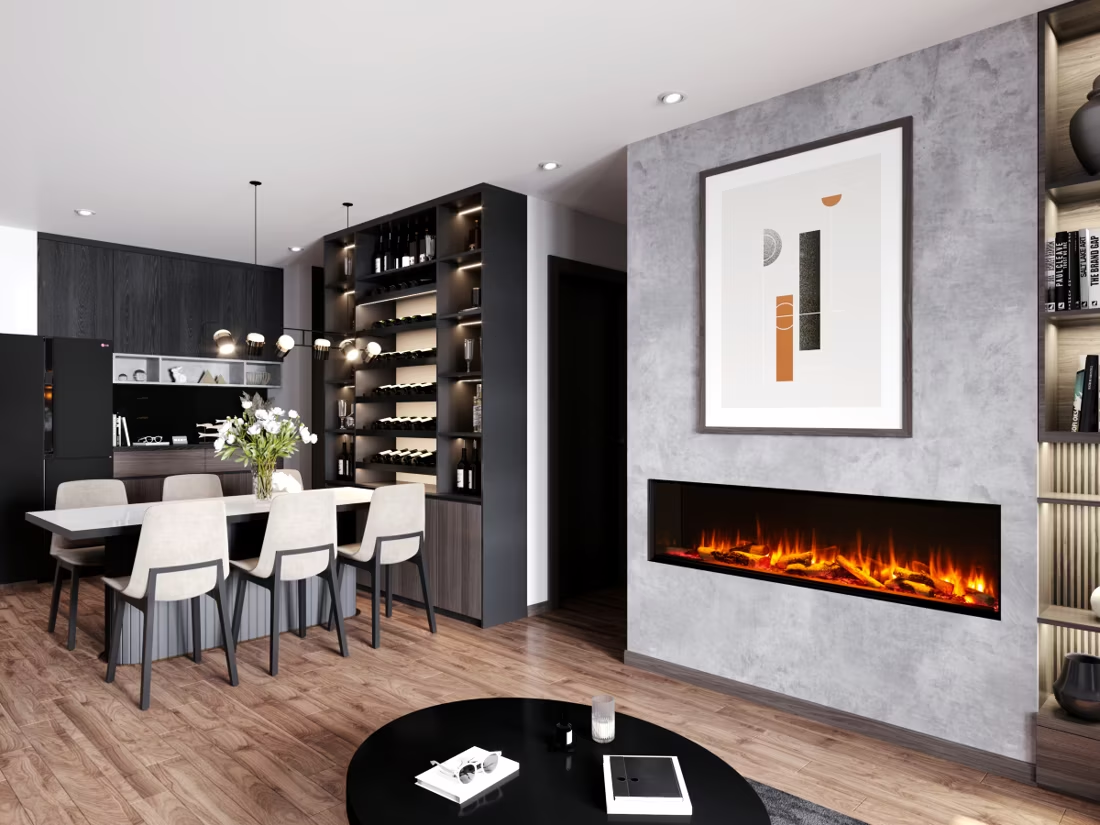
No—that's its superpower. An electric fireplace needs a wall and an outlet, period. No vent pipe, no gas line, no clearances to design around, which is why it works in bedrooms, offices, apartments, and walls where venting a gas or wood unit would be impractical or impossible. Installation is typically the simplest and least expensive of any fireplace type.
How much should I budget for a fireplace?
For an average home—covering the fireplace, the vent pipe, and basic installation—a budget between $3,900 and $5,500 gives you a lot of options across wood, gas, and pellet. By the time you add finish work, gas line, and electrical, the average complete installation lands between $5,000 and $12,000 all-in. In a remodel or new build, a good rule is to put about 2.5% of the total project cost toward the fireplace.
Can a fireplace actually lower my heating bill?
Yes—by creating a comfort zone. A furnace heats every square foot of the house just to warm the one room you're in; a gas fireplace on low burns roughly a sixth of the gas a typical furnace does. Set the furnace around 55–60 degrees as a baseline, then heat the rooms your family actually uses. Families who heat this way commonly save $20–$60 a month.
Stove and Fireplace Dealers in Beltrami County
Find your electric fireplace in Beltrami County.
Tell us about the room you're trying to warm and we'll put together a free Project Guide & Parts List—the right electric fireplace or insert, the exact parts, and a trusted local Beltrami County dealer to install it.
Find Your Fireplace →