
Zone heat for Washtenaw County's long winters—no chimney, no gas line.
With a long, cold heating season and winter lows averaging 16°F, Washtenaw County homes from Ann Arbor to Ypsilanti to Chelsea often need supplemental heat in rooms the furnace can't quite reach. An electric fireplace plugs into any outlet or a dedicated circuit—find the right unit and get matched with a trusted local dealer.
Every Project Starts From One of These Five Situations
Real supplemental warmth, zero venting, and it fits almost anywhere.
Washtenaw County spans a mix of historic neighborhoods, dense university housing, and newer subdivisions—the Old West Side and Water Hill districts in Ann Arbor, downtown condos near U-M, rental stock in Ypsilanti, and newer builds out toward Saline, Chelsea, and Dexter. A lot of that housing stock has no masonry chimney and no realistic path to add one, and Ann Arbor's historic district review process makes exterior venting changes slow and expensive even when they're technically possible. Climate zone 5A and winter lows around 16°F mean most of these homes still want extra heat in a bonus room, finished basement, or sunroom that the central furnace struggles to keep even.
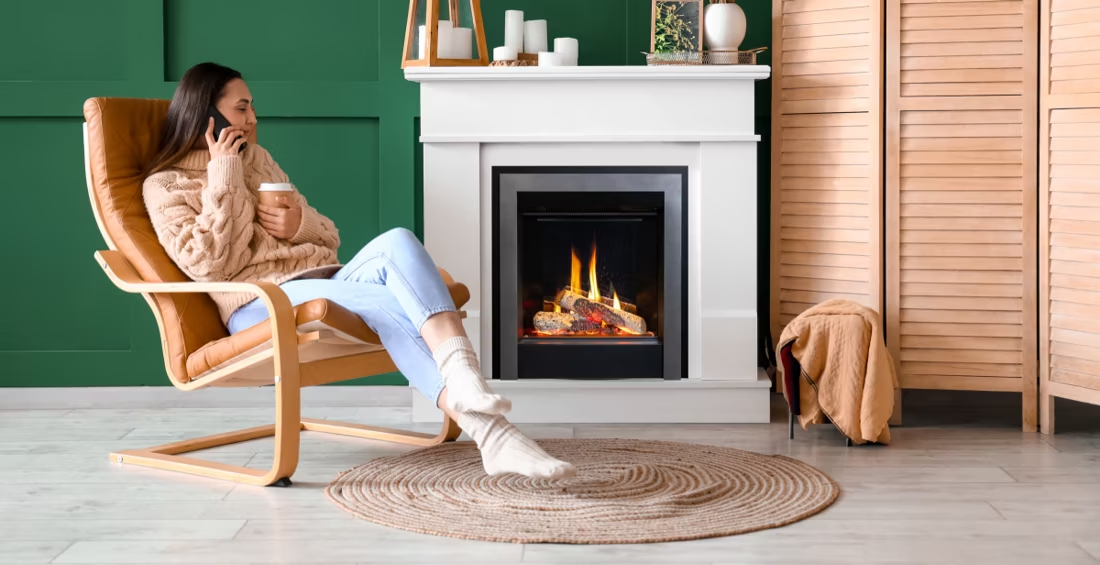
That's where electric fireplaces do real work. DTE Energy serves most of the county's electric accounts, with Consumers Energy covering some western and southern townships, and either utility can run a standard 1,500-watt fireplace insert without any special hookup. There's no flue to build, no gas line to run, and no combustion byproducts to vent—which also makes electric the practical answer for U-M-area rentals, condo associations that prohibit anything requiring exterior penetration, and older homes where a chimney simply isn't in the cards. It won't replace your furnace on a January night, but it will make that one cold room livable, and it does it without a permit hassle in most cases.
Three steps. No salesperson until you're ready.
Tell us about your project
Your zip code, your situation, and the fuel you're leaning toward—or let the answers point you to one.
See what's actually available
The brands dealers within 100 miles genuinely carry—real options, never a catalog mirage.
Get your dealer & Project Guide
A trusted local dealer, plus the free Project Guide & Parts List that names every component of the job.
Frequently Asked Questions
How much does an electric fireplace installation cost in Washtenaw County?
A plug-in insert or freestanding electric stove typically runs $300 to $1,500 installed, since most just slide into an existing opening or sit on the floor and plug into a standard outlet. A recessed wall-mounted unit that requires an electrician to run a dedicated 120V or 240V circuit—common in newer Ann Arbor and Saline builds where the fireplace goes into a great room wall—typically runs $1,500 to $3,500 depending on wire run length and panel access. A full mantel-surround package with custom framing, built-in shelving, or stone veneer can reach $4,000 to $6,000. Local dealers will size the right unit and quote the electrical work as part of an in-home visit.
Will an electric fireplace actually heat my room, or is it just for looks?
Most electric fireplaces top out at 1,500 watts—the maximum allowed on a standard 15-amp household circuit—which translates to roughly 5,000 BTUs, enough to noticeably warm a single room of 400 to 1,000 square feet depending on insulation and ceiling height. In a Washtenaw County home with a long, cold heating season and stretches of single-digit nights, that's genuinely useful as zone heat for a bonus room, finished basement, or sunroom addition that the furnace doesn't reach well—but it's not a whole-home heating solution. If you want primary or backup heat capable of running without the grid, wood or a properly vented gas unit is a better fit; electric shines as targeted supplemental warmth.
Do I need a permit to install an electric fireplace in Washtenaw County?
In most cases, no—a plug-in insert or freestanding unit that uses an existing outlet doesn't trigger a permit anywhere in the county. If your installer needs to run new wiring or add a dedicated circuit for a built-in wall unit, that work typically requires an electrical permit through your local jurisdiction—the City of Ann Arbor, Ypsilanti, Saline, Chelsea, or Washtenaw County's building department for unincorporated townships. If you're in one of Ann Arbor's historic districts (Old West Side, Water Hill, Germantown), the electrical work itself usually doesn't need historic district review since there's no exterior alteration, which is part of why electric is often the path of least resistance for those homes.
What's the difference between an electric insert, a freestanding stove, and a built-in wall unit?
An electric insert is sized to slide into an existing fireplace opening—a common upgrade for Washtenaw County homes with an old, drafty wood-burning fireplace that a family wants to convert to something simpler. A freestanding electric stove sits on the floor like a traditional wood stove and just needs a nearby outlet, making it the fastest option for a basement or bonus room. A built-in wall unit is recessed into new or existing framing, usually flush with the wall, and is the choice for new construction or a remodel where you want the fireplace to read as a permanent architectural feature rather than an appliance.
Will my electric fireplace work during a power outage?
No—and this is worth being direct about. Electric fireplaces run on grid power, so when Washtenaw County loses electricity in an ice storm or summer thunderstorm outage, the fireplace goes dark along with everything else. If your priority is heat you can count on when the power's out, a wood stove or a gas fireplace with battery-backed ignition is the better tool for that job. Electric is best understood as convenient, no-mess supplemental heat for normal operating conditions, not an emergency heat source.
What's the best electric fireplace for a Washtenaw County home?
For most homes here, look at 1,500-watt units from brands like Dimplex, Napoleon, or Amantii, which offer realistic flame effects and independent control of heat versus ambiance—useful if you want the visual on a mild fall evening without running the heater. For finished basements common in Ann Arbor and Saline subdivisions, a freestanding stove-style unit is easy to place near seating without any electrical work. For a great-room renovation, a built-in linear unit set into the wall gives a cleaner architectural look. Local dealers can match wattage and size to your specific room rather than guessing from a box store display.
Electric vs. gas vs. wood—which is right for my home?
Wood offers real backup heat during outages and pairs with the oak, maple, birch, and ash that are common firewood species across the county, but it needs a chimney, cutting or buying cordwood, and regular cleaning. Gas offers instant, strong heat and can run during outages with battery-backed ignition, but it requires venting and a gas line, pushing install costs higher. Electric skips the venting and gas line entirely, installs fast, and costs the least upfront—but it won't function without grid power and won't out-heat a real furnace on the coldest nights. For a lot of Washtenaw County homes, the practical answer is electric in a bonus room or condo where venting isn't an option, and wood or gas in the main living space where more serious heat output matters.
How much does it cost to run an electric fireplace with DTE Energy or Consumers Energy rates?
At Michigan's typical residential rate of roughly 17 cents per kilowatt-hour, a standard 1,500-watt electric fireplace costs about $0.25 per hour to run on the heat setting, or a bit less than a penny a minute. Running it four hours a night through a Washtenaw County winter adds roughly $30 to $35 to a monthly DTE Energy or Consumers Energy bill—cheap compared to propane on a per-BTU basis, though it can't compete with natural gas prices where gas service is already run to the house. Most owners use it selectively rather than continuously, which keeps the added cost modest.
Is an electric fireplace a good fit for older Ann Arbor homes or condos without a chimney?
It's often the best fit. A lot of housing stock in Ann Arbor's historic districts, near-campus rentals, and downtown condo buildings has no masonry chimney and no practical way to add flue penetration through a shared roof or a historic-district-protected facade. An electric insert or built-in wall unit sidesteps that problem entirely—no venting, no gas line, and in most cases no exterior alteration that would trigger historic district review. It's why electric shows up so often in condo association rules as the only fireplace type explicitly allowed.
Can I put a TV above my fireplace?
Yes—with an asterisk. Fireplaces are hot and TVs don't like heat. Either put a mantel between them to deflect rising warmth, or choose a fireplace with heat-management technology that creates a cool zone on the wall above—the wall stays around 125 degrees, barely warm, while the room still gets full heat. If you like clean lines and don't want a mantel, heat management is the answer.
Do electric fireplaces actually produce heat?
Yes—most put out around 4,800–5,000 BTUs from a standard outlet, which comfortably warms a bedroom, office, or den as a comfort-zone heater. What they won't do is carry a whole house the way wood, gas, or pellet can. Think of electric as ambiance-first with honest supplemental heat: flames on with no heat in July, flames plus warmth in January.
How much should I budget for a fireplace?
For an average home—covering the fireplace, the vent pipe, and basic installation—a budget between $3,900 and $5,500 gives you a lot of options across wood, gas, and pellet. By the time you add finish work, gas line, and electrical, the average complete installation lands between $5,000 and $12,000 all-in. In a remodel or new build, a good rule is to put about 2.5% of the total project cost toward the fireplace.
Can a fireplace actually lower my heating bill?
Yes—by creating a comfort zone. A furnace heats every square foot of the house just to warm the one room you're in; a gas fireplace on low burns roughly a sixth of the gas a typical furnace does. Set the furnace around 55–60 degrees as a baseline, then heat the rooms your family actually uses. Families who heat this way commonly save $20–$60 a month.
Stove and Fireplace Dealers in Washtenaw County
Listings include WhyFire partner dealers, dealers we have verified as authorized for the brands we recommend, and established local businesses that carry hearth products. Every listing shows which one it is. The ones marked Preferred run on WhyFire's software, so they can show you real pricing and book your appointment right here. No manufacturer pays for placement. How we verify dealers →
Big Georges Appliance Mart
Big George’s
Fireside Hearth & Home - Canton
Brighton Stone & Fireplace
Fireside Hearth & Home- Brighton
Premier Furniture
Glenn's Fireplace & Spa
Lighting Hearth & Home By Gross Electric
Jw Fireplace
Find your electric fireplace in Washtenaw County.
Tell us about your room and your home, and we'll match you with a trusted local Washtenaw County dealer and send over a free Project Guide & Parts List—sized to your space, with the exact parts and your recommended installer.
Find Your Fireplace →