
Warm up Shiawassee County—no chimney required.
Electric fireplaces and inserts for Owosso, Corunna, Perry, Durand, and every community across Shiawassee County—no chimney, no gas line, and no venting required. Get matched with a trusted local dealer who'll size it right for your room.
Every Project Starts From One of These Five Situations
Heat without the venting, the permits, or the mess.
Shiawassee County sits in mid-Michigan's Saginaw Valley—flat farmland and small towns like Owosso, Corunna, Perry, Durand, and New Lothrop, with winters that run cold enough and long enough to rank among the harder heating seasons in the country, and average lows around 16°F. That's a heating season on par with Madison, Wisconsin—long, gray, and cold enough that most homes run their furnace from October through April. Electric fireplaces have become a standard fixture in Shiawassee County homes, not as a furnace replacement, but as a way to add real, felt warmth to the rooms that matter most: a finished basement rec room in Owosso, a sunroom addition outside Corunna, or a bedroom in an older Perry farmhouse where the ductwork never quite reaches.
With no wood-smoke air quality restrictions in the county and plenty of homes without a natural gas line reaching every room, electric is often the simplest fix—no venting, no chimney, no gas permit, just a dedicated circuit for built-in models or a standard outlet for plug-in inserts. Electric works best as zone heat rather than a whole-home solution: a 1,500-watt unit comfortably warms a single room, not a drafty two-story farmhouse near Bancroft or Vernon. For households that still keep a wood or pellet stove running elsewhere in the house—oak, maple, birch, and ash are all common local firewood, and pellet brands like Indeck Energy Services, Lignetics, and Somerset Pellet Fuel are sold regionally—an electric fireplace is frequently the second heat source, chosen for convenience and ambiance in rooms where a flue was never in the plan.
Three steps. No salesperson until you're ready.
Tell us about your project
Your zip code, your situation, and the fuel you're leaning toward—or let the answers point you to one.
See what's actually available
The brands dealers within 100 miles genuinely carry—real options, never a catalog mirage.
Get your dealer & Project Guide
A trusted local dealer, plus the free Project Guide & Parts List that names every component of the job.
Frequently Asked Questions
How much does an electric fireplace installation cost in Shiawassee County?
Electric fireplace costs in Shiawassee County vary more by installation type than by brand. A plug-in insert or mantel package runs $300 to $1,200 for the unit itself and needs nothing more than a standard 15-amp outlet—most homeowners handle this themselves in an afternoon. A built-in wall unit or linear electric fireplace set into new framing is a different project: expect $800 to $2,500 once you include a dedicated 20-amp circuit, wall preparation, and a licensed electrician's time. Homes in older Owosso or Corunna neighborhoods with dated wiring or an undersized panel sometimes need electrical upgrades first, which adds to the total.
Do I need a permit for an electric fireplace in Shiawassee County?
Plug-in electric fireplaces typically don't require a permit—they're treated like any other appliance you plug into the wall. Built-in units that need a new dedicated circuit are different: that's electrical work, and most municipalities require an electrical permit for new circuit runs, pulled by a licensed electrician. If your project also involves new framing or moving a wall, check with your local jurisdiction—Owosso, Corunna, Perry, and Durand each handle their own permitting, while unincorporated township land typically routes through the county.
Will an electric fireplace actually heat my room, or is it just for looks?
Yes, but set your expectations correctly. A 1,500-watt electric fireplace—the standard output for most residential units—will noticeably warm a single room of 300 to 400 square feet, which is genuine heat, not just a glowing screen. It won't replace a furnace in a Shiawassee County winter that averages 16°F lows and a long, demanding heating season stretching from October through April. Think of it as zone heat: it lets you nudge the thermostat down a couple degrees in the rest of the house while keeping the room you're actually using comfortable.
What's the difference between an electric insert, built-in, and freestanding electric stove?
An electric insert slides into an existing fireplace opening—masonry or zero-clearance—and is the most common upgrade for Shiawassee County homes with an old, rarely-used wood fireplace they want to simplify. A built-in, or linear, electric fireplace is designed into new framing during a remodel and can be recessed flush into a wall for a modern look. A freestanding electric stove mimics a wood stove's shape, sits on the floor, and plugs into a standard outlet—a popular choice for finished basements and additions where running new wiring isn't practical.
Can I install an electric fireplace in a room with no existing chimney or gas line?
Yes—that's one of the main reasons electric fireplaces are popular across Shiawassee County. No chimney, gas line, or venting of any kind is required, which makes electric the only realistic fireplace option for interior rooms, basements, and additions that were never built with a flue in mind. That covers a lot of the county's older farmhouse stock around Bancroft, Vernon, and New Lothrop, where retrofitting a chimney into a mid-century addition would cost far more than simply running the fireplace off the existing electrical panel.
Will my electric fireplace work during a power outage?
No—electric fireplaces need power to run, full stop, so they won't help during an outage. That's a real consideration in Shiawassee County, where ice storms and downed lines can knock out power for hours, and in bad years, days, across the rural parts of the county. Many households pair an electric fireplace for everyday convenience with a wood or pellet stove for genuine backup heat—oak, maple, birch, and ash are all readily available locally for firewood, and pellet brands like Indeck Energy Services, Lignetics, and Somerset Pellet Fuel are sold regionally—since that heat source keeps working when the grid doesn't.
What size electric fireplace do I need for my Shiawassee County home?
Electric fireplace sizing is simpler than wood or gas because there's no BTU-per-square-foot chimney math involved—it comes down to the width of the space and the wattage of the heater element. A 36-to-50-inch unit suits most living rooms and bonus rooms common in Shiawassee County's ranch and split-level housing stock; smaller 26-to-30-inch units work well for bedrooms or a basement corner. Nearly every unit sold uses a standard 1,500-watt heater regardless of size, so a bigger unit mostly buys you a bigger flame display, not more heat—worth knowing if a salesperson tries to upsell you on heating output.
Electric vs. wood vs. gas—which is right for my home?
Wood offers the most heat per dollar and keeps working when the power's out—a real advantage given Shiawassee County's ice-storm-prone winters—and it burns local oak, maple, birch, and ash. Gas offers instant, thermostat-controlled heat without touching a woodpile, but needs either a natural gas line or a propane tank. Electric needs neither, installs in almost any room, and produces zero emissions or ash, but it's the least efficient at heating a whole home and stops working the moment the power does. Most Shiawassee County homes running electric fireplaces are using them for convenience and ambiance in a specific room, with the furnace—and often a backup wood or pellet stove—doing the heavy lifting elsewhere.
Where can I find a licensed installer for an electric fireplace near me?
For a simple plug-in unit, most Shiawassee County homeowners install it themselves—no professional needed. For a built-in or linear electric fireplace that requires a new dedicated circuit, you want a licensed electrician, ideally one who's handled fireplace installs before and knows the clearance and heat-shield requirements around combustible framing. A trusted local hearth dealer will typically coordinate both the fireplace and the electrical work as part of the install, which is simpler than hiring an electrician separately and hoping the specs line up.
Does an electric fireplace need a vent or chimney?
No—that's its superpower. An electric fireplace needs a wall and an outlet, period. No vent pipe, no gas line, no clearances to design around, which is why it works in bedrooms, offices, apartments, and walls where venting a gas or wood unit would be impractical or impossible. Installation is typically the simplest and least expensive of any fireplace type.
Can I put a TV above my fireplace?
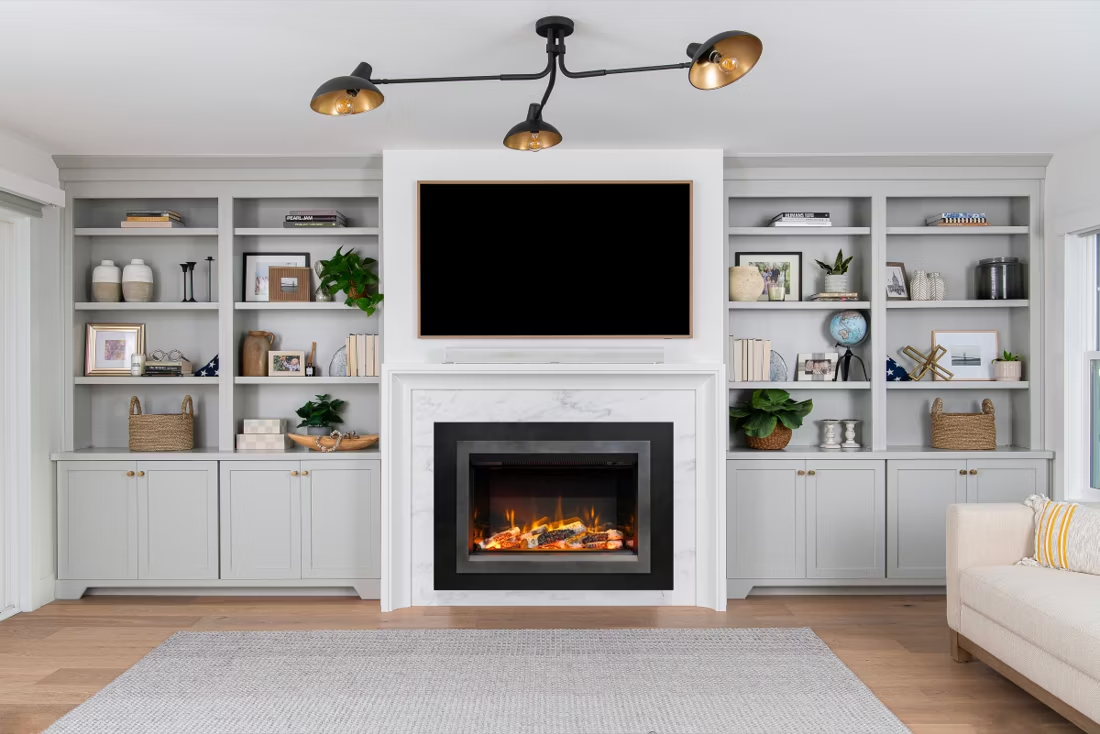
Yes—with an asterisk. Fireplaces are hot and TVs don't like heat. Either put a mantel between them to deflect rising warmth, or choose a fireplace with heat-management technology that creates a cool zone on the wall above—the wall stays around 125 degrees, barely warm, while the room still gets full heat. If you like clean lines and don't want a mantel, heat management is the answer.
Does a fireplace add value to my home?
On average, a fireplace adds back to the home about the same amount you spent installing it. Add the monthly savings from heating the rooms you actually use instead of the whole house—often hundreds of dollars a year—and the value case is strong before you even count what a fire does for how your family uses the room.
Can a fireplace actually lower my heating bill?
Yes—by creating a comfort zone. A furnace heats every square foot of the house just to warm the one room you're in; a gas fireplace on low burns roughly a sixth of the gas a typical furnace does. Set the furnace around 55–60 degrees as a baseline, then heat the rooms your family actually uses. Families who heat this way commonly save $20–$60 a month.
Find your electric fireplace in Shiawassee County.
Tell us a bit about your Shiawassee County home and we'll match you with a trusted local dealer and a free Project Guide & Parts List—the exact electric fireplace, mounting hardware, and circuit requirements for your space, with no big-box guesswork.
Find Your Fireplace →