
Warm up your Osceola County home, no chimney required.
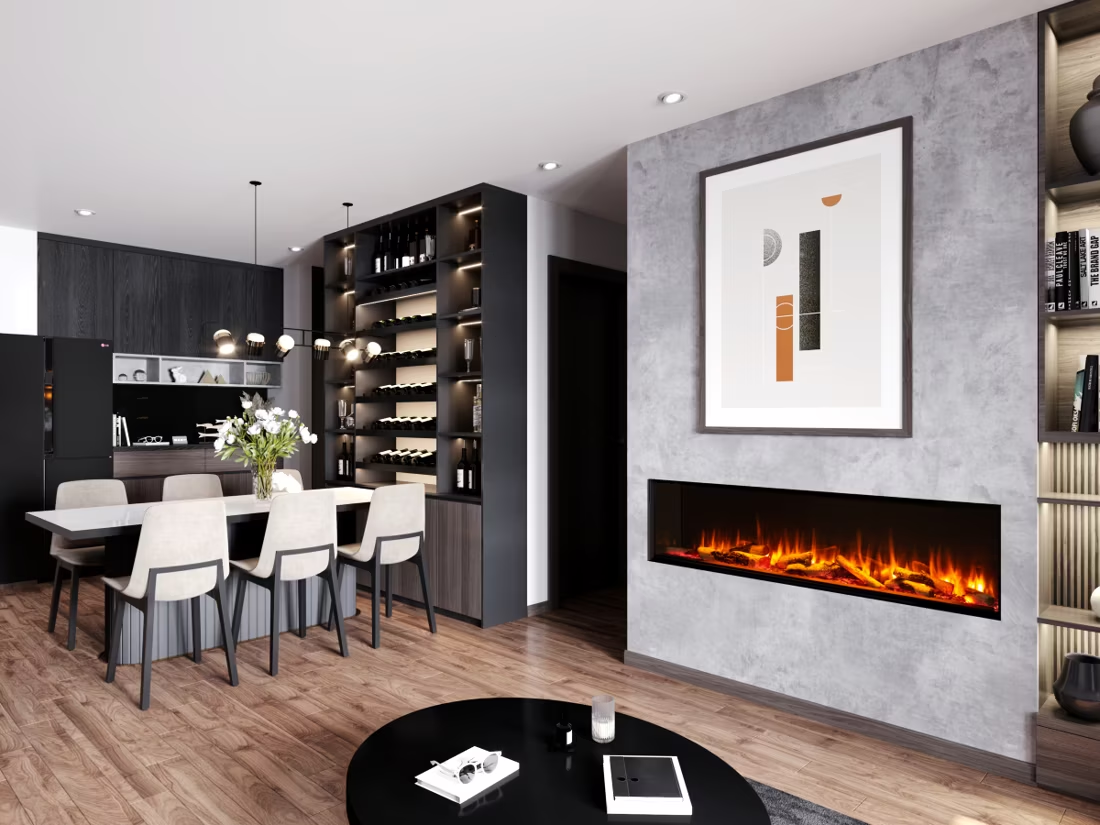
Osceola County winters push well below freezing for months at a time, and most homes here lean on wood stoves and propane furnaces to get through them. An electric fireplace won't replace either—but it adds instant, no-mess warmth to a living room, bonus room, or finished basement without touching your chimney or gas line.
Every Project Starts From One of These Five Situations
The easiest fireplace to add to a wood-and-propane county.
Osceola County sits in Michigan's climate zone 6A, with an average winter low around 13°F and roughly 7,620 heating degree days a year—a heating season on par with Minneapolis. Across the county's small towns—Reed City, Evart, Marion, LeRoy, Hersey, and Tustin—most homes stay warm through the coldest months with a propane furnace, a wood stove burning local oak, maple, birch, or ash, or some combination of the two. Natural gas mains don't reach much of the county's rural stretches, so propane delivery trucks are a common winter sight.
Electric fireplaces fit into that mix as a supplement, not a replacement. There's no chimney to build, no gas line to run, and in most cases no permit beyond a standard electrical hookup—plug-in units just need a 120V outlet, while larger built-ins may call for a dedicated circuit. What they can't do is keep a house warm through a power outage the way a wood stove can, which is why most Osceola County homeowners who add one keep their existing wood or propane heat in place and use the electric unit for zone heat in a bonus room, a finished basement, or simply for the look of a fire in a room that never had a working fireplace.
Three steps. No salesperson until you're ready.
Tell us about your project
Your zip code, your situation, and the fuel you're leaning toward—or let the answers point you to one.
See what's actually available
The brands dealers within 100 miles genuinely carry—real options, never a catalog mirage.
Get your dealer & Project Guide
A trusted local dealer, plus the free Project Guide & Parts List that names every component of the job.
Frequently Asked Questions
How much does it cost to install an electric fireplace in Osceola County?
Electric fireplaces are the least expensive hearth product to put in, mainly because there's no chimney, no gas line, and no venting to run. A basic plug-in insert or wall-mount unit typically costs $300 to $900 installed, while a larger built-in model that needs a dedicated 120V or 240V circuit run by an electrician can land closer to $1,000 to $1,800. Compare that to a wood stove installation in this county, which usually means a masonry chimney or Class A pipe and runs several thousand dollars more. A local dealer can give you a firm number once they know the unit and your home's electrical panel.
Do I need a permit to install an electric fireplace in Osceola County?
In most cases, no. A cord-and-plug electric fireplace or insert that runs on a standard 120V household outlet doesn't require a building permit anywhere in Osceola County. If you're installing a larger built-in unit that needs its own dedicated circuit, the electrical work itself typically needs to be pulled by a licensed electrician and may require an electrical permit through the county or your local municipality—Reed City and Evart each handle their own permitting separately from the rest of Osceola County. Your dealer or electrician can tell you which applies to your specific unit.
Can an electric fireplace heat my whole house?
Not in this climate. Most electric fireplaces top out around 1,500 watts, which works out to roughly 5,000 BTU—enough to comfortably warm a single room of 400 to 1,000 square feet depending on insulation, but nowhere near what's needed to carry a home through an Osceola County winter with 7,620 heating degree days. Think of it as zone heat for the room you're sitting in, layered on top of whatever furnace or wood stove is already doing the heavy lifting.
Will my electric fireplace still work if the power goes out?
No—and this is the biggest trade-off compared to a wood stove. An electric fireplace has no function without grid power, so during winter storm outages it goes dark along with everything else in the house. That's a real consideration in a rural county like Osceola, where outages can stretch for hours or longer. Many homeowners here keep a wood stove or propane heater as backup for exactly that reason, and add the electric unit purely for convenience and ambiance on ordinary nights.
Electric vs. pellet vs. wood—which fits my Osceola County home?
Wood stoves burning local oak, maple, birch, or ash remain the go-to backup heat source here, and Forest Service cutting permits through the Huron-Manistee National Forests run $10 to $20 per cord during the May-to-October season for homeowners who cut their own. Pellet stoves, stocked by regional suppliers like Indeck Energy Services, Lignetics, and Somerset Pellet Fuel, offer a cleaner, more automated middle ground but still need electricity to run the auger and blower. Electric fireplaces sit at the convenience end of that spectrum—no fuel to haul, no ash, no chimney—but they contribute the least actual heat and depend entirely on the grid. Many Osceola County homes end up with two of the three: a primary heat source (propane or wood) plus an electric unit for a room that needs a quick, clean upgrade.
What are my installation options for an electric fireplace?
You've got three basic paths: a freestanding electric stove that plugs in anywhere near an outlet, a wall-mount or built-in unit set into framing (common in new additions or remodeled living rooms), or an insert sized to slide into an existing masonry fireplace opening—a popular option for older Osceola County farmhouses that have an unused wood fireplace and want the look of a fire without the upkeep. A local dealer can walk your space and tell you which fits your opening and electrical setup.
How much does an electric fireplace cost to run?
A typical 1,500-watt unit costs a few cents an hour on low heat settings and somewhat more on high—running one for three or four hours a night through an Osceola County winter typically adds somewhere in the range of $15 to $40 a month to an electric bill, depending on your rate and how much you use the heater function versus just the flame effect. That's a fraction of what it costs to run electric resistance heat as a whole-house system in a 7,620-HDD climate, which is exactly why these units work best as supplemental heat rather than a primary furnace replacement.
Does Osceola County have any restrictions on wood or electric heat?
Osceola County has no air quality nonattainment designation and no winter burn curtailment program, so wood stoves here run without the kind of restrictions you'd see in some western states. That also means there's nothing stopping you from running an electric fireplace year-round for ambiance—no combustion, no smoke, no local ordinance to check. The only real limitation is the electrical capacity of your home's panel if you're adding a larger built-in unit.
Electric vs. gas fireplace—which is right for my home?
Gas fireplaces put out real, usable heat—often 20,000 to 30,000 BTU from a direct-vent unit—and can serve as legitimate supplemental heat in a propane-heavy county like Osceola. Electric fireplaces put out far less heat but need no gas line, no venting, and almost no ongoing maintenance, which makes them the simpler and cheaper choice for a room where you mainly want the look of a fire and a little warmth rather than a real heat source. If you already have propane service to the house, a gas unit is worth a look; if you just want to add a fireplace feature to a room without touching your propane line, electric is usually the easier call.
Can I put a TV above my fireplace?
Yes—with an asterisk. Fireplaces are hot and TVs don't like heat. Either put a mantel between them to deflect rising warmth, or choose a fireplace with heat-management technology that creates a cool zone on the wall above—the wall stays around 125 degrees, barely warm, while the room still gets full heat. If you like clean lines and don't want a mantel, heat management is the answer.
Do electric fireplaces actually produce heat?
Yes—most put out around 4,800–5,000 BTUs from a standard outlet, which comfortably warms a bedroom, office, or den as a comfort-zone heater. What they won't do is carry a whole house the way wood, gas, or pellet can. Think of electric as ambiance-first with honest supplemental heat: flames on with no heat in July, flames plus warmth in January.
Can I install a fireplace myself?
If you're putting a fire in your house on purpose, it's best to work with an expert. Unless you're genuinely experienced in framing, gas line, vent pipe, and the national code on clearances to combustibles, have a professional do it—and ideally the same company that sells you the fireplace, so warranty, service, and liability all live under one roof.
How much should I budget for a fireplace?
For an average home—covering the fireplace, the vent pipe, and basic installation—a budget between $3,900 and $5,500 gives you a lot of options across wood, gas, and pellet. By the time you add finish work, gas line, and electrical, the average complete installation lands between $5,000 and $12,000 all-in. In a remodel or new build, a good rule is to put about 2.5% of the total project cost toward the fireplace.
Stove and Fireplace Dealers in Osceola County
Find your electric fireplace in Osceola County.
Tell us a bit about your home and we'll match you with the right electric fireplace or insert—plus a free Project Guide & Parts List with the exact parts for your space and a recommended local Osceola County dealer to install it.
Find Your Fireplace →