
Warm up any room in Hillsdale County—no venting, no permits, no mess.
Winter lows in Hillsdale County average 15°F with a long, cold heating season—enough cold to make a supplemental heat source worth having in the rooms your furnace struggles to reach. Find the right electric unit and connect with a trusted local dealer.
Every Project Starts From One of These Five Situations
Reliable zone heat without the chimney work.
Hillsdale County sits in south-central Michigan along the Ohio and Indiana border, home to the city of Hillsdale and smaller communities like Jonesville, Litchfield, Reading, and Camden. With winters bringing a cold-climate heating load in the same range as Madison, Wisconsin, most county homes lean on a furnace as primary heat, and plenty of older farmhouses still burn oak, maple, ash, or birch in a wood stove for backup warmth during outages. Electric fireplaces fill a different, more targeted role: they don't replace the furnace or the wood stove, but they solve the specific problem of a cold finished basement, a converted sunroom, or a rental unit in town where running a chimney or gas line isn't practical.
Hillsdale County has no wood-smoke air quality restrictions to work around, so the appeal of electric here isn't about emissions—it's about simplicity. A plug-in insert or wall-mount unit gives instant, controllable heat in a single room without touching your electrical panel, which matters in a county with a lot of older farmhouse wiring and manufactured housing where a full gas or wood installation would mean a bigger, more expensive project. For lake cottages around Baw Beese Lake used only part of the year, or apartments above Main Street storefronts in the city of Hillsdale, electric is often the only realistic option.
Three steps. No salesperson until you're ready.
Tell us about your project
Your zip code, your situation, and the fuel you're leaning toward—or let the answers point you to one.
See what's actually available
The brands dealers within 100 miles genuinely carry—real options, never a catalog mirage.
Get your dealer & Project Guide
A trusted local dealer, plus the free Project Guide & Parts List that names every component of the job.
Frequently Asked Questions
How much does an electric fireplace installation cost in Hillsdale County?
A plug-in freestanding or insert unit that runs off a standard household outlet typically costs $150 to $600 installed, since there's no wiring or venting work involved beyond plugging it in and securing the surround. A built-in wall unit or a larger insert that needs a dedicated 20- or 30-amp circuit run by a licensed electrician runs $800 to $2,500, depending on how far the new circuit has to travel from the panel. Older Hillsdale County farmhouses with dated fuse panels sometimes need a panel upgrade first, which adds to the cost—a local electrician or hearth dealer can tell you quickly whether your existing service can handle a new circuit.
What size electric fireplace do I need for my room?
Most electric fireplace inserts and wall units run about 1,500 watts and 4,600 to 5,200 BTUs, which is enough to noticeably warm 400 to 1,000 square feet depending on ceiling height and insulation. That's plenty for a single finished basement room, a converted porch, or a bedroom in an older Hillsdale County home with drafty original windows, but it's not meant to heat an entire farmhouse on its own—think supplemental zone heat, not a furnace replacement. If you're trying to warm a larger open floor plan, a local dealer can help you decide between one larger unit or two smaller ones placed strategically.
Do I need a permit to install an electric fireplace in Hillsdale County?
Usually not for a plug-in unit—there's no combustion, no venting, and no gas line, so most townships and the city of Hillsdale don't require a building permit for a standard electric insert or mantel unit. If your installation needs a new dedicated circuit, an electrical permit is typically required, whether you're in the city of Hillsdale or one of the surrounding townships like Jonesville or Reading Township. A licensed electrician pulling the permit as part of the install is the norm, so it's rarely something you have to handle yourself.
Will my electric fireplace still work if the power goes out?
No—and this is worth being clear about. Electric fireplaces are entirely dependent on grid power; when it's out, the unit is out, heat and flame effect included. In a county where winter ice storms and downed lines aren't rare, that's the tradeoff for the convenience of no venting and no fuel handling. If backup heat during outages matters to your household, pair the electric unit with a wood stove burning local oak or ash, which many Hillsdale County homes already have, rather than relying on electric as your only heat source in a storm.
Electric vs. wood—which is right for my Hillsdale County home?
Wood heat has deep roots in this county—oak, maple, ash, and birch are all common local species, and a wood stove keeps working through the kind of extended power outages that can follow a Michigan winter storm. Electric fireplaces can't do that, but they win on convenience: no chimney, no ash, no wood stacking, and they can go into rooms where venting simply isn't an option, like an apartment above a storefront in town or a finished basement with no exterior wall access. Many county households end up with both—wood for the primary or backup heat, electric for ambiance and zone warmth in a specific room.
What's the difference between an electric insert, a wall-mount unit, and a freestanding electric fireplace?
An electric insert is built to slide into an existing fireplace opening—a common choice if a Hillsdale County home has an old wood-burning fireplace that's no longer used and the owner wants heat and flame effect without dealing with a chimney. A wall-mount unit hangs directly on a wall like a flat-screen TV and works well in a room with no existing fireplace, such as a finished basement or converted porch. A freestanding or mantel-style unit is furniture that plugs in anywhere near an outlet, which makes it the easiest option for renters or anyone not ready to modify a wall.
How much does it cost to run an electric fireplace?
A typical 1,500-watt electric fireplace running on the heat setting costs roughly $0.20 to $0.30 per hour at current Michigan residential electric rates, or a few dollars for a full evening of use. That's meaningfully cheaper than heating an entire farmhouse with the furnace just to warm one occupied room, which is the main financial argument for using an electric unit as zone heat in a specific space rather than running central heat harder.
Do electric fireplaces need any maintenance?
Very little compared to wood or gas. There's no chimney to sweep, no gas line to inspect, and no pilot light to service. Most maintenance is limited to occasionally dusting the heating element and vents and replacing an LED light strip years down the road if the flame effect dims. This low-maintenance profile is part of why electric units are popular in rental properties and vacation cottages around Baw Beese Lake, where no one wants to schedule annual service visits.
Electric vs. pellet stove—which is right for me?
It's worth knowing that pellet stoves also require electricity to run their auger and blower, so neither option gives you backup heat in a power outage the way a wood stove does. Where they differ: a pellet stove burns hardwood pellets—brands like Indeck Energy Services, Lignetics, or Somerset Pellet Fuel are all sold regionally—and puts out real, substantial heat suitable as a primary or near-primary source for a Hillsdale County home. An electric fireplace produces a lower, supplemental heat output but installs almost anywhere with zero venting and far less maintenance. If you need serious heat for a whole living area, pellet is the stronger choice; if you want ambiance and mild warmth in a specific room with the simplest possible install, electric wins.
Can I put a TV above my fireplace?
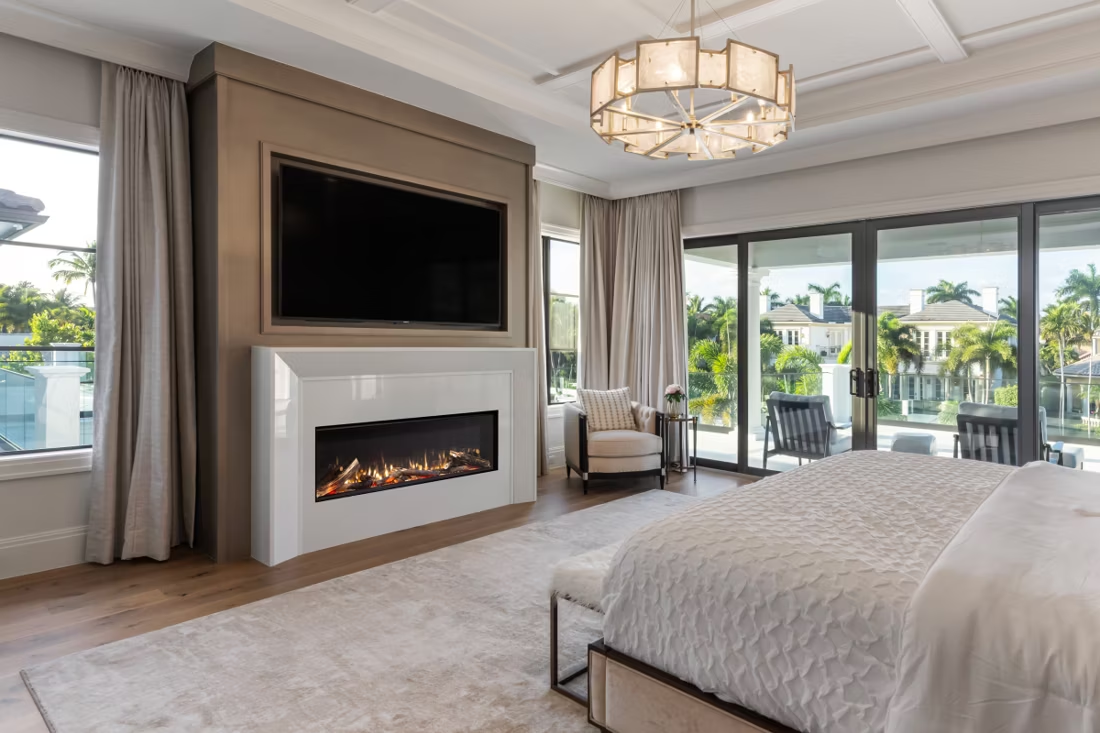
Yes—with an asterisk. Fireplaces are hot and TVs don't like heat. Either put a mantel between them to deflect rising warmth, or choose a fireplace with heat-management technology that creates a cool zone on the wall above—the wall stays around 125 degrees, barely warm, while the room still gets full heat. If you like clean lines and don't want a mantel, heat management is the answer.
Do electric fireplaces actually produce heat?
Yes—most put out around 4,800–5,000 BTUs from a standard outlet, which comfortably warms a bedroom, office, or den as a comfort-zone heater. What they won't do is carry a whole house the way wood, gas, or pellet can. Think of electric as ambiance-first with honest supplemental heat: flames on with no heat in July, flames plus warmth in January.
Can a fireplace actually lower my heating bill?
Yes—by creating a comfort zone. A furnace heats every square foot of the house just to warm the one room you're in; a gas fireplace on low burns roughly a sixth of the gas a typical furnace does. Set the furnace around 55–60 degrees as a baseline, then heat the rooms your family actually uses. Families who heat this way commonly save $20–$60 a month.
How much should I budget for a fireplace?
For an average home—covering the fireplace, the vent pipe, and basic installation—a budget between $3,900 and $5,500 gives you a lot of options across wood, gas, and pellet. By the time you add finish work, gas line, and electrical, the average complete installation lands between $5,000 and $12,000 all-in. In a remodel or new build, a good rule is to put about 2.5% of the total project cost toward the fireplace.
Stove and Fireplace Dealers in Hillsdale County
Find your electric fireplace in Hillsdale County.
Tell us a bit about your home and we'll put together a free Project Guide & Parts List—the right electric fireplace or insert for your space, matched with a trusted local Hillsdale County dealer who can install it correctly.
Find Your Fireplace →