
Add Real Warmth to Your Grosse Pointe Farms Home—No Chimney Required.
Zone heat and ambiance for the Lake St. Clair cold, without touching a gas line or a masonry chimney. Find the right unit and connect with a trusted local dealer.
Every Project Starts From One of These Five Situations
Zone heat for historic homes, without the venting headaches.
Grosse Pointe Farms sits along Lake St. Clair with winters in the same range as Buffalo, NY—a long, cold heating season—and average winter lows around 17°F. Much of the city's housing stock is colonial and tudor construction from the 1920s through 1940s, with plaster walls and masonry fireboxes that, decades later, often no longer have a safe or functioning flue. That combination makes electric fireplaces and inserts a natural fit: they drop into an existing opening or mount on a wall, need no chimney, no liner, and no gas line, and still deliver real supplemental heat to a single room.
Most of Grosse Pointe Farms is served by DTE Electric Company, with a smaller portion of the area served by the Wyandotte Municipal Service Commission. Electric fireplaces are the lowest-cost fireplace fuel to install of any option, and unlike wood or gas, there's no permit-heavy venting project to plan around—just the right unit, the right circuit, and a spot on the wall.
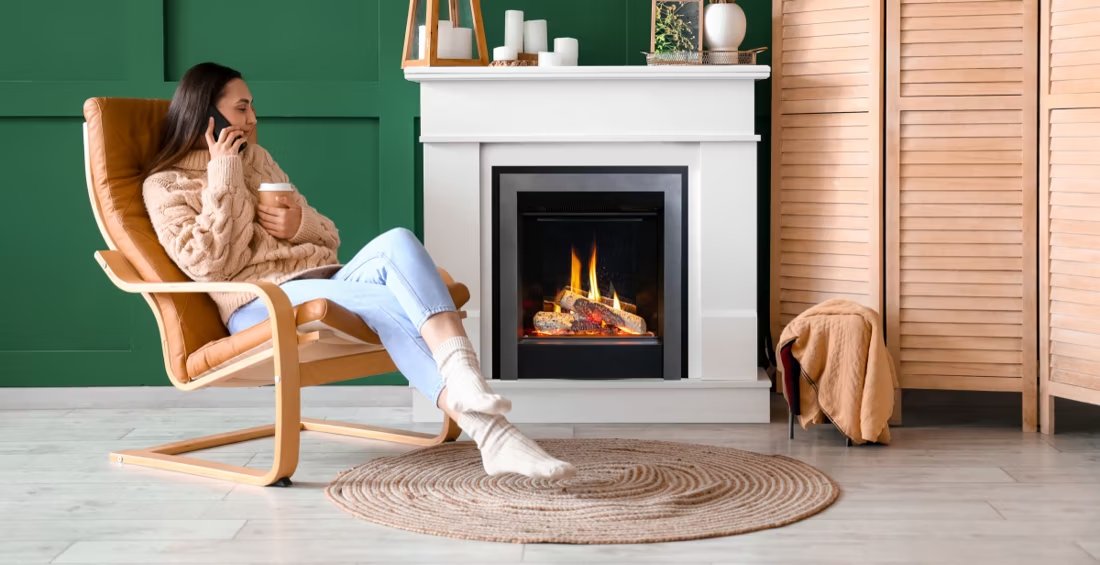
Three steps. No salesperson until you're ready.
Tell us about your project
Your zip code, your situation, and the fuel you're leaning toward—or let the answers point you to one.
See what's actually available
The brands dealers within 100 miles genuinely carry—real options, never a catalog mirage.
Get your dealer & Project Guide
A trusted local dealer, plus the free Project Guide & Parts List that names every component of the job.
Frequently Asked Questions
How much does it cost to install an electric fireplace or insert in Grosse Pointe Farms?
Electric units themselves typically run $300 to $2,500 depending on size and whether it's a mantel-style fireplace, wall-mounted unit, or insert. Because there's no venting, chimney, or gas line involved, installation costs are the lowest of any fireplace fuel type—often nothing beyond the unit itself for a standard 120V plug-in model, or $200 to $600 for a licensed electrician to add a dedicated circuit for a hardwired unit. Compare that to a gas insert conversion in one of the city's older homes, which usually means running new gas line and venting through solid masonry walls.
What will it actually cost to run an electric fireplace here?
Most Grosse Pointe Farms homes are served by DTE Electric Company, where the residential rate runs close to $0.20 per kWh—on the higher end for Michigan. A typical 1,500-watt electric fireplace running on high heat costs roughly $0.30 an hour at that rate. Homes in the smaller area served by the Wyandotte Municipal Service Commission pay closer to $0.16 per kWh, bringing that same hour down to about $0.24. Either way, using one as zone heat in the room you're actually sitting in is usually cheaper than pushing the whole-house furnace up a few degrees.
Can I put an electric insert into my existing masonry fireplace?
Yes, and it's one of the most common electric fireplace projects in Grosse Pointe Farms. Many of the city's colonial and tudor homes have original masonry fireboxes that haven't had a safely usable chimney in decades. An electric insert fits into that same opening, needs no liner or chimney work, and only requires a nearby outlet or a simple dedicated circuit. It restores a working, good-looking fireplace without the tuckpointing or full liner replacement a wood or gas conversion would demand.
Do I need a permit or a licensed electrician to install one?
A plug-in electric fireplace on a standard 120V outlet generally doesn't require a permit and can be installed without an electrician. A built-in or wall-mounted unit that needs a dedicated 240V circuit, or any installation tied to new framing or remodeling, typically requires an electrical permit through your local building department and should be wired by a licensed electrician. Ask your local hearth dealer which category your chosen model falls into before you buy—it changes the installation cost significantly.
How well will an electric fireplace actually heat a room during a Michigan winter?
With a long, cold heating season and average winter lows near 17°F, Grosse Pointe Farms sees genuinely cold, long winters—similar to what Buffalo, NY deals with. Most electric fireplaces are rated to comfortably supplement 400 to 1,500 square feet, enough for a living room, bedroom, or den, but they're not a substitute for your furnace on the coldest nights. The real value is zone heating: turn the thermostat down a few degrees in the rest of the house and let the fireplace carry the room you're actually using.
What's the difference between an electric fireplace, insert, and wall-mounted unit?
An electric insert is built to slide into an existing masonry or built-in firebox opening at standard dimensions. A freestanding or mantel-style electric fireplace is a self-contained piece with its own surround, useful in rooms without an existing fireplace. A wall-mounted electric fireplace hangs flat like artwork—a popular choice in the condos and smaller carriage-house-style homes scattered around Grosse Pointe Farms where floor space is limited. All three rely on the same basic infrared or ceramic heating element and produce comparable flame effect and heat output.
Electric vs. gas—which is right for my home here?
Gas fireplaces put out more heat and can double as backup heat during a winter power outage, which matters given how long Michigan's cold season runs—but installation means gas line work and venting, and typically a licensed gas-fitter through DTE. Electric fireplaces cost far less to install, work in any room with an outlet, and don't require opening a wall in a historic home. Electric is also the default for renters, condo owners, and homes where masonry or plaster construction makes venting impractical. Plenty of Grosse Pointe Farms homeowners run both: gas in the main living room, electric in a bedroom, den, or sunroom.
Are wood-burning fireplaces still common in Grosse Pointe Farms?
Not really, and it's worth saying plainly. Grosse Pointe Farms is a dense, established lakefront suburb with no nearby public land for cutting firewood and none of the wood-heat culture you'd find in a rural or forested part of Michigan. Most wood fireplaces still standing in the city's older oak-and-maple-framed homes are decorative or have already been converted. If the goal is ambiance and easy supplemental warmth in an existing wood firebox, an electric insert is usually the simplest and least invasive route.
Does it matter which utility serves my house when choosing an electric fireplace?
Most of Grosse Pointe Farms is served by DTE Electric Company, with a smaller area served by the Wyandotte Municipal Service Commission at a noticeably lower residential rate. The utility doesn't change which fireplace fits your room, but it's worth knowing your rate before deciding between a lower-wattage ambiance-focused unit and a full 1,500-watt heating model—the gap between DTE's roughly $0.20/kWh and Wyandotte's $0.16/kWh adds up over a full heating season if you're running it daily.
Can I put a TV above my fireplace?
Yes—with an asterisk. Fireplaces are hot and TVs don't like heat. Either put a mantel between them to deflect rising warmth, or choose a fireplace with heat-management technology that creates a cool zone on the wall above—the wall stays around 125 degrees, barely warm, while the room still gets full heat. If you like clean lines and don't want a mantel, heat management is the answer.
Do electric fireplaces actually produce heat?
Yes—most put out around 4,800–5,000 BTUs from a standard outlet, which comfortably warms a bedroom, office, or den as a comfort-zone heater. What they won't do is carry a whole house the way wood, gas, or pellet can. Think of electric as ambiance-first with honest supplemental heat: flames on with no heat in July, flames plus warmth in January.
Can a fireplace actually lower my heating bill?
Yes—by creating a comfort zone. A furnace heats every square foot of the house just to warm the one room you're in; a gas fireplace on low burns roughly a sixth of the gas a typical furnace does. Set the furnace around 55–60 degrees as a baseline, then heat the rooms your family actually uses. Families who heat this way commonly save $20–$60 a month.
Does a fireplace add value to my home?
On average, a fireplace adds back to the home about the same amount you spent installing it. Add the monthly savings from heating the rooms you actually use instead of the whole house—often hundreds of dollars a year—and the value case is strong before you even count what a fire does for how your family uses the room.
Nearby Dealers
Hearth shops serving Grosse Pointe Farms and the surrounding area. Every listing shows whether it is a WhyFire partner, a dealer we have verified as authorized for the brands we recommend, or a local business carrying hearth products. No manufacturer pays for placement. How we verify dealers →
Marquis Fireplace Ltd.
Syles
Bourlier & Sons Inc
AirMaster
Scott’s Fireplace
Fireside Hearth & Home - Royal Oak
Fireside Hearth & Home - Utica
Bourlier's (Macombs)
American Grill And Patio
Allstate By Watsons
Allstate Billiards, Patio, Fireplace
This Is It Shop's House Of Fire
Glenn's Fireplace & Spa
Premier Furniture
Fireside Hearth & Home - Canton
Electric Service in Grosse Pointe Farms
An electric fireplace's heater draws about 1,500 watts—pennies per hour at local rates.
Dte Electric Company
Wyandotte Municipal Serv Comm
Find your electric fireplace in Grosse Pointe Farms.
Tell us a bit about your home and we'll put together a free Project Guide & Parts List—the right electric fireplace or insert, the exact parts you need, and a trusted local dealer to install it.
Find Your Fireplace →