
Instant heat for Linganore's four-season nights.
Reliable, flip-a-switch warmth for Lake Linganore-area homes—whether you're converting an old wood fireplace or starting fresh with propane. Get matched with a trusted local dealer.
Every Project Starts From One of These Five Situations
Reliable warmth without a natural gas main.
Linganore sits in rolling Frederick County countryside at about 475 feet, in climate zone 4A with a winter heating season comparable to a typical mid-Atlantic year and winter lows averaging in the mid-20s. That's a real but moderate cold season—nowhere near the brutal stretches homeowners deal with in a place like Burlington, VT, but still enough that a furnace alone leaves plenty of rooms in a Lake Linganore-area house feeling cold on a January evening. Gas heat fills that gap without the wood-hauling and ash cleanup that comes with a traditional hearth.
Linganore is largely outside the natural gas main service area that covers parts of the City of Frederick, so propane—not piped natural gas—is the standard fuel for gas fireplaces, inserts, and stoves here. That's normal for this part of Frederick County, and every major hearth manufacturer builds propane-configured versions of their direct-vent units. Local dealers coordinate the propane tank, gas-fitter work, and venting together, so you're not left juggling a propane supplier, an HVAC contractor, and a hearth shop separately.
Three steps. No salesperson until you're ready.
Tell us about your project
Your zip code, your situation, and the fuel you're leaning toward—or let the answers point you to one.
See what's actually available
The brands dealers within 100 miles genuinely carry—real options, never a catalog mirage.
Get your dealer & Project Guide
A trusted local dealer, plus the free Project Guide & Parts List that names every component of the job.
Frequently Asked Questions
How much does a gas fireplace installation cost in Linganore?
Most installations in the Linganore area run roughly $4,000 to $10,000, with the wide range driven by whether you're installing a direct-vent unit into an existing masonry fireplace (lower end) or building out a new fireplace with framing and venting for a remodel or addition (higher end). Because most homes here run on propane rather than piped gas, add $500 to $1,500 if you need a new propane tank set and line run from a local propane supplier. A dealer will size all of this after an in-home look at your fireplace opening or planned location.
Can I convert my existing wood fireplace to gas?
Yes, and it's a common project in this part of Frederick County, where plenty of homes built in the 1970s through 1990s around Lake Linganore have open masonry fireplaces that get little use. A direct-vent propane insert typically drops into that opening, runs a stainless liner up your existing chimney, and connects to a new propane line. Expect $4,500 to $9,500 depending on the insert and how much gas line work is involved—homes with an existing propane tank for a range or water heater are usually on the lower end.
Do I need natural gas, or does my gas fireplace run on propane?
In Linganore, propane. There's no natural gas main serving most of this community, so gas fireplaces, inserts, and stoves here are almost always propane-fired. That's not a downgrade—nearly every direct-vent fireplace model on the market ships in a propane-orifice configuration, and it burns just as cleanly as natural gas. You'll either use an existing propane tank if your home already has one for the water heater or range, or your dealer will arrange a new tank set through a local propane supplier as part of the install.
Will my gas fireplace work if the power goes out?
Most will, with the right ignition system. Units with IPI (intermittent pilot ignition) run on a AA battery backup that kicks in automatically when Potomac Edison service drops during a storm—the fireplace lights and operates normally, just off batteries instead of house power. Valor fireplaces skip batteries entirely, generating their own electricity from the pilot's thermocouple. For a rural stretch of Frederick County where storm-related outages can run a few hours to a day, that battery backup or self-powered pilot is worth asking about specifically when you're comparing units.
What's the difference between a gas fireplace, gas insert, and gas stove?
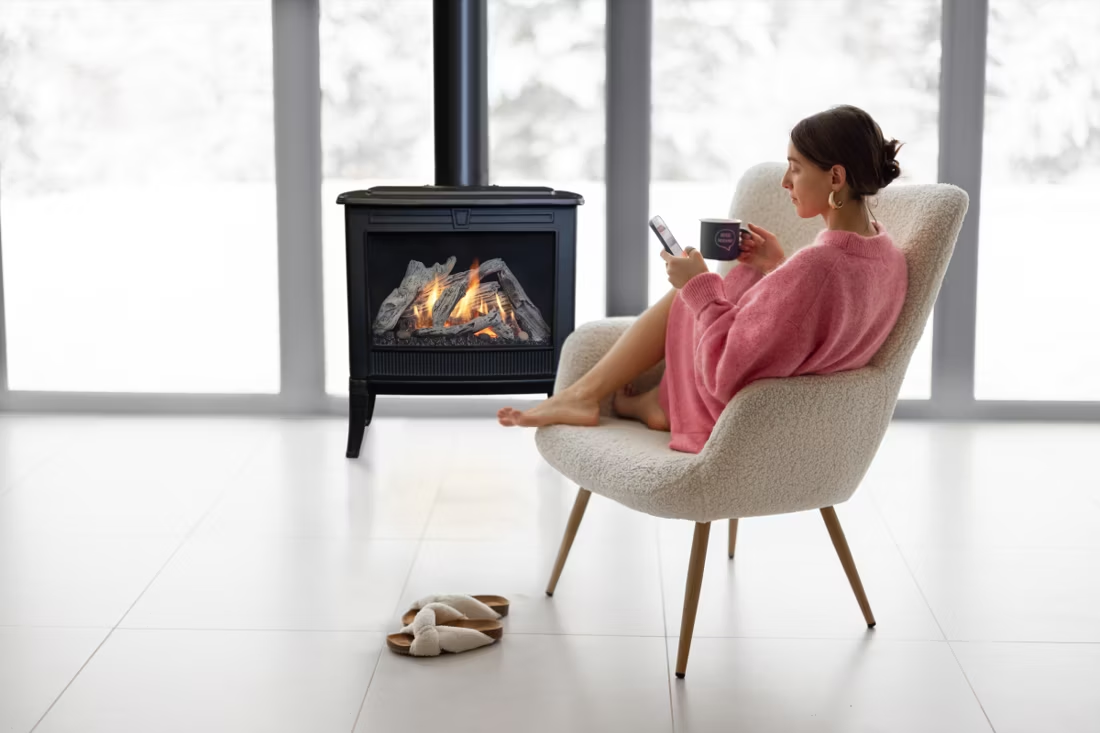
A gas fireplace is a fully built-in unit framed into a wall—the right call for new construction or a remodel without an existing hearth. A gas insert slides into an existing masonry fireplace opening and uses your current chimney as the vent path, which is why it's the go-to choice for older Linganore-area homes with an underused wood fireplace. A gas stove is a freestanding cabinet-style unit that sits on the floor, useful in a room with no fireplace at all and enough clearance for a hearth pad.
Do I need a permit to install a gas fireplace in Linganore?
Yes. Linganore falls under Frederick County's Division of Permitting and Development Review, which requires a building permit for the fireplace installation and a separate mechanical or gas-line permit for the propane connection. A licensed gas-fitter has to handle the line work regardless of who sells you the unit. Most established local hearth dealers pull these permits as part of the job and schedule the inspection, so you're not the one coordinating the county, the propane supplier, and the installer separately.
Are vent-free gas fireplaces allowed in Linganore?
Maryland permits vent-free (ventless) gas fireplaces, but they come with strict room-size and ventilation requirements and an oxygen-depletion sensor, and they release combustion byproducts directly into the room. Direct-vent units, by contrast, draw outside air and exhaust outside through a sealed pipe, so nothing goes into your living space. For most homes around Linganore, direct-vent is the more common and more strongly recommended choice—you get real heat output and full-size flames without any indoor air quality tradeoff. Ask your dealer to walk through both if you're weighing a smaller supplemental unit.
How often does a gas fireplace need to be serviced?
Plan on an annual inspection, ideally before the coldest stretch hits—typically $150 to $250 for a technician to check the burner, pilot or ignition system, glass, and venting. Because most units here run on propane rather than natural gas, the technician will also check the regulator and line pressure from your tank, which isn't something natural-gas-fed units need checked in the same way. Skipping this is the most common reason a fireplace that worked fine last winter won't light reliably this year.
Gas vs. wood—which makes more sense for a Linganore home?
Frederick County has plenty of oak, hickory, and maple for anyone who wants to burn wood, and a traditional wood fireplace still works during a power outage without any batteries involved. But gas wins on convenience—no hauling, no ash, no chimney creosote buildup, and instant on-off heat that a lot of Linganore homeowners want for daily use in a family room or basement. A common local pattern is keeping an existing wood fireplace for occasional use and adding a propane insert or freestanding gas stove in the room that actually needs regular heat.
Why is a fireplace insert so efficient?
An insert does two things: it seals the chimney completely, so you stop losing air you already paid to heat, and it radiates warmth into the room through the firebox and glass. Most add a heat-exchange fan that pulls cool room air underneath, wraps it around the hot firebox, and pushes it back out warm. Your home is more efficient before you've even lit the first fire.
What does it take to replace an existing fireplace?
Fireplaces are like icebergs—bigger behind the wall than in front of it. Replacement means removing the surrounding tile or stone (the finish material laps onto the fireplace face), pulling the old unit, setting the new one in the same enclosure, and re-finishing the wall. A hearth professional can determine what's behind your wall without demolition during an in-home preview.
How much should I budget for a fireplace?
For an average home—covering the fireplace, the vent pipe, and basic installation—a budget between $3,900 and $5,500 gives you a lot of options across wood, gas, and pellet. By the time you add finish work, gas line, and electrical, the average complete installation lands between $5,000 and $12,000 all-in. In a remodel or new build, a good rule is to put about 2.5% of the total project cost toward the fireplace.
What is an in-home preview and do I need one?
It's a visit where a hearth professional measures your space, confirms the model you picked actually works in your home, and walks the specs—framing, gas line, venting, finish work—before anything is ordered. Some details you just can't know until you see the house. Never make a down payment without one; it's the single most-skipped step that burns buyers.
Nearby Dealers
Hearth shops serving Linganore and the surrounding area. Every listing shows whether it is a WhyFire partner, a dealer we have verified as authorized for the brands we recommend, or a local business carrying hearth products. No manufacturer pays for placement. How we verify dealers →
Best Htg And Air
Bodmer's Stoves And Pottery
Chelsea's Chimney
The Fireplace Shop
Magic Mountain Chimney
Ash Away Chimney Services
Costello's Hearth & Spa - Rockville
Cyprus Air
Westlake Ace Hardware
Mace Energy Supply Inc.
Find your gas fireplace in Linganore.
Tell us about your home and your existing fireplace, if you have one, and we'll match you with a trusted local dealer plus a free Project Guide & Parts List—the exact parts, including the vent kit, for your Linganore gas fireplace project.
Find Your Fireplace →