
Plug It In and Feel the Heat—No Chimney Required.
For the older homes, rentals, and Naval Support Facility housing around Indian Head, electric is the fastest path to real supplemental warmth. Find the right unit and connect with a trusted local dealer.
Every Project Starts From One of These Five Situations
The heat that fits any wall, any lease, any budget.
Indian Head sits on a narrow peninsula along the Potomac in Charles County, population under 4,000, and home to Naval Support Facility Indian Head. Winter lows average 28°F and the area gets a heating season on the order of Richmond, VA—nowhere near the sub-zero stretches of Duluth MN, but damp river-bottom cold that settles into older wood-frame houses and makes a single warm room worth having from December through February. Much of the housing stock here is modest single-family homes, rowhouses, and rental units tied to Naval personnel turnover, which is exactly the situation electric heat is built for.
There's no chimney to inspect, no gas line to run, and no firewood to source—which matters in a town with no listed public-land cutting permit office and little practical wood heat infrastructure. Electric service comes from either Southern Maryland Electric Cooperative (SMECO) or Virginia Electric & Power Co, doing business as Dominion Energy, depending on your exact parcel, with residential rates running roughly 14 to 15 cents per kWh. A well-chosen electric fireplace or insert delivers instant zone heat for pennies an hour, installs in an afternoon, and works in a rental unit or Naval housing situation where permanent gas or wood modifications aren't an option.
Three steps. No salesperson until you're ready.
Tell us about your project
Your zip code, your situation, and the fuel you're leaning toward—or let the answers point you to one.
See what's actually available
The brands dealers within 100 miles genuinely carry—real options, never a catalog mirage.
Get your dealer & Project Guide
A trusted local dealer, plus the free Project Guide & Parts List that names every component of the job.
Frequently Asked Questions
How much does an electric fireplace installation cost in Indian Head?
Simple plug-in electric fireplace inserts run $150 to $800 installed, since most just slide into an existing mantel surround or media cabinet on a standard 120V outlet. Hardwired wall-mounted units or built-in electric fireplaces that require an electrician to run a dedicated 20-amp circuit typically land between $800 and $2,000, depending on wall construction and whether you're cutting into drywall for a flush-mount look. Because Indian Head has a lot of older single-story and Cape Cod-style homes, most jobs here fall on the lower half of that range—there's rarely structural work involved.
Do I need a permit to install an electric fireplace in Indian Head?
A plug-in unit on an existing outlet needs no permit at all. If you're hardwiring a built-in electric fireplace or adding a new dedicated circuit, Charles County requires an electrical permit through its Building Permits Division, and the work should be done by a licensed electrician. Unlike wood or gas installs, there's no venting, clearance-to-combustible chimney inspection, or gas-fitter involved—the permit process, when needed at all, is limited to the electrical work itself.
SMECO or Dominion Energy—does it matter which utility I have for an electric fireplace?
Most of Indian Head is served by Southern Maryland Electric Cooperative (SMECO), with residential rates around 14.7 cents per kWh, while a portion of the area falls under Virginia Electric & Power Co, operating as Dominion Energy, at closer to 14.1 cents per kWh. In practice that's a small difference—a typical 1,500-watt electric fireplace costs roughly 20 to 22 cents an hour to run regardless of which utility serves your address. Check your bill or SMECO's territory map if you're unsure which provider covers your parcel; it won't change which fireplace fits your home, just your monthly operating cost by a few cents.
Electric vs. gas fireplace—which is right for my Indian Head home?
Gas is a solid option here too—natural gas and propane service both reach parts of Charles County, and a direct-vent gas fireplace puts out real heat that can offset a furnace on cold nights. But gas installs require a gas line, venting, and a larger upfront investment. Electric skips all of that: no venting, no gas permit, and it can go virtually anywhere there's an outlet or a simple circuit run. For renters near the Naval base, apartment dwellers, or anyone who wants ambiance and supplemental warmth without construction, electric is usually the faster and cheaper answer. For a primary heat source in a larger home, gas often wins on raw output.
Why don't more homes in Indian Head use wood heat?
Wood heat just doesn't have much infrastructure here. There's no nearby public-land cutting permit office serving Charles County, lot sizes in town are small, and a lot of the housing stock is rental or Naval-affiliated, where a chimney installation or firewood storage isn't practical. A handful of older homes with existing masonry fireplaces still burn oak, hickory, or maple sourced from local tree services, but it's the exception rather than the rule. Electric and gas have effectively taken over as the practical choices for anyone adding heat to an Indian Head home today.
What size or style of electric fireplace works best for Indian Head homes?
Given the smaller square footage typical of Indian Head's housing stock—older single-story homes, duplexes, and rental units near the base—a 1,400 to 1,500-watt wall-mounted or insert-style unit is usually plenty to heat a single room, roughly 300 to 400 square feet, as supplemental heat. Renters often prefer a freestanding or media-console style unit that requires no wall modification and can move with them at lease-end. Homeowners doing a more permanent installation tend to go with a recessed wall-mount or a mantel package for a built-in look. A local dealer can size the right wattage and unit style to your specific room during a quick consultation.
Will my electric fireplace work during a power outage?
No—this is the one real tradeoff to know going in. Electric fireplaces need continuous power to run their heating elements, blowers, and flame-effect motors, so they shut off the moment the grid does. That matters along the lower Potomac, where SMECO and Dominion territory both see occasional outages from summer storms and winter ice. If backup heat during an outage is a priority, pair an electric fireplace with a battery or generator setup, or consider a vented gas unit with a standing pilot as a secondary heat source. For everyday supplemental warmth and ambiance, though, electric remains the simplest and least maintenance-heavy option.
What's the difference between an electric insert, a wall-mount, and a mantel package?
An electric insert is designed to drop into an existing fireplace opening or a built-in cabinet cutout—a common upgrade for Indian Head's older homes with existing masonry or wood-framed fireplace openings that never get used. A wall-mount is a flatter unit that hangs on the wall like a TV, either plugged in or hardwired, and works well in smaller rooms or rentals. A mantel package pairs an insert or electric log set with a surrounding mantel and hearth for a more traditional look, and usually costs the most of the three since it includes furniture-grade cabinetry. Local dealers can walk through all three based on your room layout and whether you're renting or own.
Where can I find a qualified installer near Indian Head?
For a hardwired or wall-mounted unit, you'll want a licensed electrician pulling the Charles County electrical permit and running any new circuit—a hearth retailer serving Southern Maryland can typically coordinate that work as part of the install rather than leaving you to find your own electrician. For plug-in units, most hearth and appliance retailers in the Waldorf and La Plata area handle delivery and basic setup directly. Working with a dealer who regularly installs in Charles County means they already know the local permitting process and won't be guessing at code requirements.
Can I put a TV above my fireplace?
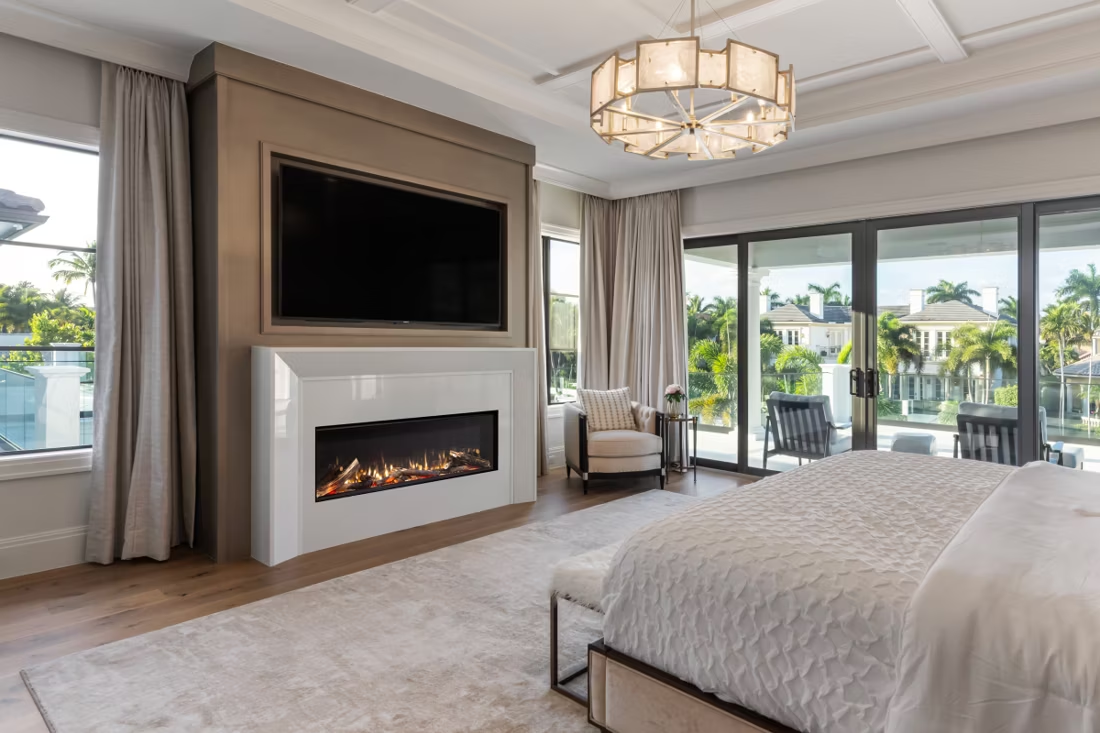
Yes—with an asterisk. Fireplaces are hot and TVs don't like heat. Either put a mantel between them to deflect rising warmth, or choose a fireplace with heat-management technology that creates a cool zone on the wall above—the wall stays around 125 degrees, barely warm, while the room still gets full heat. If you like clean lines and don't want a mantel, heat management is the answer.
Do electric fireplaces actually produce heat?
Yes—most put out around 4,800–5,000 BTUs from a standard outlet, which comfortably warms a bedroom, office, or den as a comfort-zone heater. What they won't do is carry a whole house the way wood, gas, or pellet can. Think of electric as ambiance-first with honest supplemental heat: flames on with no heat in July, flames plus warmth in January.
Does a fireplace add value to my home?
On average, a fireplace adds back to the home about the same amount you spent installing it. Add the monthly savings from heating the rooms you actually use instead of the whole house—often hundreds of dollars a year—and the value case is strong before you even count what a fire does for how your family uses the room.
How much should I budget for a fireplace?
For an average home—covering the fireplace, the vent pipe, and basic installation—a budget between $3,900 and $5,500 gives you a lot of options across wood, gas, and pellet. By the time you add finish work, gas line, and electrical, the average complete installation lands between $5,000 and $12,000 all-in. In a remodel or new build, a good rule is to put about 2.5% of the total project cost toward the fireplace.
Nearby Dealers
Hearth shops serving Indian Head and the surrounding area. Every listing shows whether it is a WhyFire partner, a dealer we have verified as authorized for the brands we recommend, or a local business carrying hearth products. No manufacturer pays for placement. How we verify dealers →
We’ve paused dealer listings for this connection today. Enter your zip or postal code above to find dealers near you, or come back tomorrow.
Popular Electric Brands
Where each brand came from, what's inside it today, and every current model. No brand pays to be here. Not every dealer carries every brand, so enter your zip code to see what's sold near Indian Head.
Fireplace Xtrordinair
Fireplace Xtrordinair, now often called FireplaceX, is the fireplace brand of Travis Industries, Inc., of Mukilteo, Washington.
5 electric models →DaVinci
DaVinci Custom Fireplaces is a brand of Travis Industries, Inc., of Mukilteo, Washington, the company behind Lopi and Fireplace Xtrordinair.
5 electric models →Kozy Heat
Kozy Heat was founded in 1976 by Dudley Hussong in Lakefield, Minnesota, and incorporated as Hussong Manufacturing Co., Inc. in 1978.
3 electric models →Forge & Flame
Forge & Flame is the stove brand Hearth & Home Technologies introduced in August 2023 to bring Vermont Castings, Harman, and Quadra-Fire under one name.
1 electric model →Electric Service in Indian Head
An electric fireplace's heater draws about 1,500 watts—pennies per hour at local rates.
Virginia Electric & Power Co
Southern Maryland Elec Coop Inc
Find your electric fireplace in Indian Head.
Tell us a bit about your home and we'll help you find the right electric fireplace, insert, or wall-mount unit—and help you find a trusted local dealer near the Potomac.
Find Your Fireplace →