
Affordable warmth for Swan River's long, cold winters.
At 340 metres in the Manitoba Parklands, winter lows average minus 22.2°C and the heating season runs seven months or more. Manitoba Hydro's residential rate of about 10.3 cents per kWh makes electric fireplaces one of the cheapest ways to add zone heat and ambiance to a room, and I'll match you with a local dealer who knows what actually fits your panel and your walls.
Every Project Starts From One of These Five Situations
Cheap hydro power meets a serious heating season.
Swan River sits in climate zone 7B on the western edge of the Manitoba Parklands, and its winters are among the coldest an inhabited Prairie town sees anywhere in the country—closer in severity to Fort McMurray, AB, or Thunder Bay, ON than to Winnipeg. With average lows near minus 22.2°C, an electric fireplace here almost never carries the whole house. Instead it does what it does best: warms a living room, basement, or bonus room without a gas line, a chimney, or a woodpile, while the furnace handles the rest.
Manitoba Hydro's residential electricity rate, around 10.3 cents per kWh, is among the lowest in Canada thanks to the province's hydroelectric generation, which makes running an electric unit for daily supplemental heat genuinely inexpensive. The honest caveat: when winter storms knock out power across the Parklands, an electric fireplace goes dark with everything else in the house. That's why plenty of Swan River households pair one with a wood stove burning local trembling aspen, paper birch, bur oak, or black ash, or with a gas fireplace on Manitoba Hydro's gas network, as an outage backup rather than relying on electric alone for resilience.
Three steps. No salesperson until you're ready.
Tell us about your project
Your postal code, your situation, and the fuel you're leaning toward—or let the answers point you to one.
See what's actually available
The brands dealers within 100 miles genuinely carry—real options, never a catalog mirage.
Get your dealer & Project Guide
A trusted local dealer, plus the free Project Guide & Parts List that names every component of the job.
Frequently Asked Questions
How much does an electric fireplace installation cost in Swan River?
Most electric fireplace projects here run $500 to $1,600, a fraction of what wood or gas systems cost because there's no venting or chimney involved. A plug-in insert or freestanding unit sits at the low end and can go in without an electrician if the room has a suitable outlet. A built-in linear fireplace or a unit needing a dedicated 240-volt circuit, common in newer additions on the edges of town, pushes toward the top of that range once a licensed electrician runs wiring and your local dealer handles the surround and finish work.
Is an electric fireplace actually cheaper to run than gas or wood in Swan River?
For supplemental heat, yes, day to day. At Manitoba Hydro's residential rate of about 10.3 cents per kWh, running a 1,500-watt electric fireplace for a few hours a night costs pennies compared to the cutting, splitting, and permit costs of wood, or the metered gas use of a fireplace on Manitoba Hydro's gas network. Where electric loses ground is as a primary heat source through a seven-month Swan River winter, where a stove or furnace still does most of the work. Most homeowners here run electric for evening ambiance and zone heat, not as the main event.
Do I need a permit to install an electric fireplace in Swan River?
Usually it's simpler than people expect. A plug-in unit typically needs no permit at all. If your dealer is running a new dedicated circuit or a built-in unit needs electrical work, that falls under the municipal building department and requires a licensed electrician's sign-off. This is a real contrast to wood systems here, which fall under CSA B365 installation code and commonly need a WETT inspection for insurance purposes—electric skips both of those requirements entirely.
What happens to my electric fireplace during a power outage?
It stops working, along with the rest of the house's electrical heat. This matters more in Swan River than in milder parts of the country because winter storms across the Parklands do knock out Manitoba Hydro service occasionally, and minus 22.2°C is not a temperature you want to ride out without heat. It's the main reason many local households keep a wood stove or a gas fireplace as a backup heat source and treat the electric unit as a convenience feature rather than their only line of defence.
What size electric fireplace do I need for a Swan River home?
Since electric units here mostly supplement a furnace rather than replace it, sizing is more about the room than the whole house. A compact 1,000 to 1,500-watt insert comfortably takes the chill off a bedroom or den. For an open-concept living space in one of the newer builds around town, a larger linear unit in the 1,500 to 4,800-watt range, sometimes wired on its own circuit, gives you enough output to feel real heat rather than just the visual flame effect on the coldest evenings.
Electric vs. wood vs. gas—what makes sense for backup heat in Swan River?
Wood wins on outage resilience: a stove burning trembling aspen or paper birch keeps running with no power at all, and Manitoba Natural Resources issues cutting permits from $26 for 2.5 cubic metres up to $74.50 for 25 cubic metres, with most areas open to cutting year-round. Gas, through Manitoba Hydro's gas network, offers instant heat with battery-backed ignition on many models, typically $6,000-$15,000 installed. Electric is the cheapest to run day-to-day at 10.3 cents per kWh and the simplest to install, but it's the first thing to go dark in a storm. Many Swan River homes end up with electric for convenience and one of the other two for genuine backup.
Electric insert vs. electric stove vs. built-in linear fireplace—which fits my house?
An electric insert drops into an existing masonry firebox, a common retrofit in older Swan River homes that have an unused wood fireplace they no longer want to maintain to CSA B365 standards. An electric stove is freestanding on the floor, similar in footprint to a wood stove but with none of the venting. A built-in linear fireplace gets framed into a wall during a renovation or addition and tends to run on its own circuit. For most existing homes, an insert is the least disruptive option since it reuses the opening you already have.
Where do I actually buy an electric fireplace near Swan River?
With a population around 4,200, Swan River doesn't have a big hearth showroom of its own, so most homeowners end up working with a dealer who serves the wider Parkland region out of Dauphin, Brandon, or Winnipeg. That's really the point of getting matched with the right one: a dealer who already knows Manitoba Hydro's electrical requirements and what actually ships and gets serviced this far north will save you from ordering something online that a local electrician can't easily support.
How much maintenance does an electric fireplace need in Swan River?
Very little compared to a wood or gas system. There's no chimney to sweep and no annual WETT inspection to schedule. Occasionally dusting the unit, vacuuming the vent grille, and replacing the light bulb behind the flame effect every few years covers most of it. It's one more reason electric fireplaces are popular as a low-maintenance ambiance layer in Swan River homes that already carry the burden of maintaining a wood stove or furnace through a long Parklands winter.
How much does an electric fireplace cost to run?
With the heater on, a typical unit draws about 1,500 watts—at average electric rates that's roughly 20 cents an hour. Run the flame effect alone and it costs pennies; the flames are LED-driven and use about as much power as a light bulb. There's no pilot light, no fuel delivery, and essentially no maintenance.
What fireplace styles should I know before shopping?
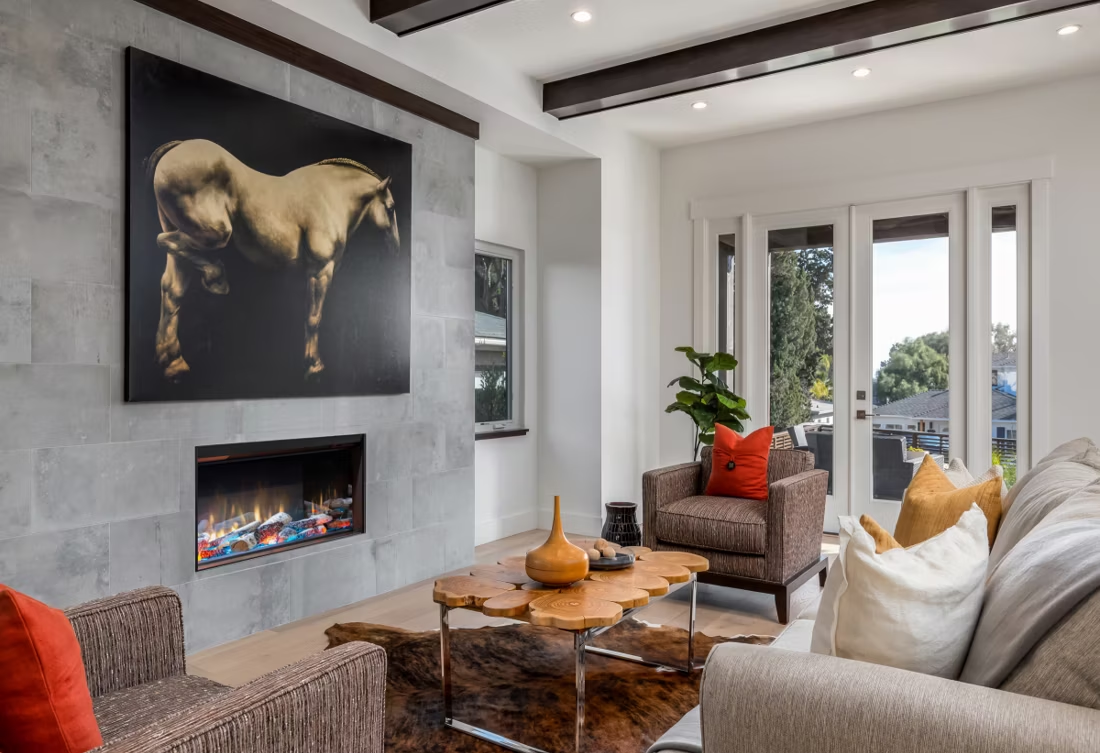
Four cover most of the market: screen-front traditional (mesh front, open feel, fits craftsman homes), traditional door set (the classic look you grew up with), modern linear (wide, low, the statement piece for entertaining), and clean face contemporary (no trim—your tile or stone runs right to the fire's edge). Walk in knowing those four terms and you're ahead of most buyers.
Does an electric fireplace need a vent or chimney?
No—that's its superpower. An electric fireplace needs a wall and an outlet, period. No vent pipe, no gas line, no clearances to design around, which is why it works in bedrooms, offices, apartments, and walls where venting a gas or wood unit would be impractical or impossible. Installation is typically the simplest and least expensive of any fireplace type.
Can I put a TV above my fireplace?
Yes—with an asterisk. Fireplaces are hot and TVs don't like heat. Either put a mantel between them to deflect rising warmth, or choose a fireplace with heat-management technology that creates a cool zone on the wall above—the wall stays around 125 degrees, barely warm, while the room still gets full heat. If you like clean lines and don't want a mantel, heat management is the answer.
Nearby Dealers
Hearth shops serving Swan River and the surrounding area. Every listing shows whether it is a WhyFire partner, a dealer we have verified as authorized for the brands we recommend, or a local business carrying hearth products. No manufacturer pays for placement. How we verify dealers →
McMunn & Yates
Health Basics
McMunn & Yates
McMunn & Yates
Electric Service in Swan River
An electric fireplace's heater draws about 1,500 watts—pennies per hour at local rates.
Manitoba Hydro
Get your free Project Guide & Parts List for a Swan River electric fireplace.
Tell me about your room, your panel, and whether you're after supplemental heat or backup for outage season, and I'll match you with a trusted local dealer and send a free Project Guide & Parts List sized right for a Manitoba Parklands winter.
Find Your Fireplace →