
Thermostat-steady heat for winters that average -26.9°C.
Norway House sits near the north end of Lake Winnipeg in one of Canada's coldest inhabited regions, at 217 metres of elevation and roughly six months of hard freeze. I'll match you with a trusted local dealer who knows what pellet equipment actually survives the freight north, and send you a free planning packet.
Every Project Starts From One of These Five Situations
Automated heat for one of Manitoba's most remote communities.
Norway House sits in climate zone 7B, with an average winter low of -26.9°C and a heating season that runs from October well into April. That puts it alongside Thompson and Flin Flon as some of the coldest inhabited ground in the province—winters here are longer and harsher than almost anywhere else in southern Canada, closer in character to Whitehorse or Fort McMurray than to Winnipeg, four and a half hours south by road. A fireplace or stove here isn't decorative; it's expected to hold a house through real cold for real stretches of the season.
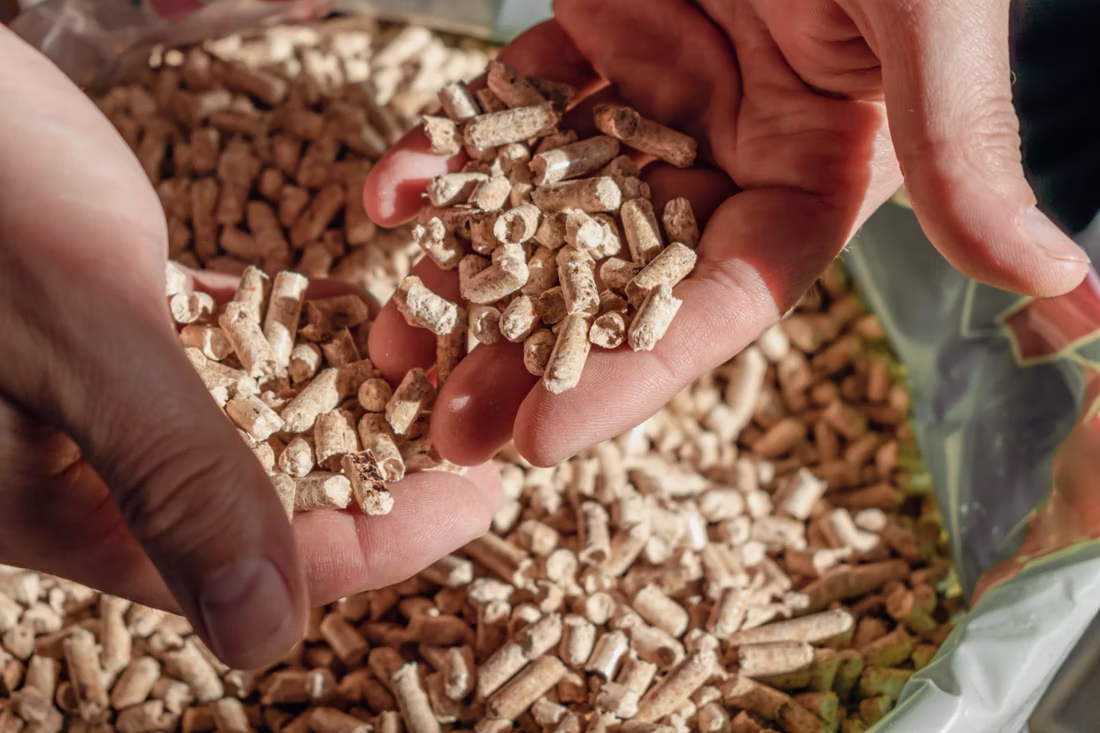
Pellet appliances fit that job well because they burn cleanly, hold a steady output without constant attention, and don't require splitting or hauling cordwood the way a wood stove does—a real consideration in a community where firewood species like trembling aspen, paper birch, bur oak, and black ash have to be cut, split, and seasoned well ahead of freeze-up. The tradeoff is that pellet stoves need electricity to run the auger and blower. Norway House sits close to Manitoba Hydro's Kelsey Generating Station on the Nelson River, and hydro rates here are among the lowest in the country at roughly 10.3 cents per kWh—but the transmission lines serving this part of the north are long, and a storm-related outage still means a pellet stove without power won't burn. A lot of households here pair a pellet stove with a small backup power source or keep a wood-burning option in reserve.
Three steps. No salesperson until you're ready.
Tell us about your project
Your postal code, your situation, and the fuel you're leaning toward—or let the answers point you to one.
See what's actually available
The brands dealers within 100 miles genuinely carry—real options, never a catalog mirage.
Get your dealer & Project Guide
A trusted local dealer, plus the free Project Guide & Parts List that names every component of the job.
Frequently Asked Questions
How much does a pellet stove installation cost in Norway House?
Most installs run $6,000 to $10,000 CAD, and where you land in that range often comes down to freight and travel more than the appliance itself. A straightforward insert into an existing masonry opening or a stove venting through an exterior wall sits toward the low end. Homes needing a full Class A chimney system, or installs that require a crew to travel up from Winnipeg or Thompson, push toward the top of the range once mileage and lodging are factored into the quote. Ask any dealer you're considering whether travel is already built into their number.
Why is pellet fuel more expensive in Norway House than in southern Manitoba?
Pellets here typically run $400 to $575 CAD a ton, noticeably higher than pricing closer to Winnipeg, and freight is the main reason. Regional brands like La Crete Sawmills and Spruce Products truck product a long way north, and that cost shows up at the pallet. Because of that, most local burners buy their season's supply in one or two deliveries rather than picking up bags as needed, and it's worth asking your dealer about ordering early in the fall before winter conditions and demand both tighten supply.
What permits or inspections does a pellet stove need here?
Installations go through the municipal building department, and the work has to meet the CSA B365 installation code, same as any solid-fuel appliance in Manitoba. Even though pellet stoves burn cleaner than cordwood, most home insurers still ask for a WETT-qualified inspection before they'll cover a solid-fuel appliance, pellet included—it's worth confirming with your insurer up front rather than after the stove is already installed. A local dealer who's done installs in the north will typically walk you through both steps.
What happens to my pellet stove if the power goes out?
It stops. The auger that feeds pellets and the blower that pushes heat into the room both need electricity, so a pellet stove goes cold in an outage just like a furnace does. That matters in a community served by long transmission lines running up from Manitoba Hydro's generating stations on the Nelson River—outages here tend to be weather-related and can run longer than a quick blip. Because of that, a lot of Norway House households either run a small backup generator sized for the stove's draw, or keep a wood stove or fireplace as a second heat source that doesn't depend on the grid at all.
What size pellet stove do I need for a Norway House home?
With winter lows averaging -26.9°C and cold snaps that go well past that, undersizing is the bigger risk. A stove rated for 1,200 to 1,800 square feet is a reasonable starting point for an average local home, but older houses with less insulation or larger open floor plans often do better sized toward the top of that range, or with a second appliance for a detached addition or garage. A dealer will size it against your actual wall and window construction rather than square footage alone, since two homes the same size can have very different heat loss up here.
Pellet stove or wood stove—which makes more sense in Norway House?
Wood is the more traditional choice locally, and species like trembling aspen, paper birch, bur oak, and black ash are all cut under permits from Manitoba Natural Resources' Forestry Branch, running from about $26 for 2.5 cubic metres up to $74.50 for 25 cubic metres. Wood also keeps burning with no power at all, which counts for a lot given how remote this area is from the grid's main lines. Pellet stoves trade that independence for convenience—no splitting, stacking, or creosote buildup, and a more even, thermostat-controlled heat—but they depend on electricity and on pellets shipped in from mills like La Crete Sawmills or Spruce Products. Many households end up with one of each: pellet for daily comfort, wood in reserve for outages.
Is natural gas a better option than pellet in Norway House?
Manitoba Hydro does provide gas service in the community, so it's a real option worth comparing. Gas fireplaces install for roughly $6,000 to $15,000 CAD and give you instant, thermostat-controlled heat without any fuel storage or hauling. Pellet installs typically run a bit less, from $6,000 to $10,000, and some homeowners prefer knowing their fuel is stored on-site through the winter rather than depending on a gas line during a severe cold snap. Either way, a local dealer can tell you what's actually feasible for your address before you commit to one path.
How should I store pellets through a Norway House winter?
Pellets need to stay bone dry—a few percent of moisture pickup is enough to make them swell, jam an auger, or stop feeding altogether, and that's a real risk in a climate with heavy snow load and freeze-thaw cycling on unheated porches or sheds. Most local burners store pallets inside a garage or a dedicated dry outbuilding rather than under a tarp outdoors, and buy a season's worth at once given how far the product has to travel to get here. Keeping bags off a concrete floor, on pallets or shelving, cuts down on moisture wicking up from below.
How often does a pellet stove need cleaning and service in Norway House?
Plan on a full inspection and cleaning once a year, ideally in September before the heating season locks in, plus regular ash removal and glass cleaning every one to two weeks during heavy winter use. Given that many homes here run a pellet stove close to daily from October through April, the burn pot and venting see more wear than in a milder climate, and a stove that's neglected mid-season is a hard thing to get serviced quickly this far north. Booking your annual service early, before local dealers' fall schedules fill up, is worth doing.
Why do fireplace quotes vary so much?
Because a fireplace is an iceberg—there's more behind the wall than in front of it. A low quote often covers only the unit; the full scope includes vent pipe, gas line or electrical, framing, and the tile or stone that has to come off and go back on. Make every bidder price the whole job. If a dealer can't speak to the full scope with confidence, that's your signal to keep looking.
Is it worth replacing an old fireplace that still sort of works?
Ask three questions: Is it ugly? Is it drafty? Does it actually work? Most old fireplaces fail at least two. Beyond looks, an old unit leaks air around the damper year-round and—if it's gas with a standing pilot—quietly burns a couple hundred dollars a year. A modern replacement seals the wall, heats the room, and changes how the whole space gets used.
How often does a pellet stove need cleaning?
A clean pellet stove is a happy pellet stove. Plan on cleaning the burn pot about once a week when you're burning regularly—ash and clinkers gum up the air holes just like a pellet barbecue. Most pellet stove problems trace back to skipped cleaning that nobody explained up front. Some designs make it easy with a trapdoor burn pot: pull a lever and the gunk drops into the ash pan.
Why is a fireplace insert so efficient?
An insert does two things: it seals the chimney completely, so you stop losing air you already paid to heat, and it radiates warmth into the room through the firebox and glass. Most add a heat-exchange fan that pulls cool room air underneath, wraps it around the hot firebox, and pushes it back out warm. Your home is more efficient before you've even lit the first fire.
Nearby Dealers
Hearth shops serving Norway House and the surrounding area. Every listing shows whether it is a WhyFire partner, a dealer we have verified as authorized for the brands we recommend, or a local business carrying hearth products. No manufacturer pays for placement. How we verify dealers →
McMunn & Yates
McMunn & Yates
McMunn & Yates
Health Basics
Pellet Brands Stocked Around Norway House
Typical price runs $400-$575 per ton—buy early-season for the best rates. Manufacturers will point you to the nearest stocking dealer.
La Crete Sawmills
Spruce Products
Get your free Project Guide & Parts List for a Norway House pellet stove.
Tell me about your home and I'll match you with a trusted local dealer and send a free Project Guide & Parts List—sized for winters that average -26.9°C, with the vent kit and parts specified up front.
Find Your Fireplace →