
Gas fireplace heat that holds up through Cameron Parish's hurricane season.
Mild Gulf Coast winters don't demand much heat, but when a cold front rolls through—or the power goes out after a storm—a properly vented gas fireplace keeps working. Find the right unit for your elevated home and connect with a trusted local dealer.
Every Project Starts From One of These Five Situations
Heat that works on pilings, propane, and post-storm power outages.
Cameron Parish is Louisiana's low-lying Gulf Coast edge—marsh, chenier ridges, and barrier beach running from Johnson Bayou through Cameron and Grand Chenier to Hackberry. With a population of just 1,179, it's one of the smallest and most storm-tested parishes in the state; Hurricane Rita in 2005 and Hurricane Ike in 2008 nearly emptied it out, and most homes standing today were rebuilt on elevated pilings to meet FEMA flood-elevation requirements. Climate zone 2A means hot, humid summers and short, mild winters—heating demand is low most years, but Gulf Coast cold fronts still push overnight temperatures into the 20s and 30s a handful of times each winter.
There's an irony to heating in Cameron Parish: it's home to Cameron LNG, one of the largest natural gas export terminals in the country, yet almost no residential natural gas piping serves the parish outside that industrial corridor. Most homes here run on propane tanks. Wood-burning fireplaces are uncommon in this climate—cypress, oak, and pecan grow throughout the parish, but with such a short, mild winter, wood isn't a practical primary heat source, and it's rarely worth the maintenance on a stilt home. Gas fills that gap: it delivers instant warmth on the rare cold night, and—with the right ignition system—keeps running through the extended power outages that follow every major storm.
Three steps. No salesperson until you're ready.
Tell us about your project
Your zip code, your situation, and the fuel you're leaning toward—or let the answers point you to one.
See what's actually available
The brands dealers within 100 miles genuinely carry—real options, never a catalog mirage.
Get your dealer & Project Guide
A trusted local dealer, plus the free Project Guide & Parts List that names every component of the job.
Frequently Asked Questions
How much does a gas fireplace installation cost in Cameron Parish?
Most gas fireplace and insert installations in Cameron Parish run in the range of $3,500 to $9,000, though the exact number depends heavily on your home's construction. Because so many homes here are rebuilt on elevated pilings after Rita and Ike, running a gas line up through a pier foundation to a built-in fireplace can add labor and material cost compared to a slab-on-grade install elsewhere in Louisiana. If you're on propane (the norm outside the LNG terminal footprint) and don't already have a tank in place, tank setup or upgrade is an added cost. A local dealer can give you a firm number after seeing your home's foundation and existing gas setup.
Is natural gas available in Cameron Parish, or do I need propane?
For almost every home in Cameron Parish, propane is the answer. Despite the parish hosting Cameron LNG—one of the biggest natural gas export facilities in the U.S.—that infrastructure serves industrial export, not residential distribution, and there's no meaningful municipal natural gas piping reaching homes in Cameron, Grand Chenier, Johnson Bayou, or Hackberry. Nearly every gas fireplace installed in the parish is set up to run on a propane tank, either an existing tank shared with a water heater or range, or a new tank installed alongside the fireplace project.
Will my gas fireplace still work if the power goes out after a hurricane?
It can, if you choose the right ignition system—and in Cameron Parish, that's worth planning for. Extended power outages after storms like Rita, Ike, Laura, and Delta have lasted days to weeks in this parish, longer than almost anywhere else on the Louisiana coast. Gas fireplaces with intermittent pilot ignition (IPI) run on small backup batteries that keep the unit lighting on demand even with the grid down—just remember to keep fresh batteries on hand before storm season. Valor fireplaces take it a step further: their pilot generates its own electricity through the thermocouple, so the fireplace never depends on batteries or grid power at all. For a parish where post-storm outages are the norm rather than the exception, that's a real advantage worth asking your local dealer about.
Do I need a permit to install a gas fireplace in Cameron Parish?
Yes—new gas fireplace installations require a building permit, typically handled through the Cameron Parish Police Jury's building office, along with a gas line permit completed by a licensed gas-fitter or propane technician. Because most of the parish sits in a mapped flood zone, permitting on rebuilt or elevated homes often also touches on flood-elevation compliance, which is one more reason to work with a hearth dealer who's installed on pilings before rather than a general handyman. Most local retailers coordinate the permitting and elevation questions as part of the install.
What's the difference between a gas fireplace, insert, and stove for a home like mine?
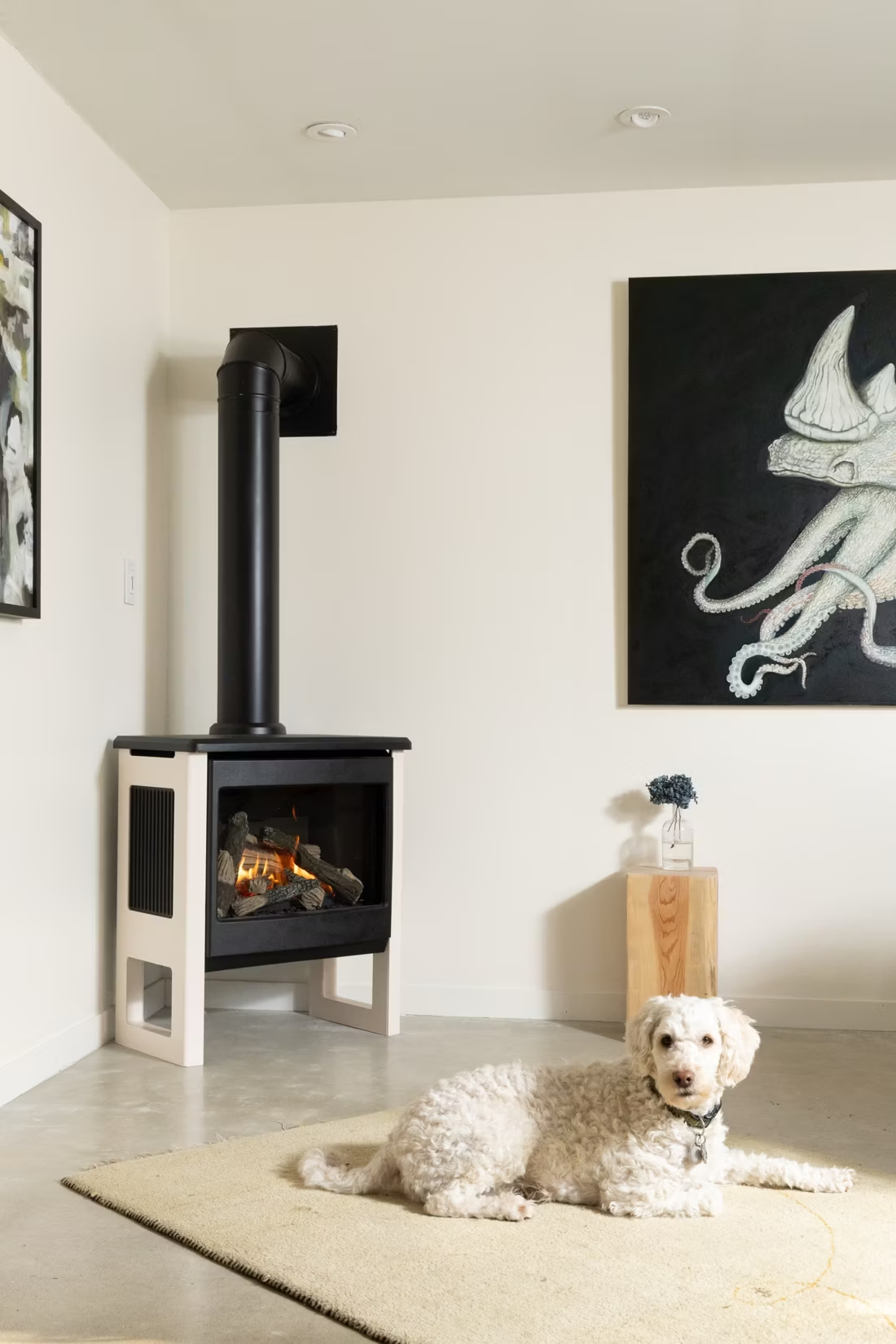
A built-in gas fireplace is framed into a wall during construction or remodel—the most common choice for the newer, elevated homes that make up much of the housing stock rebuilt since Rita and Ike. A gas insert drops into an existing masonry fireplace and uses the existing chimney as its vent path, which is less common here since older masonry-fireplace homes are rare after two major storm rebuilds. A gas stove is a freestanding cabinet-style unit that vents through a wall or roof and doesn't require a fireplace opening at all—a practical option for camps, additions, or smaller elevated homes along Grand Chenier and Johnson Bayou. Most Cameron Parish projects lean toward a built-in unit or freestanding stove rather than a conversion insert.
Should I get a vented or vent-free gas fireplace in Cameron Parish's climate?
Vented (direct-vent) units draw combustion air from outside and exhaust it back outside through a sealed pipe—they're the safer, more universally recommended choice, and they're what most local dealers install. Vent-free units burn without any external venting and release some combustion byproducts, including water vapor, directly into the room. That's a bigger downside in Cameron Parish than in a dry climate: this is already a hot, humid Gulf Coast environment prone to moisture and mold issues in marsh-adjacent homes, and adding more humidity from an unvented appliance isn't ideal. For most homes here, a direct-vent unit is the better fit.
Where can I find a gas fireplace dealer that actually serves Cameron Parish?
With a population under 1,200 spread across Cameron, Grand Chenier, Johnson Bayou, and Hackberry, the parish doesn't support its own dedicated hearth showroom—most homeowners here are served by dealers based up in Lake Charles and the broader Calcasieu Parish area who regularly travel down LA-27 or LA-82 to handle installs. That's exactly the kind of match Find My Fireplace exists to make: we connect you with a trusted dealer who genuinely covers your part of Cameron Parish, rather than leaving you to guess which retailer will actually show up for a job this far south.
How often should a gas fireplace be serviced in Cameron Parish?
An annual inspection is standard for any gas appliance, but in Cameron Parish's marine environment, it's worth being more diligent than that. Salt air off the Gulf accelerates corrosion on burner components, venting, and electronic ignition parts faster than it would inland, and homes that took on wind or water during recent storms should have their gas fireplace checked for damage before the next heating season. Plan on a pre-hurricane-season check each spring in addition to your regular annual service.
Gas vs. electric fireplace—which makes more sense for a Cameron Parish home?
Electric fireplaces skip the gas line and propane tank entirely—just plug in, which can simplify things on an elevated home where running fuel lines up through the pier foundation adds cost. They're a good fit for guest camps, smaller rooms, or homes where ambiance matters more than serious heat output. The tradeoff is that electric units depend entirely on grid power, which is exactly what goes out for days or weeks after a hurricane in this parish. Gas, especially a unit with battery-backup or self-powered ignition, keeps running when the grid doesn't—which is why most primary living spaces in Cameron Parish lean toward gas, with electric reserved for secondary rooms or camps.
Is my gas fireplace wasting gas?
If it was installed more than 15 years ago, probably. Older gas fireplaces keep a standing pilot light burning all the time, and that little flame can cost a couple hundred dollars a year. Newer models use pilot-on-demand ignition—the pilot lights only when you use the fireplace and goes out when you turn it off.
Why is a fireplace insert so efficient?
An insert does two things: it seals the chimney completely, so you stop losing air you already paid to heat, and it radiates warmth into the room through the firebox and glass. Most add a heat-exchange fan that pulls cool room air underneath, wraps it around the hot firebox, and pushes it back out warm. Your home is more efficient before you've even lit the first fire.
How much should I budget for a fireplace?
For an average home—covering the fireplace, the vent pipe, and basic installation—a budget between $3,900 and $5,500 gives you a lot of options across wood, gas, and pellet. By the time you add finish work, gas line, and electrical, the average complete installation lands between $5,000 and $12,000 all-in. In a remodel or new build, a good rule is to put about 2.5% of the total project cost toward the fireplace.
Can a fireplace actually lower my heating bill?
Yes—by creating a comfort zone. A furnace heats every square foot of the house just to warm the one room you're in; a gas fireplace on low burns roughly a sixth of the gas a typical furnace does. Set the furnace around 55–60 degrees as a baseline, then heat the rooms your family actually uses. Families who heat this way commonly save $20–$60 a month.
Find your gas fireplace in Cameron Parish.
Tell us about your home—including whether it's elevated and what fuel you're on—and we'll put together a free Project Guide & Parts List with the right unit, vent kit, and a trusted local dealer who actually covers Cameron Parish.
Find Your Fireplace →