
Instant heat and ambiance, no chimney required.
From downtown Bardstown to Bloomfield and New Haven, electric fireplaces give Nelson County homeowners zone heat and real flame-look ambiance without venting, masonry work, or a wood supply to manage. Find the right unit and connect with a trusted local dealer.
Every Project Starts From One of These Five Situations
Zone heat that fits anywhere in the house.
Nelson County sits in the rolling Knobs region of central Kentucky, anchored by Bardstown's 19th-century bourbon-town core and stretching out through Bloomfield, New Haven, and Boston along the Rolling Fork River. Winters here are moderate by national standards—average lows near 26°F and a heating season noticeably shorter and milder than what a place like Madison, WI or Minneapolis sees—but the county still gets plenty of nights below freezing where a wood stove, gas insert, or furnace is doing the real work and a room off to the side stays chilly. That's exactly the gap electric fireplaces fill here.
A lot of Nelson County's housing stock is older—brick and frame homes in downtown Bardstown with masonry fireboxes that were never built for a modern wood-burning liner, plus additions, finished basements, and bonus rooms in newer construction around Bloomfield and New Haven where running a gas line or masonry chimney isn't practical. An electric insert or wall-mounted unit solves both problems: no venting, no combustion byproducts, and power drawn straight from Salt River Electric Cooperative's grid, which serves most of the county. It won't replace the oak and hickory in the wood stove or the gas insert doing primary heat, but for supplemental warmth and year-round ambiance, it's the lowest-friction option on the table.
Three steps. No salesperson until you're ready.
Tell us about your project
Your zip code, your situation, and the fuel you're leaning toward—or let the answers point you to one.
See what's actually available
The brands dealers within 100 miles genuinely carry—real options, never a catalog mirage.
Get your dealer & Project Guide
A trusted local dealer, plus the free Project Guide & Parts List that names every component of the job.
Frequently Asked Questions
How much does an electric fireplace installation cost in Nelson County?
A basic plug-in electric insert or freestanding mantel unit typically runs $150 to $600 installed, since most models just need a standard 120-volt outlet already in the wall. Built-in wall units or larger inserts that call for a dedicated 240-volt circuit—common when a homeowner wants a wide linear unit as a real focal point in a Bardstown living room or a new addition out toward Bloomfield—run $1,500 to $3,500 once you factor in electrician time and finish carpentry around the surround. Older homes with undersized panels or knob-and-tube wiring sit at the higher end of that range because the panel work adds cost before the fireplace itself goes in.
What size electric fireplace do I need for my room?
Most electric fireplaces top out around 1,500 watts of heat output, which comfortably supplements a room in the 300-to-500-square-foot range—a den, a finished basement, a bonus room, or a primary bedroom. In Nelson County, that's almost always paired with a wood stove, gas insert, or central HVAC handling the whole-house load, since Nelson County's moderate but real winter chill means the coldest stretches in January still need real backup heat. If you're trying to heat more than one room, or you want the fireplace itself as visual centerpiece more than a heat source, size up the unit width rather than relying on wattage alone—a local dealer can walk you through both.
What's the difference between an electric insert, a wall-mounted unit, and a freestanding electric stove?
An electric insert drops into an existing masonry or prefab firebox—the go-to choice for Bardstown's older homes with a fireplace opening that's not set up for real wood burning. A wall-mounted unit hangs flush or recessed into drywall, popular in newer construction and additions where there's no existing firebox at all. A freestanding electric stove sits on the floor like a traditional wood stove but plugs into an outlet, which works well in a room where you want the look without any wall modification. All three run on standard household power; the choice comes down to what opening (or lack of one) you're working with.
Do I need a permit to install an electric fireplace in Nelson County?
A plug-in unit that runs off an existing 120-volt outlet generally doesn't require a permit—it's no different than plugging in any other appliance. If you're adding a dedicated 240-volt circuit for a larger built-in unit, that electrical work typically does need a permit, pulled by your licensed electrician through the appropriate local building department, whether that's the City of Bardstown or Nelson County depending on where the property sits. A trusted local dealer installing a hardwired unit will usually coordinate this as part of the job rather than leaving you to sort it out.
How much does it cost to run an electric fireplace with Salt River Electric Cooperative rates?
Most electric fireplaces draw around 1,500 watts on the highest heat setting, which works out to roughly 10 to 18 cents an hour depending on your specific Salt River Electric Cooperative rate and whether you're running heat or just the flame effect. Many homeowners run the flame visual alone in warmer months—that draws only a few watts—and reserve the heater function for supplemental warmth on the coldest Nelson County nights. Compared to running a wood stove or gas insert, the operating cost is low but not free, so it's worth thinking of an electric unit as a targeted, room-by-room heat source rather than a way to cut your whole-house heating bill.
What's the best electric fireplace for a Nelson County home?
For supplemental heat in a bonus room or addition, look at models from Dimplex, Napoleon, or Touchstone with a true 1,500-watt heater and a thermostat, not just a decorative flame effect. If the goal is mostly ambiance in a historic Bardstown home with a masonry firebox that can't safely support wood burning, a realistic-flame insert without much heater reliance is often the better fit. Given Nelson County's moderate winter chill, electric isn't typically the primary heat source in any home here—that role usually falls to a wood stove burning local oak or hickory, a gas furnace, or central HVAC—so match the unit to the job you actually need it to do.
Electric vs. wood vs. gas—which is right for my Nelson County home?
Wood remains a strong option here—oak, hickory, maple, and cherry are all common locally, and cutting permits through the Daniel Boone National Forest run about $20 per cord during the May-to-October season, which keeps fuel costs low for homeowners willing to manage a woodpile. Gas offers instant, thermostat-controlled heat without wood handling. Electric sits in a different category entirely: it's the easiest to install, requires no venting or fuel storage, and produces zero combustion byproducts, but it also won't keep a house warm during a winter power outage the way a wood stove will. Most Nelson County homeowners who add electric are supplementing an existing wood or gas system, not replacing it.
Can I put an electric fireplace insert into my existing masonry fireplace?
Yes—this is one of the most common projects for Nelson County's older housing stock, particularly in downtown Bardstown where many homes have a masonry firebox that was never lined for modern wood burning and would be expensive to bring up to code. An electric insert slides into that existing opening, usually with a simple surround kit to close any gaps, and runs off a nearby outlet or a new dedicated circuit if you're going with a larger unit. It preserves the look of the original fireplace while giving you flame effect and supplemental heat without touching the chimney at all.
Are electric fireplaces safe—do they produce any smoke or fumes?
Electric fireplaces produce no flame, no smoke, no soot, and no combustion byproducts of any kind, which makes them a straightforward choice for households dealing with allergies or asthma, or anyone who wants the fireplace look without worrying about carbon monoxide or indoor air quality—Nelson County doesn't have any regional air quality restrictions, but that's a non-issue with electric regardless. Most models also keep their surfaces cool to the touch even while the heater is running, which matters in homes with young kids or pets. The main safety consideration is electrical, not combustion: make sure any dedicated circuit is sized and installed correctly by a licensed electrician.
Does an electric fireplace need a vent or chimney?
No—that's its superpower. An electric fireplace needs a wall and an outlet, period. No vent pipe, no gas line, no clearances to design around, which is why it works in bedrooms, offices, apartments, and walls where venting a gas or wood unit would be impractical or impossible. Installation is typically the simplest and least expensive of any fireplace type.
Can I put a TV above my fireplace?
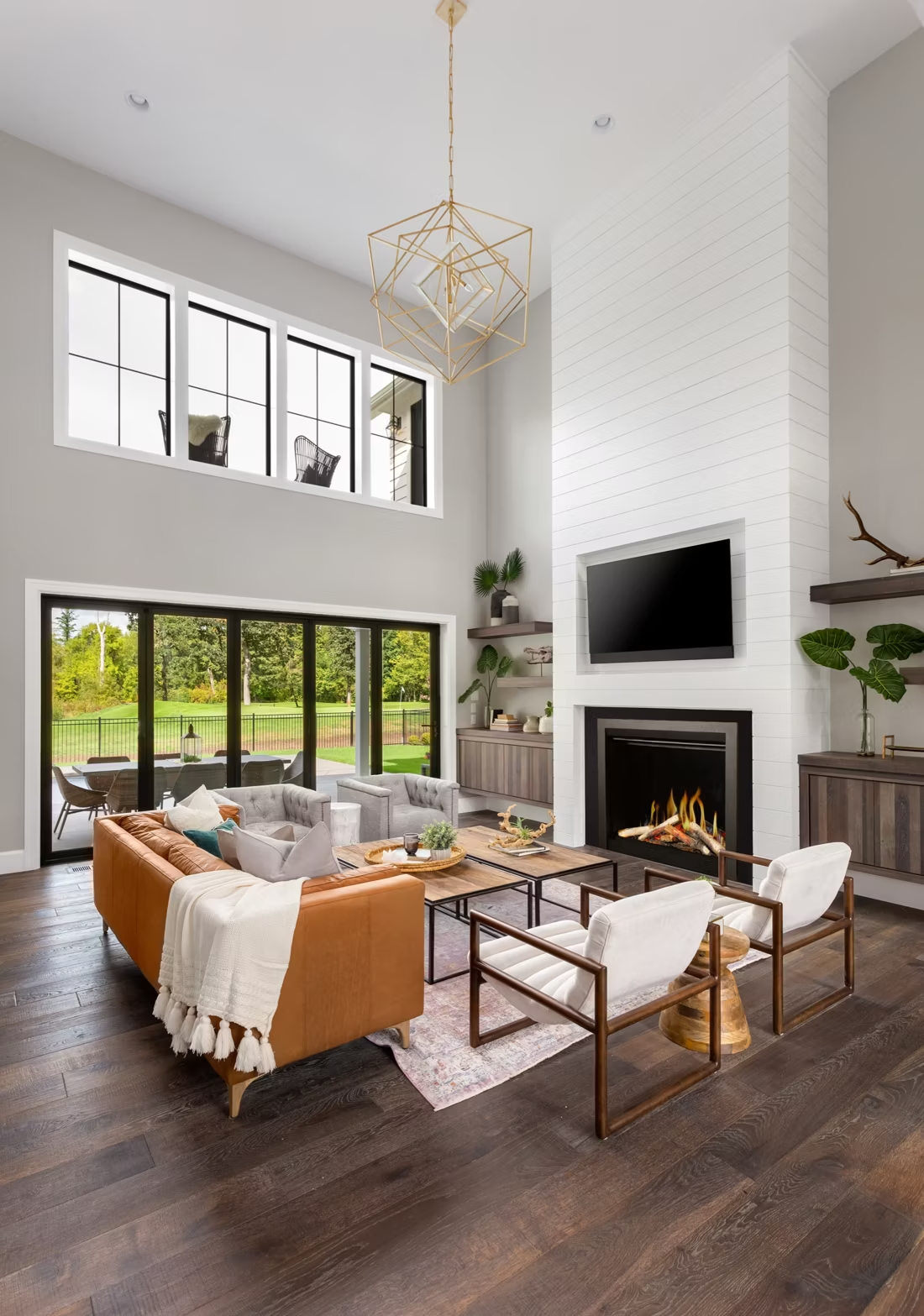
Yes—with an asterisk. Fireplaces are hot and TVs don't like heat. Either put a mantel between them to deflect rising warmth, or choose a fireplace with heat-management technology that creates a cool zone on the wall above—the wall stays around 125 degrees, barely warm, while the room still gets full heat. If you like clean lines and don't want a mantel, heat management is the answer.
How much should I budget for a fireplace?
For an average home—covering the fireplace, the vent pipe, and basic installation—a budget between $3,900 and $5,500 gives you a lot of options across wood, gas, and pellet. By the time you add finish work, gas line, and electrical, the average complete installation lands between $5,000 and $12,000 all-in. In a remodel or new build, a good rule is to put about 2.5% of the total project cost toward the fireplace.
What is an in-home preview and do I need one?
It's a visit where a hearth professional measures your space, confirms the model you picked actually works in your home, and walks the specs—framing, gas line, venting, finish work—before anything is ordered. Some details you just can't know until you see the house. Never make a down payment without one; it's the single most-skipped step that burns buyers.
Find your electric fireplace in Nelson County.
Tell us a bit about your home and we'll match you with the right electric fireplace, insert, or wall-mounted unit—plus a free Project Guide & Parts List and a trusted local Nelson County dealer to install it.
Find Your Fireplace →