
Reliable gas heat for Hickman County homes.
From Clinton to the farm roads out toward Columbus, propane-fired gas fireplaces and inserts give Hickman County homeowners instant, no-fuss warmth. Find the right unit and get matched with a trusted local dealer.
Every Project Starts From One of These Five Situations
Convenient heat, without the wood-splitting.
Hickman County sits in the Jackson Purchase region of far western Kentucky, a quiet stretch of farmland and river bluffs anchored by the county seat of Clinton and the small Mississippi River community of Columbus. The county falls in climate zone 4A—mixed-humid winters that aren't as brutal as places like Duluth or Bismarck, but still bring stretches of freezing nights and damp cold that settle into older farmhouses. Oak, hickory, maple, and cherry grow throughout the county's bottomland and hardwood stands, and plenty of longtime residents still burn wood out of habit or necessity. But for homeowners updating a house or building new, a gas fireplace or insert has become the practical choice for daily heat.
With a population of just over 1,300 spread across a mostly rural county, natural gas mains don't reach most Hickman County homes—propane is the standard fuel for gas fireplaces and inserts here, delivered and set by regional propane suppliers rather than a utility company. That's a straightforward setup: no municipal gas main to tap into, just a propane tank sized to your appliance. With no non-attainment status or winter inversion advisories affecting Hickman County, there's no regulatory hurdle to running a vented gas unit whenever you want it—just permits, proper venting, and a tank filled on schedule.
Three steps. No salesperson until you're ready.
Tell us about your project
Your zip code, your situation, and the fuel you're leaning toward—or let the answers point you to one.
See what's actually available
The brands dealers within 100 miles genuinely carry—real options, never a catalog mirage.
Get your dealer & Project Guide
A trusted local dealer, plus the free Project Guide & Parts List that names every component of the job.
Frequently Asked Questions
How much does a gas fireplace installation cost in Hickman County?
For a rural western Kentucky county like Hickman, a typical gas fireplace or insert installation runs roughly $3,500 to $9,000, depending on the unit, whether you're converting an existing masonry fireplace, and whether a new propane tank or line run is needed. A direct-vent insert dropped into an existing chimney with a propane hookup already nearby lands on the lower end. New construction, a fresh tank installation, or longer line runs out to an older farmhouse push costs toward the higher end. A local dealer can give you a firm number after seeing the space.
Do I need natural gas, or does propane work for a gas fireplace in Hickman County?
Propane is the standard fuel for gas fireplaces throughout Hickman County. Because natural gas mains don't extend through most of the county's rural roads and farmland, homeowners run on propane—either an existing tank already serving the house or a new tank set up by a regional propane supplier. Nearly every gas fireplace, insert, or stove sold today can be configured for propane with the correct orifice and regulator, so fuel type isn't a limiting factor in what you can install.
Can I convert my wood fireplace to gas?
Yes, and it's a common upgrade in older Hickman County homes with an existing masonry fireplace built for wood. A gas insert slides into that opening and uses a stainless liner run up the existing chimney, so you keep the original hearth and mantel while gaining push-button heat. Expect the project to run in the $3,500 to $8,000 range locally, with the exact number depending on the insert and whether a new propane line needs to be run from the tank to the fireplace.
Will my gas fireplace still work if the power goes out?
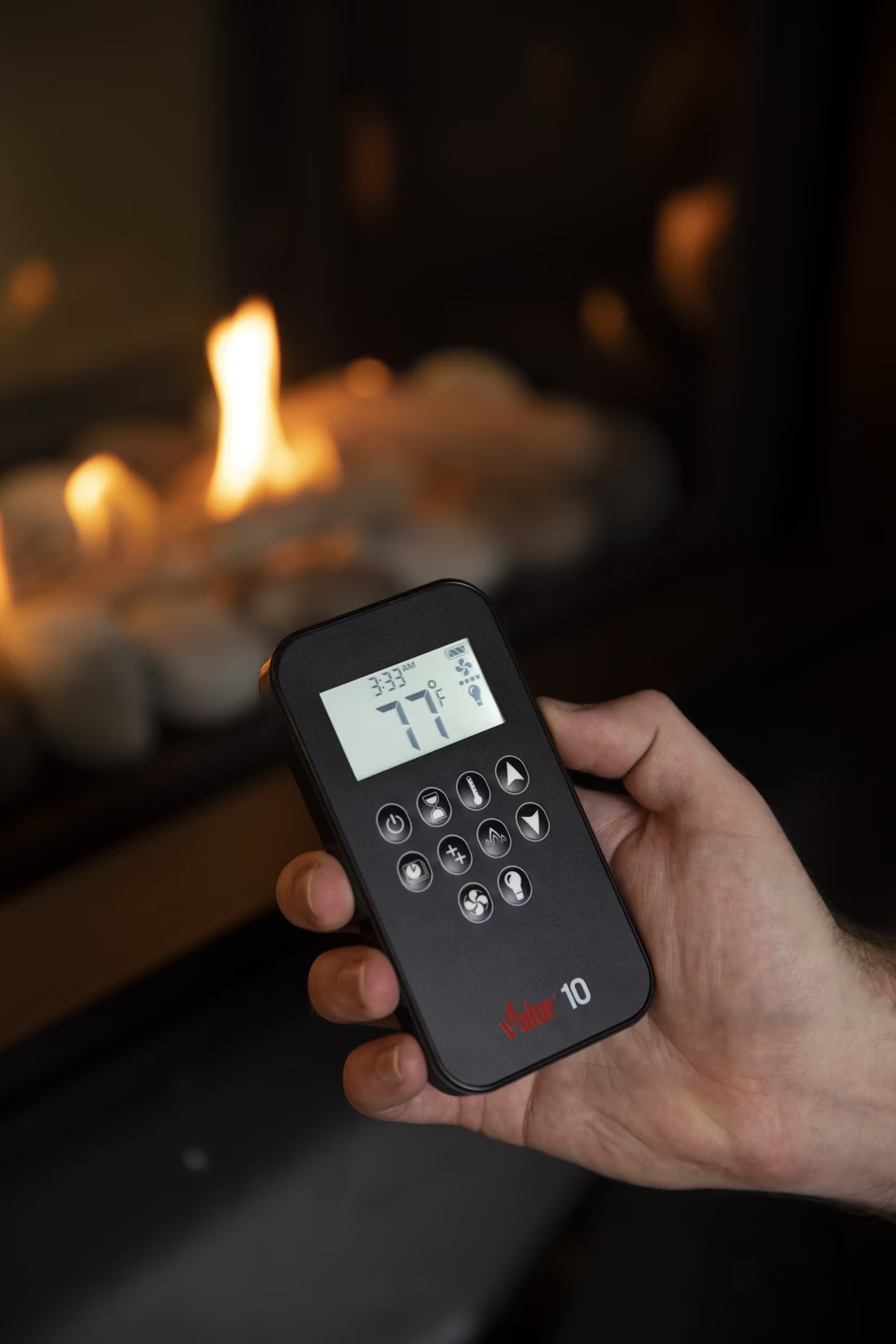
Most direct-vent gas fireplaces will, which matters in a county where rural power lines can go down in an ice storm or summer thunderstorm. Units with intermittent pilot ignition (IPI) run on a small battery backup that keeps the fireplace lighting on demand even without electricity. Valor fireplaces go a step further—their pilot assembly generates its own electricity through the thermocouple, so there are no batteries to maintain at all. Either way, ask your local dealer about the ignition system before you buy if backup heat during an outage matters to you.
What's the difference between a gas fireplace, insert, and stove?
A gas fireplace is a built-in unit framed into a wall, typically chosen for new construction or a remodel. A gas insert is built to slide into an existing masonry fireplace opening, converting an old wood-burning hearth into a sealed, efficient heat source using the chimney you already have. A gas stove is a freestanding cabinet-style unit that sits on the floor, similar in footprint to a wood stove but running on propane. For the many older farmhouses in Hickman County with an existing fireplace, an insert is usually the simplest and most cost-effective route.
Do I need a permit to install a gas fireplace in Hickman County?
Yes—a building permit is required for new gas fireplace and insert installations, handled through the Hickman County building office based at the courthouse in Clinton. Propane line work should be done by a licensed gas-fitter, and most established local dealers coordinate the permit, the line hookup, and the final inspection as part of the installation rather than leaving you to manage separate trades.
What's the difference between vented and vent-free gas fireplaces?
Vented (direct-vent) gas fireplaces pull combustion air from outside and exhaust the byproducts back outside through a sealed pipe—they're the cleanest, safest option and the most common choice for Hickman County homes. Vent-free units burn propane directly into the room without any exterior venting; they're legal in Kentucky but come with strict room-sizing requirements and an oxygen depletion sensor, and they release some moisture and combustion byproducts into your living space. For most homeowners in the county, a direct-vent unit is the better long-term choice—it delivers real heat without any tradeoff on indoor air quality.
How often should a gas fireplace be serviced?
Plan on an annual inspection, ideally before the first cold snap each fall. A technician checks the burner, pilot assembly, propane connections, and any electronic ignition components, and cleans the glass and firebox interior. It's a quick visit compared to a wood chimney sweep, but it's the step that keeps a propane-fed unit running safely and efficiently—expect to pay somewhere in the $150 to $250 range for a standard service call in this part of the state.
Gas vs. wood vs. pellet—which fits my Hickman County home?
Wood is deeply rooted in this part of Kentucky—oak, hickory, maple, and cherry are all common locally, and a wood stove keeps working with no propane bill and no dependence on electricity. Gas trades that self-sufficiency for push-button convenience: no splitting, hauling, or ash cleanup, and more even day-to-day heat, running on a propane tank rather than a utility line. Pellet stoves, using regional brands like Lignetics, Hamer Pellet Fuel, or Greenway Renewable Energy, split the difference—cleaner burning and easier to load than cordwood, but they need electricity to run the auger, so they're not a good option if outages are a concern on your stretch of road. Many Hickman County households end up with gas in the main living space for daily comfort and a wood stove or fireplace elsewhere for backup heat.
What's the difference between an insert and a zero-clearance fireplace?
An insert is a fireplace that slides into a pre-existing wood-burning fireplace—if you don't have one, there's nothing to insert it into. A zero-clearance fireplace is built into a framed wall, which makes it the answer for remodels and new construction. Simple test: existing masonry fireplace means insert; blank or framed wall means zero-clearance.
Why is a fireplace insert so efficient?
An insert does two things: it seals the chimney completely, so you stop losing air you already paid to heat, and it radiates warmth into the room through the firebox and glass. Most add a heat-exchange fan that pulls cool room air underneath, wraps it around the hot firebox, and pushes it back out warm. Your home is more efficient before you've even lit the first fire.
Can a fireplace actually lower my heating bill?
Yes—by creating a comfort zone. A furnace heats every square foot of the house just to warm the one room you're in; a gas fireplace on low burns roughly a sixth of the gas a typical furnace does. Set the furnace around 55–60 degrees as a baseline, then heat the rooms your family actually uses. Families who heat this way commonly save $20–$60 a month.
How much should I budget for a fireplace?
For an average home—covering the fireplace, the vent pipe, and basic installation—a budget between $3,900 and $5,500 gives you a lot of options across wood, gas, and pellet. By the time you add finish work, gas line, and electrical, the average complete installation lands between $5,000 and $12,000 all-in. In a remodel or new build, a good rule is to put about 2.5% of the total project cost toward the fireplace.
Find your gas fireplace in Hickman County.
Tell us about your home and we'll match you with a trusted local dealer and send over a free Project Guide & Parts List—the exact parts, including the vent kit, for your gas fireplace or insert project in Hickman County.
Find Your Fireplace →