
Find your electric fireplace in Calloway County.
No gas line, no chimney, no cutting wood—just a clean install that works in almost any room from Murray to Hazel to New Concord. Find the right unit and connect with a trusted local dealer.
Every Project Starts From One of These Five Situations
Mild winters, flexible heat—and zero venting headaches.
Calloway County sits in climate zone 4A with a moderate winter heating season and average winter lows around 27°F—a real but moderate heating season, nothing like the sub-zero stretches that keep places like Duluth, MN or Fargo, ND burning wood or gas around the clock. That milder profile is exactly why electric fireplaces have become such a practical fit for homes in Murray, Hazel, New Concord, and the county's rural stretches: most rooms need supplemental warmth on cold nights, not a primary furnace replacement.
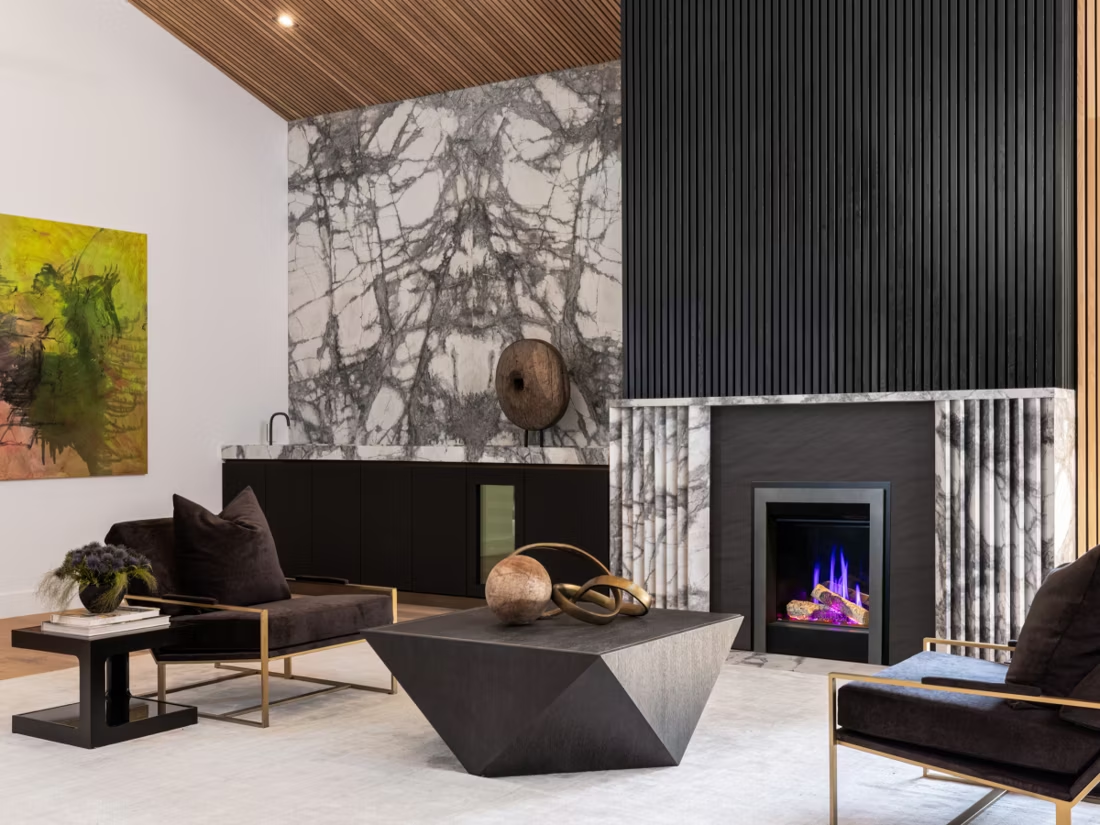
Because electric units need no chimney, no gas line, and no venting whatsoever, they install almost anywhere—a finished basement, a bedroom, an apartment, or a rental property where running gas line or cutting into a wall for venting isn't an option. For Calloway County homeowners who want the look and ambiance of a fireplace with none of the woodpile, permit, or flue maintenance that comes with oak, hickory, maple, or cherry cordwood, electric is often the simplest answer—and it's also the go-to for supplementing a heat pump on the coldest nights of a Kentucky winter without touching the ductwork.
Three steps. No salesperson until you're ready.
Tell us about your project
Your zip code, your situation, and the fuel you're leaning toward—or let the answers point you to one.
See what's actually available
The brands dealers within 100 miles genuinely carry—real options, never a catalog mirage.
Get your dealer & Project Guide
A trusted local dealer, plus the free Project Guide & Parts List that names every component of the job.
Frequently Asked Questions
How much does an electric fireplace installation cost in Calloway County?
Most electric fireplace installations in Calloway County run $400 to $1,200, and that range covers the vast majority of projects—a plug-in insert into an existing mantel opening sits at the low end, while a built-in wall unit that needs a dedicated 120V or 240V circuit run by an electrician sits toward the top. Because there's no venting or gas line involved, electric is consistently the least expensive fireplace fuel to install in the county, whether you're in a Murray subdivision or a rural property outside Hazel.
Do electric fireplaces actually put out real heat, or just visual flame?
Both, depending on the model. Most electric fireplaces include a built-in fan-forced heater rated around 4,600–5,000 BTU (roughly 1,500 watts), enough to comfortably heat a single room in the 27°F average winter lows Calloway County sees—a bedroom, den, or basement family room. The flame effect can also run independently of the heater, so you get the visual year-round without warming up the room in July. For anyone expecting whole-home heat, electric isn't the right tool; it's built for zone heating a specific space, which is exactly how most local buyers use it.
Can I install an electric fireplace myself, or do I need an electrician?
A plug-in electric insert or freestanding stove that uses a standard outlet is genuinely a DIY-friendly project—no permit, no electrician, just plug it in. Built-in wall units are different: they typically need a dedicated circuit, and depending on the amperage draw, some require a licensed electrician to run new wiring back to the panel. For those projects, a local dealer can tell you upfront whether your existing electrical service can handle it or whether panel work is needed first, which is worth knowing before you buy the unit.
Do I need a permit to install an electric fireplace in Calloway County?
Plug-in electric fireplaces and inserts generally don't require a permit since there's no gas line, venting, or structural work involved. If your installation requires new electrical wiring or a dedicated circuit—common with larger built-in wall units—that electrical work typically does need a permit and should be pulled by a licensed electrician. A local dealer can tell you which category your project falls into before you buy.
What's the difference between an electric insert, a wall-mount unit, and an electric stove?
An electric insert is built to slide into an existing fireplace opening—masonry or zero-clearance—and is the most common upgrade for Calloway County homes with an old, rarely-used wood fireplace they want converted to something simpler. A wall-mount unit hangs flush or recessed into drywall, popular in newer builds and remodels around Murray where there's no existing fireplace to work with. An electric stove is a freestanding cabinet-style unit that mimics a wood stove's footprint, a good fit for homes that want the look without cutting into a wall. All three plug into standard or dedicated circuits with no venting required.
How does electric heat compare to gas or wood for Calloway County's winters?
With average winter lows around 27°F and a moderate winter heating season overall, Calloway County's winters are moderate enough that electric zone heating covers a lot of ground—it's not competing with the kind of extended sub-zero stretches that make wood or gas the clear primary-heat choice further north. Wood, burning local oak, hickory, maple, or cherry, still wins on raw BTU output and works during a power outage, which electric cannot do. Gas offers instant, higher-output heat if a gas line is already run to the home. Electric wins on install simplicity and cost, and it's the natural choice for a supplemental room, a rental, or a space where running gas or a flue just isn't practical.
Will my electric fireplace work during a power outage?
No—electric fireplaces require power to run both the flame effect and the heater, so they go dark in an outage just like any other electrical appliance. For Calloway County homeowners who want a heat source that keeps working when the power drops during an ice storm or summer thunderstorm outage, a wood stove or a gas unit with battery-backup ignition is the better backup option. Many local homes pair an electric fireplace for everyday convenience in one room with wood or gas elsewhere as the outage-proof backup.
How much does it cost to run an electric fireplace?
A typical electric fireplace heater draws around 1,500 watts on high. At a residential electric rate in the range most Calloway County utilities charge, running the heater for a full evening—say 4 to 5 hours—costs roughly $0.50 to $1.00, depending on your rate and settings. Running just the flame effect without the heater costs only a few cents an hour since it draws minimal wattage. That low operating cost is one of the reasons electric works well as a supplemental heat source rather than a whole-home solution.
Electric vs. pellet—which is right for my home?
Pellet stoves burn compressed wood pellets (regional brands like Lignetics, Hamer Pellet Fuel, and Greenway Renewable Energy are available in the area) and put out significantly more heat than electric—enough to serve as a primary or near-primary heat source in a Calloway County home. But pellet stoves need a hopper refilled regularly, produce ash, need venting, and still require electricity to run the auger and blower, so they're not an outage-proof option either. Electric skips the venting, the pellets, and the maintenance entirely, in exchange for lower heat output. For a supplemental room or a low-maintenance ambiance fireplace, electric is simpler; for meaningful whole-home heat, pellet is the stronger performer.
Can I put a TV above my fireplace?
Yes—with an asterisk. Fireplaces are hot and TVs don't like heat. Either put a mantel between them to deflect rising warmth, or choose a fireplace with heat-management technology that creates a cool zone on the wall above—the wall stays around 125 degrees, barely warm, while the room still gets full heat. If you like clean lines and don't want a mantel, heat management is the answer.
Do electric fireplaces actually produce heat?
Yes—most put out around 4,800–5,000 BTUs from a standard outlet, which comfortably warms a bedroom, office, or den as a comfort-zone heater. What they won't do is carry a whole house the way wood, gas, or pellet can. Think of electric as ambiance-first with honest supplemental heat: flames on with no heat in July, flames plus warmth in January.
Does a fireplace add value to my home?
On average, a fireplace adds back to the home about the same amount you spent installing it. Add the monthly savings from heating the rooms you actually use instead of the whole house—often hundreds of dollars a year—and the value case is strong before you even count what a fire does for how your family uses the room.
Can a fireplace actually lower my heating bill?
Yes—by creating a comfort zone. A furnace heats every square foot of the house just to warm the one room you're in; a gas fireplace on low burns roughly a sixth of the gas a typical furnace does. Set the furnace around 55–60 degrees as a baseline, then heat the rooms your family actually uses. Families who heat this way commonly save $20–$60 a month.
Get your Calloway County electric fireplace Project Guide.
Tell us a bit about your home and we'll put together a free Project Guide & Parts List—the exact parts for your electric fireplace project and a matched, trusted local dealer in Calloway County who can install it right.
Find Your Fireplace →