
Reliable heat for the Flint Hills, whether you're on the gas main or off it.
Wabaunsee County's 3,139 residents are spread across a lot of open tallgrass prairie, and that means fuel sourcing looks different from block to block. I'll match you with a trusted local dealer who knows whether your address gets a propane tank or a gas main, and what that means for your install.
Every Project Starts From One of These Five Situations
Instant heat across a county built on propane, not pipelines.
Wabaunsee County sits in the heart of the Flint Hills, a rolling tallgrass prairie landscape with a population small enough that natural gas mains only reach the tighter clusters of homes in and around Alma, Eskridge, and Alta Vista. Outside those town cores—across the ranch country toward Harveyville, Maple Hill, Paxico, and Wabaunsee—homes run on propane, typically from a tank set on the property and filled by a regional delivery service. The county sits in climate zone 4A, and while winters here aren't as brutal as the deep cold of International Falls, MN, the near-constant Flint Hills wind adds a real chill factor, and native limestone farmhouses common in the area weren't built with modern insulation in mind.
That combination—rural propane infrastructure, exposed prairie wind, and older stone construction—is exactly where a direct-vent gas fireplace or insert earns its keep. It delivers real, thermostatically controlled heat without anyone tending a fire or hauling wood across a windswept yard, and a properly rated venting termination cap stands up to the gusts that regularly sweep across the Flint Hills. With no air quality non-attainment concerns in the county, the decision here comes down to convenience, reliable heat during winter storms, and matching the appliance to whichever fuel actually reaches your address.
Three steps. No salesperson until you're ready.
Tell us about your project
Your zip code, your situation, and the fuel you're leaning toward—or let the answers point you to one.
See what's actually available
The brands dealers within 100 miles genuinely carry—real options, never a catalog mirage.
Get your dealer & Project Guide
A trusted local dealer, plus the free Project Guide & Parts List that names every component of the job.
Frequently Asked Questions
How much does a gas fireplace installation cost in Wabaunsee County?
Most gas fireplace and insert installations in this part of Kansas run in the neighborhood of $3,500 to $9,500, with the lower end typical for a direct-vent insert going into an existing masonry firebox on a home that already has a propane tank and line nearby. The upper end covers new construction or a remodel where a fireplace is being framed in from scratch, a new gas line has to be run, or a propane company needs to set a new tank. Homes out toward Eskridge, Alta Vista, or the more remote ranch roads may see a modest travel charge added by installers based closer to Topeka or Manhattan, since Wabaunsee County itself has very few full-service hearth dealers.
Can I convert an existing wood fireplace to gas in an older stone farmhouse?
Yes, and it's a common request in Wabaunsee County given how many homes here are original native limestone construction with a masonry fireplace already built into the wall. A gas insert drops into that existing firebox and vents through a stainless liner run up the current chimney, so the stonework stays intact while the fireplace gains real, controllable heat output. The main variable is whether the home is already on propane—if there's a tank and line reasonably close, the conversion is straightforward; if not, running new gas line adds to the project cost.
Is natural gas available in Wabaunsee County, or is it all propane?
It depends heavily on where you are. The small natural gas distribution that exists tends to serve the denser parts of towns like Alma, the county seat known locally for its native limestone buildings, along with pockets of Eskridge and Alta Vista. Once you're outside those town limits—which is most of the county's land area—propane is the standard fuel, delivered and stored in a tank on the property. Before choosing a fireplace model, it's worth confirming with a local dealer which fuel actually serves your specific address, since the orifice and regulator setup differs between the two.
Will my gas fireplace still work if a Flint Hills windstorm knocks out power?
Most modern gas fireplaces are designed to keep working through an outage. Units with intermittent pilot ignition (IPI) run on a battery backup that kicks in automatically when the power drops, so the fireplace still lights on demand. Some manufacturers, like Valor, go further with a pilot assembly that generates its own electricity through the thermocouple, meaning there's no battery to maintain at all. That distinction matters in a county this exposed to prairie wind, where downed lines from an ice storm or a summer derecho can leave rural stretches without power for a day or more.
What's the difference between a gas fireplace, gas insert, and gas stove?
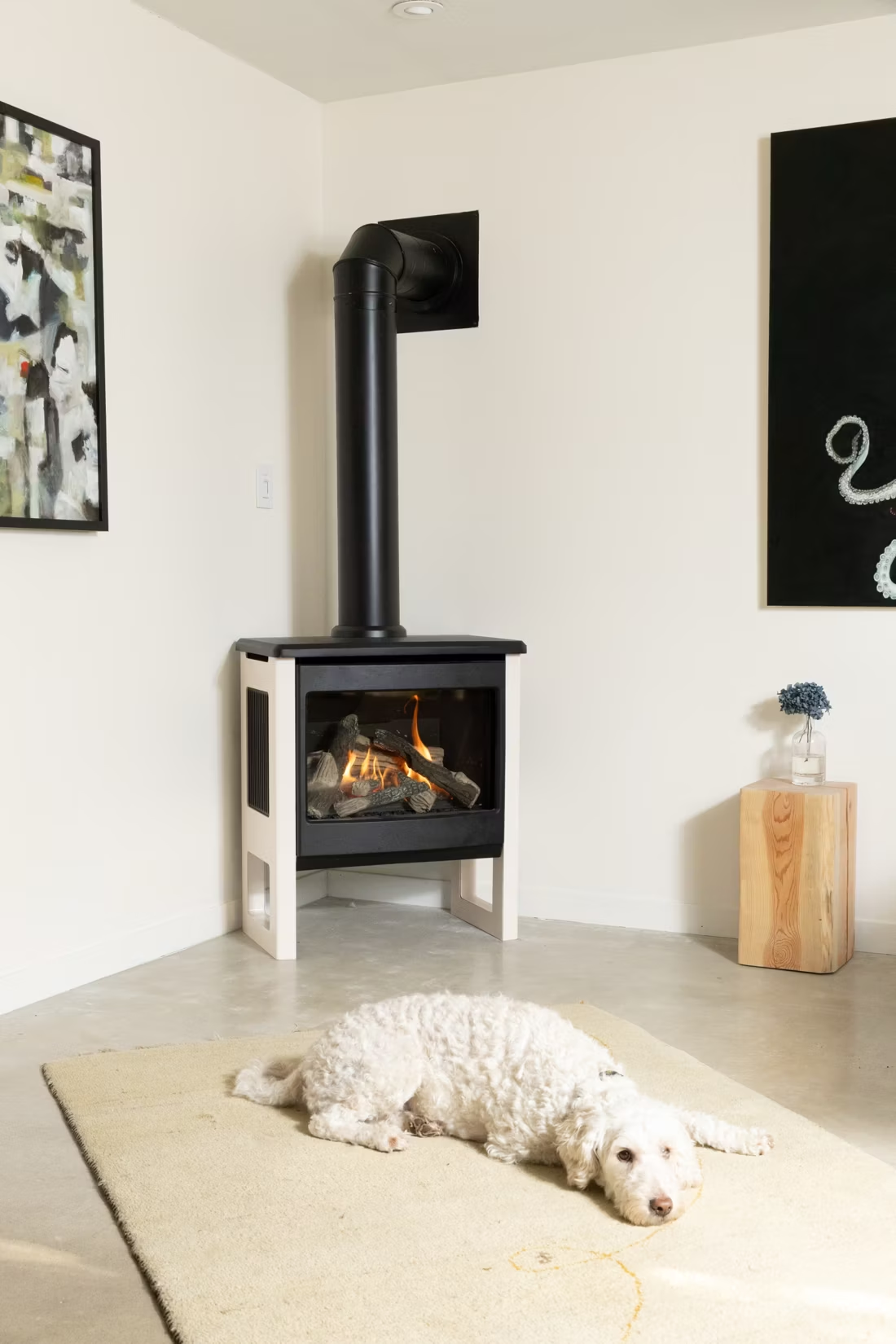
A gas fireplace is a fully built-in unit, framed into a wall—the right choice for new construction or a full remodel. A gas insert slides into an existing masonry firebox and uses the current chimney as its vent path, which is the more common project in Wabaunsee County's older stone homes. A gas stove is a freestanding, cabinet-style unit that sits on the floor like a wood stove but runs on gas—a good option for a manufactured home or a room with no existing chimney at all, which comes up often in this county's more scattered rural housing stock.
Do I need a permit to install a gas fireplace in Wabaunsee County?
Yes, in most cases. New gas fireplace installations require a building permit, and any new gas line work needs to be done by a licensed gas-fitter and inspected regardless of whether you're inside Alma city limits or out in unincorporated county territory. Check with the county's planning and zoning office in Alma before work starts. A full-service local hearth dealer typically handles the permitting and coordinates the gas line and venting inspection as part of the job, rather than leaving you to schedule separate trades yourself.
Should I choose a vented or vent-free gas fireplace?
Vented, direct-vent units pull combustion air from outside and exhaust it back outside through a sealed pipe, so nothing from the burn enters the living space. Vent-free units burn directly into the room and are legal in Kansas within specific room-sizing limits. Wabaunsee County has no air quality non-attainment concerns, so this isn't a regulatory issue here the way it is in some western states—it's mostly about personal preference and how tightly sealed your home is. Older stone farmhouses with more natural air infiltration tend to handle vent-free options fine, while newer, tighter construction usually does better with direct-vent.
How often should a gas fireplace be serviced in this climate?
Plan on an annual inspection before the heating season starts in the fall. A technician checks the burner, pilot assembly, gas connections, and venting, and cleans the glass—a much shorter visit than a wood chimney sweep, but still worth doing every year for a unit running through a full Kansas winter. This matters more, not less, for propane-fed units, since the regulator and line connections benefit from a yearly check given how exposed above-ground tanks are to Flint Hills weather swings.
Gas vs. wood—which makes more sense for a Wabaunsee County home?
Wood has deep roots here—oak, hickory, and osage orange are all common in the county's woodlots and old hedgerows, and osage orange in particular burns extremely hot once seasoned, a legacy of it being planted as windbreak fencing across the Flint Hills for generations. Wood heat also works with no electricity at all, which is worth something during a wind-driven outage. Gas, by contrast, gives you instant, thermostat-controlled heat with no splitting, stacking, or ash to manage, and it's a better fit for daily convenience in a household without the time or interest in tending a fire. Plenty of homes in the county run both—wood for backup and character, gas for the heat you can count on every single day.
Is my gas fireplace wasting gas?
If it was installed more than 15 years ago, probably. Older gas fireplaces keep a standing pilot light burning all the time, and that little flame can cost a couple hundred dollars a year. Newer models use pilot-on-demand ignition—the pilot lights only when you use the fireplace and goes out when you turn it off.
What's the difference between an insert and a zero-clearance fireplace?
An insert is a fireplace that slides into a pre-existing wood-burning fireplace—if you don't have one, there's nothing to insert it into. A zero-clearance fireplace is built into a framed wall, which makes it the answer for remodels and new construction. Simple test: existing masonry fireplace means insert; blank or framed wall means zero-clearance.
Can a fireplace actually lower my heating bill?
Yes—by creating a comfort zone. A furnace heats every square foot of the house just to warm the one room you're in; a gas fireplace on low burns roughly a sixth of the gas a typical furnace does. Set the furnace around 55–60 degrees as a baseline, then heat the rooms your family actually uses. Families who heat this way commonly save $20–$60 a month.
How much should I budget for a fireplace?
For an average home—covering the fireplace, the vent pipe, and basic installation—a budget between $3,900 and $5,500 gives you a lot of options across wood, gas, and pellet. By the time you add finish work, gas line, and electrical, the average complete installation lands between $5,000 and $12,000 all-in. In a remodel or new build, a good rule is to put about 2.5% of the total project cost toward the fireplace.
Get your free Project Guide & Parts List for a gas fireplace in Wabaunsee County.
Tell me about your home, whether you're on propane or a gas main, and how you want to use the fireplace, and I'll match you with a trusted local dealer and send a free Project Guide & Parts List—the exact equipment, vent kit, and recommended installer for your gas project.
Find Your Fireplace →