
Add real warmth to your Osage County home—no chimney required.
From Lyndon to Osage City, Burlingame to Carbondale, an electric fireplace or insert gives you instant supplemental heat and real flame ambiance without venting, permits, or a masonry chimney. Find the right unit and connect with a trusted local dealer.
Every Project Starts From One of These Five Situations
Instant warmth without the woodpile.
Osage County sits in climate zone 4A with roughly 5,184 heating degree days a year and winter lows that average around 18°F—cold enough that most homes here run supplemental heat for four to five months. This is hedge-post and oak country: osage orange, the tree the county takes its name from, along with oak and hickory, has fueled woodstoves and farmhouse fireplaces for generations, and there are no air quality restrictions on wood burning here. But not every home in the county has a chimney, and not every homeowner wants to split, haul, and stack cordwood every winter. That's where electric fireplaces fit in.
Whether you're in a rental in Osage City, an older farmhouse near Melvern or Scranton without a working flue, or a newer build in Carbondale or Overbrook with a great room that just needs a focal point, an electric insert or built-in unit delivers real heat output and a convincing flame with zero venting and no gas line. Homes here are served primarily by Evergy or a rural electric cooperative depending on location, and either way, a properly wired electric fireplace is one of the simplest heat additions a licensed electrician can complete in a single visit—no county building permit hassle for a plug-in unit, and straightforward permitting for a hardwired built-in with its own circuit.
Three steps. No salesperson until you're ready.
Tell us about your project
Your zip code, your situation, and the fuel you're leaning toward—or let the answers point you to one.
See what's actually available
The brands dealers within 100 miles genuinely carry—real options, never a catalog mirage.
Get your dealer & Project Guide
A trusted local dealer, plus the free Project Guide & Parts List that names every component of the job.
Frequently Asked Questions
How much does an electric fireplace installation cost in Osage County?
A plug-in electric insert that drops into an existing fireplace opening or media cabinet typically runs $300 to $700 for the unit itself, with no real installation cost beyond plugging it in—this is the most common route for renters in Osage City or Lyndon. A built-in wall unit or a linear electric fireplace set into new framing usually runs $1,200 to $2,500 once you factor in a dedicated 20-amp circuit and an electrician's time, which is common in newer Carbondale and Overbrook construction. Retrofitting an electric insert into an old masonry fireplace that no longer has a safe flue runs somewhere in between, since it also solves a chimney problem homeowners in older Osage County farmhouses often deal with.
What's the difference between a plug-in electric fireplace and a built-in unit?
A plug-in insert or freestanding electric stove runs off a standard 120V outlet and can go almost anywhere—bedroom, basement, apartment—with no electrician needed. A built-in electric fireplace is recessed into a wall or custom mantel and usually requires its own circuit, especially if it includes a larger heater. For Osage County homes without existing fireplace infrastructure, plug-in units are the faster, lower-cost option; for a remodel or new construction project in towns like Burlingame or Vassar where you're framing a feature wall anyway, a built-in gives a more finished, permanent look.
Will an electric fireplace actually heat my room, or is it just for looks?
Most electric fireplace heaters put out around 4,600 to 5,200 BTU (roughly 1,500 watts), which is enough to noticeably warm a single room—300 to 400 square feet in a reasonably insulated space—but it's supplemental heat, not a whole-home solution. Given Osage County's roughly 5,184 heating degree days and winter lows near 18°F, an electric unit works best paired with your existing furnace, taking the edge off a chilly bonus room, finished basement, or sunroom rather than replacing central heat for the whole house.
Do I need a permit for an electric fireplace in Osage County?
A plug-in electric insert or freestanding unit doesn't require a permit since it's no different than plugging in any other appliance. A hardwired built-in unit that needs a new dedicated circuit typically requires an electrical permit, and within incorporated towns like Lyndon or Osage City that means pulling one through the local building office; in unincorporated parts of the county, check with the Osage County zoning and building department before work begins. Either way, a licensed electrician handling the circuit work will know exactly what's required.
Electric vs. wood—which makes more sense for my Osage County home?
Wood has deep roots here—oak, hickory, and osage orange (hedge) all burn hot and are locally abundant, and a wood stove keeps working during an ice storm power outage, which matters on rural lines outside Melvern or Scranton. Electric can't run without power, so it's not a storm-heat backup. But electric wins on convenience: no splitting, hauling, or ash cleanup, no chimney to maintain, and instant on-off heat at the flip of a switch. Many Osage County households end up with both—wood for backup heat and heritage, electric for the room that doesn't have a flue or where a low-maintenance flame is simply easier.
What should I look for in an electric fireplace for a cold Kansas winter?
Look for a unit with a real thermostat (not just a high/low switch) so it can maintain a set room temperature through Osage County's coldest stretches, and check the heater rating—most quality units top out around 1,500 watts, which is the practical ceiling for a standard outlet. LED flame technology has improved enough that mid-range and premium units look convincing even in a bright living room, which matters if the fireplace is doing double duty as your main focal point rather than a supplemental heater tucked in a basement.
How much does it cost to run an electric fireplace through an Osage County winter?
A 1,500-watt heater running on a typical evening setting costs roughly 15 to 20 cents per hour depending on your Evergy or rural electric cooperative rate—call it $1.50 to $3 for a several-hour evening of use. Run daily through a cold stretch, that adds up to a modest addition to a winter electric bill, but it's still far less than heating an entire room with central HVAC alone, which is why electric fireplaces work well as zone heat for a specific space rather than a whole-house strategy.
Can I put an electric insert into my existing masonry fireplace?
Yes, and it's a common fix for older Osage County farmhouses where the original flue has deteriorated or was never properly lined. An electric insert slides into the existing firebox opening, plugs in or gets hardwired depending on the model, and gives you flame ambiance and supplemental heat without needing to repair or reline a chimney that's no longer safe for wood burning. It's often the most cost-effective way to bring a decades-old fireplace back into daily use.
Electric vs. pellet stove—which is the better fit?
Pellet stoves, using brands like Lignetics or Indeck Energy Services pellets available regionally, burn hotter and can serve as genuine primary or near-primary heat for a home, but they need electricity to run the auger and blower, a place to store pellet bags, and periodic ash cleanout. Electric fireplaces need none of that upkeep but only provide supplemental warmth for one room. For an Osage County homeowner who wants meaningful heat output and doesn't mind maintenance, pellet is the stronger primary-heat option; for someone who wants a clean, low-maintenance flame in a den, bedroom, or basement, electric is the simpler answer.
Can I put a TV above my fireplace?
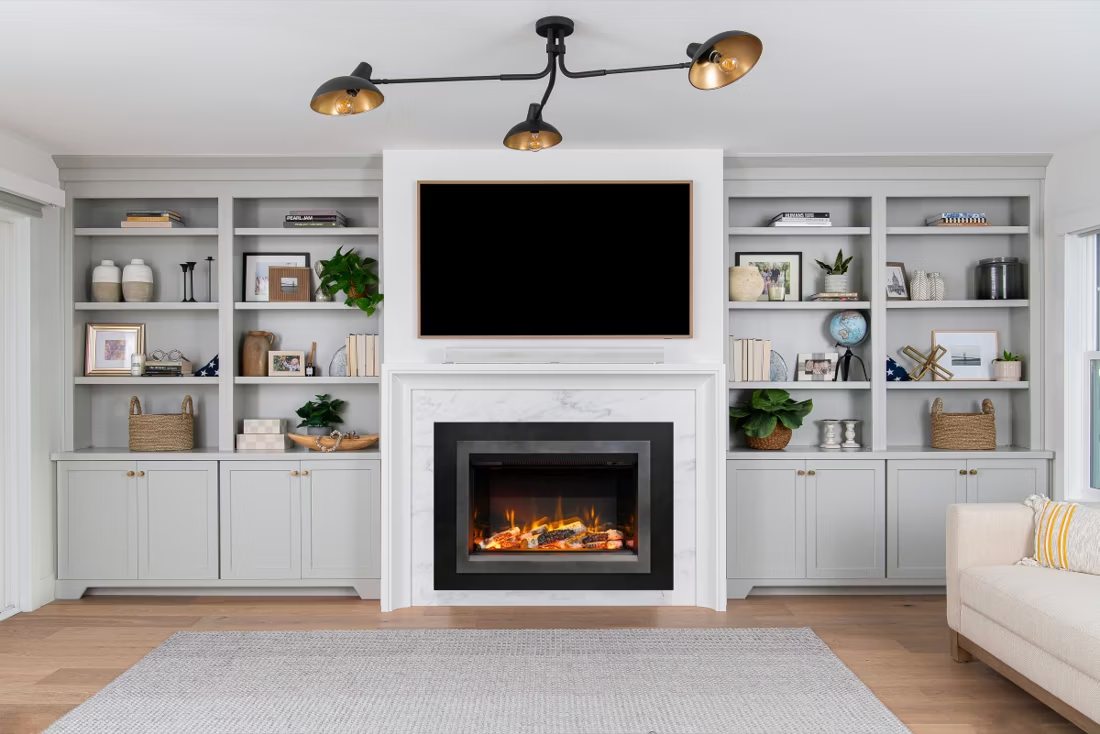
Yes—with an asterisk. Fireplaces are hot and TVs don't like heat. Either put a mantel between them to deflect rising warmth, or choose a fireplace with heat-management technology that creates a cool zone on the wall above—the wall stays around 125 degrees, barely warm, while the room still gets full heat. If you like clean lines and don't want a mantel, heat management is the answer.
Do electric fireplaces actually produce heat?
Yes—most put out around 4,800–5,000 BTUs from a standard outlet, which comfortably warms a bedroom, office, or den as a comfort-zone heater. What they won't do is carry a whole house the way wood, gas, or pellet can. Think of electric as ambiance-first with honest supplemental heat: flames on with no heat in July, flames plus warmth in January.
How much should I budget for a fireplace?
For an average home—covering the fireplace, the vent pipe, and basic installation—a budget between $3,900 and $5,500 gives you a lot of options across wood, gas, and pellet. By the time you add finish work, gas line, and electrical, the average complete installation lands between $5,000 and $12,000 all-in. In a remodel or new build, a good rule is to put about 2.5% of the total project cost toward the fireplace.
Can a fireplace actually lower my heating bill?
Yes—by creating a comfort zone. A furnace heats every square foot of the house just to warm the one room you're in; a gas fireplace on low burns roughly a sixth of the gas a typical furnace does. Set the furnace around 55–60 degrees as a baseline, then heat the rooms your family actually uses. Families who heat this way commonly save $20–$60 a month.
Find your electric fireplace in Osage County.
Tell us about your space and heating goals, and we'll put together a free Project Guide & Parts List—the right electric fireplace or insert for your Osage County home, plus a trusted local dealer to install it.
Find Your Fireplace →